



Combustion engines and fuel cells vie for vessel designer’s attention
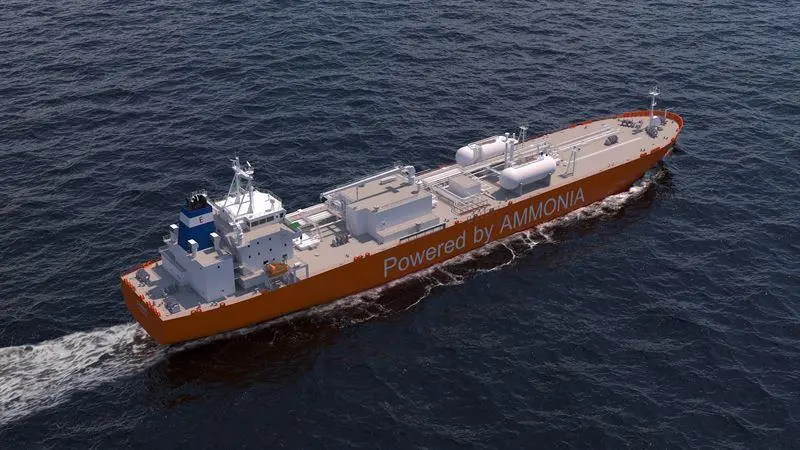
2023 marked a breakout year for ammonia, and new orders have continued this year with at least 13 orders for vessels to date, according to DNV’s Alternative Fuels Insight (AFI) platform.
Orders include the May announcement from Trafigura that it has signed a contract for four ammonia dual-fuel gas carriers from HD Hyundai Mipo Dockyard. This followed news of Exmar’s latest newbuilding gas carriers which will be the first oceangoing vessels to be propelled by dual-fuel engines capable of operating with ammonia. Four vessels were originally ordered to operate on LPG, but in October last year, Exmar declared an option to change the fuel system to ammonia.
The engines for the Exmar vessels will be provided by WinGD, and the engine designer is also working with Korean shipbuilder K Shipbuilding (KSB), Alfa Laval and ABS on the development of an ammonia-fuelled MR tanker design.
In May, WinGD also secured an order for its X‑DF‑A ammonia-fuelled engines in what will be the world’s first ammonia dual-fuel Aframax tankers. Two vessels ordered by Singapore based shipowner and operator AET will be built at Dalian Shipbuilding Industry with six-cylinder X62DF‑A engines.
The X52DF‑A engine is the smallest bore size available in WinGD’s ammonia-fuelled X‑DF‑A series, and the first to be developed. WinGD has secured orders for it for ammonia carriers as well as X72DF‑A engines for bulk carriers. The 52 and 72-bore variants will be delivered in 2025 followed by the 62 bore and other engine sizes from 2026, according to market needs, accommodating a wide range of vessel types from small tankers and car carriers to very large tankers. The engines operate according to the Diesel principle in both diesel and ammonia modes, with the same cylinder configurations and rating fields as WinGD’s diesel-fuelled X‑Engine range.
“First adopters of ammonia fuel are signalling confidence in the viability of both the fuel and the technology to use it,” said WinGD director of sales, Volkmar Galke.
Separately, WinGD has continued to develop the safety credentials for ammonia-engines, securing approvals in principle (AiPs) from four classification societies: Lloyd’s Register, Bureau Veritas, China Classification Society, and ClassNK.
Lloyd’s Register has granted approvals for a range of ammonia-fuelled designs including:
- · an 8,200 teu container ship design from SDARI, Mediterranean Shipping Co and MAN Energy Solutions
- · a 12,800 CEU dual-fuel PCTC and a 360,000dwt dual-fuel ore carrier from MARIC
- · a very large ammonia carrier from Samsung Heavy Industries using Amogy’s ammonia-to-power fuel cell system
- · a container feeder from HD Hyundai Mipo Dockyard and Korea Shipbuilding and Offshore using Amogy’s ammonia-to-power system
- · a 3,500 TEU container feeder from an industry taskforce including A. P. Møller-Mærsk, MAN Energy Solutions, Deltamarin, Eltronic FuelTech, ABS, and LR, which was led by the Mærsk Mc-Kinney Møller Center for Zero Carbon Shipping.
A joint study into ammonia safety onboard ships was published last year by LR’s Maritime Decarbonisation Hub and the Mærsk Mc-Kinney Møller Center for Zero Carbon Shipping (MMMCZCS). It was the result of a quantitative risk assessment analysis that identified vessel design and operational measures that would reduce ammonia risks to be “as low as reasonably practicable” (ALARP).
LR’s decarbonisation risk specialist, Samie Parkar, says the work identified that the safety impacts of an ammonia leak differ depending on the ammonia’s storage pressure and temperature. “It is recommended that ammonia fuel is stored at as low a temperature as possible,” says Parkar. When stored in a non-pressurized condition at -33°C, an ammonia leak will form a pool that will evaporate as it heats up. This evaporation is relatively slow compared to a pressurised and warm condition, where the leaked ammonia evaporates immediately when the pressure is released, leading to a bigger cloud.
Additionally, secondary containment mechanisms, such as double-walled piping, used for ammonia related equipment outside of already-restricted areas significantly reduce risk. The number of leak sources in a single space should be minimised. For example, the fuel preparation room could be divided into two or more separate spaces containing different groups of equipment that could leak ammonia. Ventilation outlets from spaces containing ammonia equipment should be placed in a safe location adequately separated from areas accessed by crew. Multiple sensors of different types to detect ammonia leaks should also be installed.
“One of the main considerations for the location of an ammonia storage tank is protection against tank rupture (and loss of containment) in the event of a collision,” says Parkar. “This risk can be reduced by adherence to the B/5 criteria as per the IGF code (a minimum safe distance between the storage fuel tank and the ship’s shell of 1/5th of the ship’s beam, B). This is particularly relevant for vessels where the fuel tank is in the hold. A tank on deck would be less likely to be impacted by a striking ship.”
The Kraken rises this summer
The NH3 Kraken, the world’s first carbon-free ammonia-powered tug is set to sail later this year. The NH3 Kraken will take its maiden voyage in an inland waterway in New York.
The tugboat was originally built in 1957 and used diesel generators and electric motors. Amogy is retrofitting the NH3 Kraken with its ammonia-to-electrical power system, as part of its final technical demonstration as the company heads toward product commercialization.
The company has recently announced several partnerships focused on integrating the Amogy system into vessel designs. These collaborations vary in scope, but our containerized solution is modular, allowing for multiple systems onboard to achieve desired power outputs, says Anastasija Kuprijanova, director of maritime business development at Amogy. “For instance, we’ve partnered with HD Hyundai Mipo Dockyard and Korea Shipbuilding and Offshore Engineering to design a feeder ship incorporating our system for both main and auxiliary propulsion, resulting in a combined power output of 8,000kW. This design recently received approval in principle (AiP) from Lloyd’s Register.
“Additionally, we’ve joined forces with HD Hyundai Heavy Industries and Capital Gas Ship Management to develop a 93,000cbm ammonia carrier equipped with our technology providing approximately 1,400 kW of auxiliary power. This design has received AiP from both ABS and the Liberian Registry. These examples highlight the adaptability of our technology.”
Amogy’s ammonia-to-electrical power system cracks liquid ammonia into its base elements of hydrogen and nitrogen, which then funnels the hydrogen into a fuel cell. The system is fuel cell agnostic and Amogy has collaborated with several fuel cell providers to ensure the system can be integrated with their technology. Its partnerships include a contract with Hanwha Ocean for marine applications that combine the Amogy cracking system with Hanwha Aerospace’s hydrogen fuel cell system.
The system’s waste heat is used in multiple applications including ammonia fuel vaporization and preheating. Its operation is carbon-free. “While combusting ammonia typically leads to substantial NOx emissions, we are cracking ammonia, which allows us to avoid these emissions. This is a significant advantage of our system over ammonia internal combustion engines. Furthermore, combusting ammonia requires the use of a pilot fuel, such as diesel, which generates carbon emissions,” says Kuprijanova.
Alma targets deepsea shipping with SOFC technology
The deepsea shipping segment holds the greatest potential for solid oxide fuel cell (SOFC) technology, says Ivar Singstad, vice-president of business development at Alma during an Ocean Hyway Cluster webinar in June. A key reason for that is that the system requires 24 hours to reach operating temperature of 800oC for the first time and a few hours from idle mode.
A key advantage over ammonia combustion engines is that it achieves over 60% electrical efficiency and it is fuel flexible – capable of running on natural gas, methanol, ammonia, and hydrogen without the need for a separate cracking step. The SOFC runs at maximum efficiency at around 50-60% load.
Despite the higher capex than a combustion engine, Singstad calculates a payback period of two years given that fuel costs by far outweigh any other OPEX expenses.
Another advantage: “SOFC is also ideal for carbon capture since you never mix fuel and air,” says Singstad. “You have a lower exhaust volume and then higher CO2 concentration.”
Lab tests last year on a 6kW system test using ammonia achieved 61-69% efficiency. A 100kW system is now being tested under maritime conditions, and Alma is targeting 70% efficiency. The product launch is expected in 2025, and a 500kW system will be installed on the cruise ship Helenus using LNG as fuel in collaboration with Chantiers de l’atlantique and MSC in 2026.
Related Articles
 ALTERNATIVE FUELS & LUBRICANTS
 ALTERNATIVE FUELS & LUBRICANTS
 ALTERNATIVE FUELS & LUBRICANTS