



Condition monitoring is vital for safety
One of the key commercial goals of all marine operators is to maximise vessel availability while simultaneously minimising operating costs. Inevitably, this means keeping vessels at sea for longer, achieving optimum fuel efficiencies and reducing maintenance and overhaul expenditure. Nevertheless, keeping vessels at sea for longer means that routine maintenance becomes ever more important if onboard systems are to function reliably for extended periods, while ultimately avoiding machine failure at all costs.
It is not just downtime and increased costs that can come as a result of the failure of critical operating equipment in the marine sector. Indeed, it poses a significant threat to safety, with machinery failure being, at best, hazardous and, at worst, catastrophic.
MAIB figures
It is worth noting that published figures from the UK Government’s Marine Accident Investigation Branch (MAIB), state that about 23% of all accidents involving merchant vessels with a gross tonnage of over 100gt were due to machinery failure; while for passenger and other commercial vessels with a gross tonnage of under 100gt this figure rose to almost 35%.
The MAIB definition of what constitutes a marine accident is wide ranging but in extreme cases includes loss of a vessel, injury to ship’s crew or passengers, and loss of life. Similarly, the definition of machinery failure includes many different factors, from burst pressure pipes and hoses to movement of cargo and collapse of hoists or hatch covers.
Cause of failure
The key issue, however, is what causes the machinery to fail in the first place. Again, the reasons can be varied, but surveys of the maritime industry by the Japanese Ministry of Land, Transport and Tourism found that around 60% of marine machinery failures could be attributed to factors such as insufficient maintenance, inspection or handling of equipment. To this figure can be added problems caused by both incorrect lubrication and poor machine installation and, in particular, misalignment and balancing of shafts.
As a result, it is easy to understand that tackling the issues of vibration and heat generation within systems is one important avenue that can be explored to help overcome these problems. Indeed, vibration has long been a major cause of degradation and failure in marine propulsion systems and auxiliary equipment. Furthermore, with the extremely tight tolerances found in modern rotating equipment, the need to minimise the problem is more important than ever in order to reduce maintenance and extend the service life of components.
Vibration in marine applications is typically caused by the wear of components or the misalignment of rotating shafts in propulsion systems. These problems can occur for a number of reasons including incorrect installation, mechanical damage and even slight changes in the operating environment, such as climatic conditions. In addition, misalignment often results in increased loads on components and elevates levels of friction and vibration still further, ultimately causing fatigue and premature failure.
Many of these problems can be addressed through the implementation of best practice procedures and the use of appropriate testing equipment, such as alignment tools and automatic lubricators, during system construction and routine maintenance. Additionally, the adoption of simple but effective techniques to monitor levels of vibration precisely in essential machinery throughout its service life can help operators and maintenance engineers identify sources of wear before they become a problem, and therefore develop a proactive condition-based maintenance strategy.
In particular, the condition monitoring of vital shipboard equipment, especially propulsion and manoeuvring systems, engines and turbochargers, is an essential process that is increasingly gaining in popularity. However, although condition monitoring has become established among the larger operators, the equipment and techniques used are not always widely understood.
Technological advances
To address the issue, leading manufacturers have recently initiated a number of significant advances in condition monitoring technologies that are ensuring this approach is simple, accurate and cost effective, while making a considerable contribution to reducing operating costs. These range from the introduction of small yet powerful hand-held vibration monitors and thermal imagers, to the launch of integrated ship-wide systems linked by satellite to remote monitoring centres.
For example, the latest sensors or accelerometers used for vibration monitoring, such as those supplied by SKF, generally use piezoelectric or piezoceramic technology. This provides a robust and reliable method of measuring both high and low frequencies, with low hysteresis characteristics and excellent levels of accuracy over a wide temperature range. Additionally, these sensors can be packaged in a compact stainless steel sensor housing sealed against moisture, dust, oils and other contaminants.
In simple terms, these devices function by using a piezoelectric crystal element bonded to a mass so that when the sensor is subject to an accelerative force the mass compresses the crystal, causing it to produce an electrical signal that is proportional to the level of force applied. The signal is then amplified and conditioned using inbuilt electronics that create an output signal, which is suitable for use by higher level data acquisition or control systems.
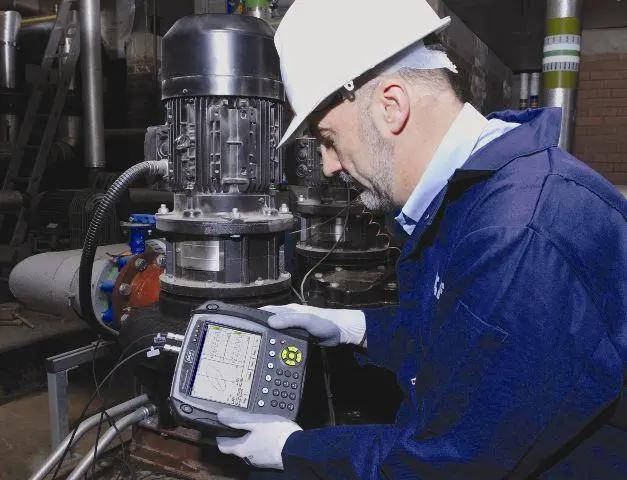
Accelerometers are generally mounted in a number of key locations on the equipment to be monitored, with output data either being read periodically using sophisticated hand-held data collectors, for immediate analysis or subsequent downloading to a PC, or being routed via switch boxes to a centralised or higher level system for continuous monitoring.
Correct implementation
There is a growing recognition among ship operators that to benefit from modern condition monitoring technology and techniques they must be used and implemented correctly. This is particularly important in the marine sector where operating conditions are subject to a far wider range of variables, as opposed to many other industries where plant or factory operations remain largely static. For instance, data readings taken when the vessel is under ballast conditions may be different from those gathered during loaded passage, while readings taken in port will almost certainly be different from those taken when the vessel is at sea, especially in heavy weather.
In essence, an effective condition-based maintenance programme should include assessment and mapping, data collection, analysis, correction, verification and improvement.
The first stage, assessment and mapping, begins with a detailed mapping of a ship’s critical machinery and the establishment of measuring points and trend values. Data can then be collected using the latest techniques as previously mentioned, using a combination of portable analysers, fixed on-line systems and remote wireless or satellite connections being used to gather and communicate critical vessel information. Perhaps most importantly, the use of remote monitoring systems enables safety levels to be maximised as well as the performance of onboard machinery, as engineers are no longer required to come into close contact with potentially hazardous equipment.
Once machine reliability data has been collected, it needs to be analysed and interpreted, either by a ship’s engineers or by a remote monitoring centre that can analyse data in real time and then advise the ship’s crew of any remedial action that needs to be taken. In addition, such reports can also help create a schedule of future maintenance procedures.
Data collection can be improved still further through the use of a number of powerful software tools which can be run on both hand-held and centralised computer systems. For example, SKF Results Reporter is a data management and reporting tool that can be used onboard as well as onshore by most fleets and organisations. The system is available in modular packages, allowing each operator to select a combination that meets their specific business needs.
Finally, the condition-based maintenance programme will involve the effective use of the feedback from the data analysis process. This could involve repairs or modifications to machine systems, including scheduled replacement of bearings or other wearing parts or realignment or rebalancing of shafts or interconnected systems.
Continued monitoring
Perhaps most crucially, once remedial work is complete it is then vital to continue to monitor conditions to identify areas for further improvement in terms of machine performance, energy efficiency or output. Essentially, this becomes a continuous process of machine reliability improvement using a database of statistics and readings gathered over time. With this continuous cycle of assessment, analysis and correction in place, the problems associated with maintenance can be cut significantly.
Adopting this type of approach to machine maintenance gives vessel operators a greater degree of control that can allow them to improve both vessel operating life and the safety of crew and passengers. Just as importantly, a condition-based maintenance programme can help reduce the costs of routine machine overhaul with a system where repairs can be carefully planned to fit in with business operations, which ultimately can help to improve operating margins.
Related Articles
 PROPULSION
 GENERAL NEWS
 GENERAL NEWS