



Constant speed versus variable engine speed
According to Fredrik Carstens, head of medium-speed offshore sales at MAN Diesel & Turbo, “Operators in the offshore industry never pay for their fuel oil This is because they are hired by the charterer, which pays for the fuel. Even though we are dealing with the oil industry, it is very important how much fuel oil we consume with the engines.”
Mr Carstens points out that the operational profiles of the many different types of offshore vessels varies considerably. He presents some examples. A typical AHTS ship only actually handles anchors for a maximum 11% of its lifetime, with a total generator load of 65%. It is in bollard pull using 100% engine load just 1% of its lifetime. A platform supply vessel going back and forth from the coast to the platform is in transit only 11% of the total time, using 27% engine load. It stays at the rig in DP mode 47% of its lifetime, using only 7% of its engine capacity. At standby the vessel spends 17% of its time at a generator load of 4%.
“Offshore vessels are very different, but their operating profile is similar,” Mr Carstens explains, and notes that the designers of these vessel look at peak conditions. “When selling an anchor handler, the buyer asks: What is the bollard pull? We get paid for the bollard pull so we design the vessel for 100% engine load which it will only use 1% of its lifetime.”
For 80% of the operating time this type of vessel could operate at low engine load, from 10% to 60% of maximum power. One third of its life will be spent at extremely low engine load, from 30% down to 10%.
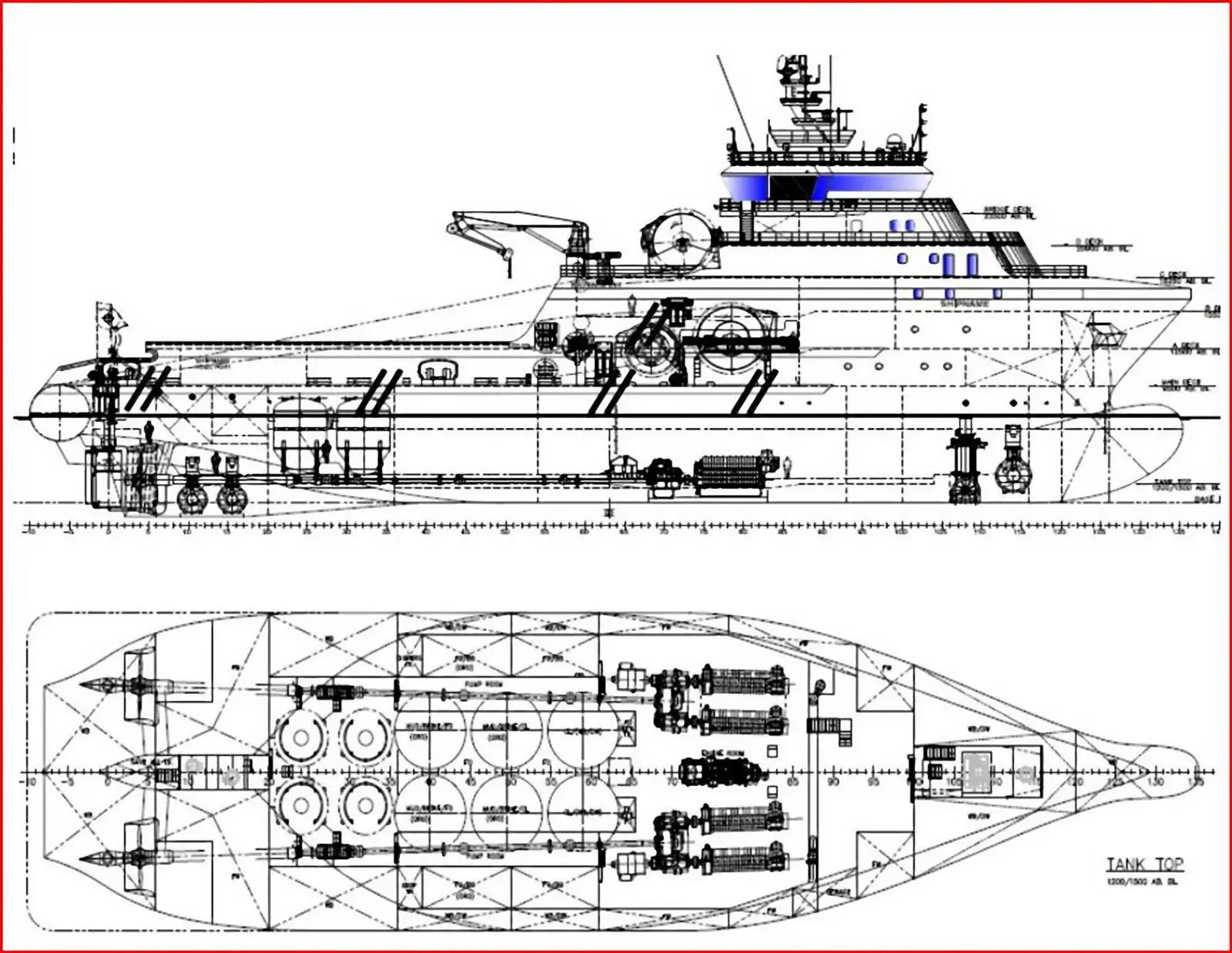
MAN has tested a 170t bollard pull AHTS vessel, with traditional diesel mechanical machinery, comprising four engines with CP propellers and twin input/single output gears. CP propellers mean that the engines can run at a constant speed. For the test, instead of running the engines at a certain speed, adjusting thrust by turning the angle of the propeller blades, the speeds of the engines were adjusted.
“Most vessels are designed pretty much alike, with constant speed for CP propellers and constant speed on diesel electric ships. That uses an enormous amount of fuel oil,” Mr Carstens argues.
41% fuel oil was saved in this test, done in light conditions during a very short time frame with the vessel in DP mode. “This test is not representative, but is a pretty good indicator that we could save a lot of fuel if we would operate correctly.”
For the MAN L27/38 engine there is comparatively little scope for fuel saving at 100% to 80% engine load, but further down, and particularly below 20%, much can be gained by varying the rpm. “There is room for improvement, but it has to be taken into the design phase of the vessel,” Mr Carstens says. “There are other benefits, including lower noise and vibrations, resulting in a better working environment onboard.”
Regarding design options, one could choose a power management system to control the engine speed, or the heavy consumers on the vessel could be operated at a floating frequency to reduce the fuel consumption. Another choice would be to have the hotel load supplied by an auxiliary genset at fixed frequency. “A detailed analysis has to be made before deciding on the system,” notes Mr Carstens.
Related Articles
 PROPULSION
 GENERAL NEWS
 GENERAL NEWS