



Could turbines turn again for cruise?
Cruise ships used to make the most of gas turbines: “Early adopters found they could throttle back the power when approaching Alaska without creating the kind of plume of black smoke that would attract the attention of environmental activists sitting on the hillside,” says Jeremy Barnes, GE Marine.
Further, cruise ships found another advantage in the combined gas turbine, electric and steam (COGES) plant because this system yields a much better power density than standard diesel gensets; the high-temperature exhaust from the gas turbine can be used to generate steam and, subsequently, drive a steam turbine generator – without using any additional fuel. The energy from both gensets is then fed through to a common electrical bus where it can be picked up for propulsion or other services.
This high power, small footprint combination meant that some cruise lines were able to get around 45 extra cabins onboard. Even though the fuel – MGO – was slightly more expensive at around US$75 more per tonne than HFO, the financial balance was still weighted in favour of turbines. Unfortunately it didn’t last.
“What changed after the first 17 cruise installations was that the price of MGO went through the roof. And it simply stopped making economic sense, even with the extra cabins,” says Mr. Barnes.
But could cruise ships now see technology come full circle?
“The new emissions regulations will drive HFO out of the equation which should return the advantage to gas turbines,” says Mr Barnes. “Of course lines could decide to put in exhaust scrubbers, but this cost more and will take up more space as well as needing to deal with the waste products, the catalysts and so on.”
Further, gas turbines don’t fall prey to methane issues as they have a continuous, high temperature combustion and rotary action that beats medium speed diesel and even low speed engines on greenhouse gas release; exhibiting “virtually zero” methane slip, he explains.
For pretty much the same reason, NOx emissions from GE turbines are also low compared to traditional diesels but adding water injection or dry low emissions (DLE) systems allows the LM2500 to get NOx down to as low as 15 ppm, meeting Tier 3 IMO (or Tier 4 US EPA) requirements with no additional exhaust after treatment.
There’s also reliability: given filtered air and clean fuel (according to Mr Barnes “the two things that are needed to make these engines purr”) the turbines command a long, 50,000 hour maintenance cycle, partly because the solution is functionally elegant – not a reciprocating ‘pulse’ but more like a fan – and partly because the engine benefits from decades of development spanning the aviation, power generation, oil & gas and marine sectors. When it comes to docking the compact footprint has also allowed some cruise ship designers to create a layout that allows for a turbine swap in as little as 12 or 14 hours. “They just pull the gas engine out of the surrounding package, put it on a dolly and wheel it back to the lower cargo entrance and disembark that way,” he explains.
Another element is being added to the mix “as LNG is becoming more viable every day”. More, the safety of using LNG in marine applications is becoming accepted as the fears of ‘Hollywood nightmare’ accidents seem to be receding, says Mr Barnes. “Although the cruise industry previously didn’t consider LNG because of the perceived risks, the attitude seems to have swung round 180° and now they’re looking toward LNG to help them meet environmental legislation.” He points out that last summer saw Carnival Corporation ordering four LNG-ready cruise vessels from Meyer Werft – and he expects more to follow.
While bunkering availability is still the obvious stumbling block, dual-fuel combustion systems with MGO, MGO-equivalent biofuel or LNG would give some fuel flexibility, “especially as these turbines can switch over on-the-fly” says Mr Barnes. This doesn’t demand a lot of prep during operation as the extra fuel system runs alongside the standard methane fuel lines, feeding into the same double-headed fuel nozzles. “Basically you press a button on the control that triggers the change over from MGO to LNG and you don’t even know it’s happened. There’s no speed reduction – or anything else – required.”
So, Mr Barnes believes that even taking the space required for LNG tanks into account, the installation will still present lines with an economic advantage – especially since the COGES systems are compact, relatively lightweight and allow for layout flexibility, including being positioned high up (the Queen Mary II showed creative flair by putting them inside the funnels) without affecting stability.
However the overall potential of marine turbines is being further enhanced by the advent of an alternative.
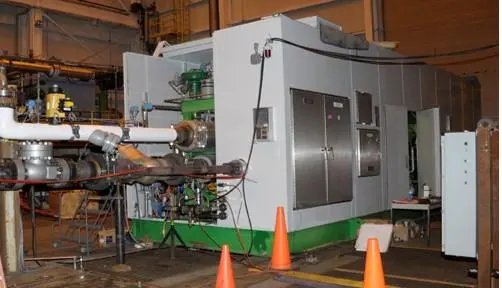
Echogen’s innovation – the larger of which has been sized to return an extra 8MW of power from GE’s LM2500 gas turbine – has the exhaust from the engine heating up a closed CO2 heat exchange loop, which is under pressure to keep it in the supercritical phase. The fluid is expanded across a powered turbine generator to create electricity: the fluid cools and is collected in the condenser before being compressed and sent through the heat exchanger again. Mr Barnes adds that CO2 has many benefits: “It’s safer than steam, you don’t have to make sure you have a reservoir of pure water or regularly blow down the turbine, in short you generally have less of a maintenance issue. And you’re basically using CO2 to reduce CO2… How much greener can you get?”
Related Articles
 PROPULSION
 GENERAL NEWS
 GENERAL NEWS