



CPP response prime cause of tanker collision, says MAIB
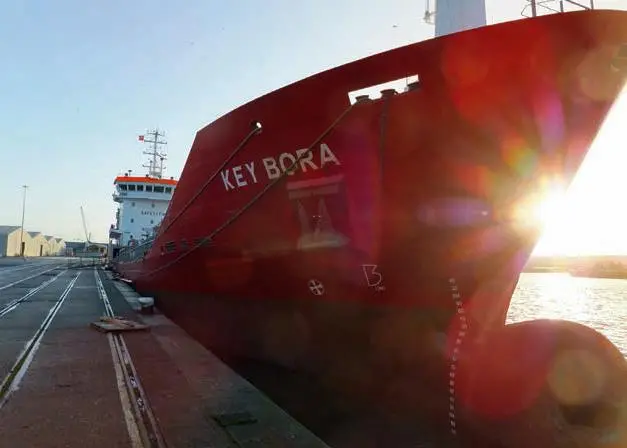
The report mentions that the ship’s CPP system had a history of responding slowly to demands for astern pitch. On this occasion it did not respond in time to the pilot’s order of full astern to prevent the bow striking the quay. The bulbous bow was holed above the waterline, but fortunately there was no pollution and no serious injury occurred.
Key Bora had an MaK 6 M 25 main propulsion engine and a ZF Marine KH 960 CPP system, controlled via an ECS 4000 electronic system supplied by NORIS. The vessel, under V.Ships management, was known for slow astern CPP response, and had a new Master in charge who had already experienced an incident on the voyage from Rotterdam to Hull. Although there was a backup system for controlling the CPP, the Master did not know of this at the time.
The pilot had noted before boarding the ship that its astern response was known to be slow, so had ordered the pitch to be set to zero well in advance, and asked for anchors to be made ready. When the pilot asked for full astern the system was very slow to respond, so realising that a collision was likely the pilot applied maximum thrust on the bow thruster and ordered the starboard anchor to be dropped. Because of a fault in the ship’s talkback system, communication between bridge and foredeck was by UHF radio, and the noise of the thruster meant that the deck crew did not hear the order to drop the anchor in time.
The MAIB subsequently found that the control parameters for the CPP system had been incorrectly set in the programmable controller, and this error probably dated back to when the system was commissioned, but records were not comprehensive enough to establish this. Response times for the Key Bora system were definitely longer than those for other similarly-equipped vessels, particularly astern.
The MAIB investigation identified that:
• The pilot was aware of the vessel’s poor astern response but did not test the engine prior to manoeuvring.
• The master was unaware of the function of the CPP backup control system, which could have been used to bring the situation under control.
• The crew at the anchor station had difficulty hearing the master’s order to drop the anchor over the hand-held UHF2 radio.
• Fault finding and assessment of the CPP system performance was hampered by the lack of installation records against which to judge the system’s response.
The port authority, ABP, has taken steps to ensure that astern propulsion is tested and ready for use before departure or arrival from any berth, regardless of the vessel’s size. V.Ships has been recommended to investigate and rectify the anomaly with the CPP system on Key Bora and to include in its safety management system a requirement for bridge watchkeeping officers to familiarise themselves with the emergency backup control of their CPP system. Following a recommendation from the chief inspector, the classification society, BV, has requested IACS to include response times in its forthcoming unified requirement for commissioning trials on CPP systems.
Related Articles
 ALTERNATIVE FUELS & LUBRICANTS
 GENERAL NEWS
 GENERAL NEWS