



Custom waterjet solutions improve maintenance and safety
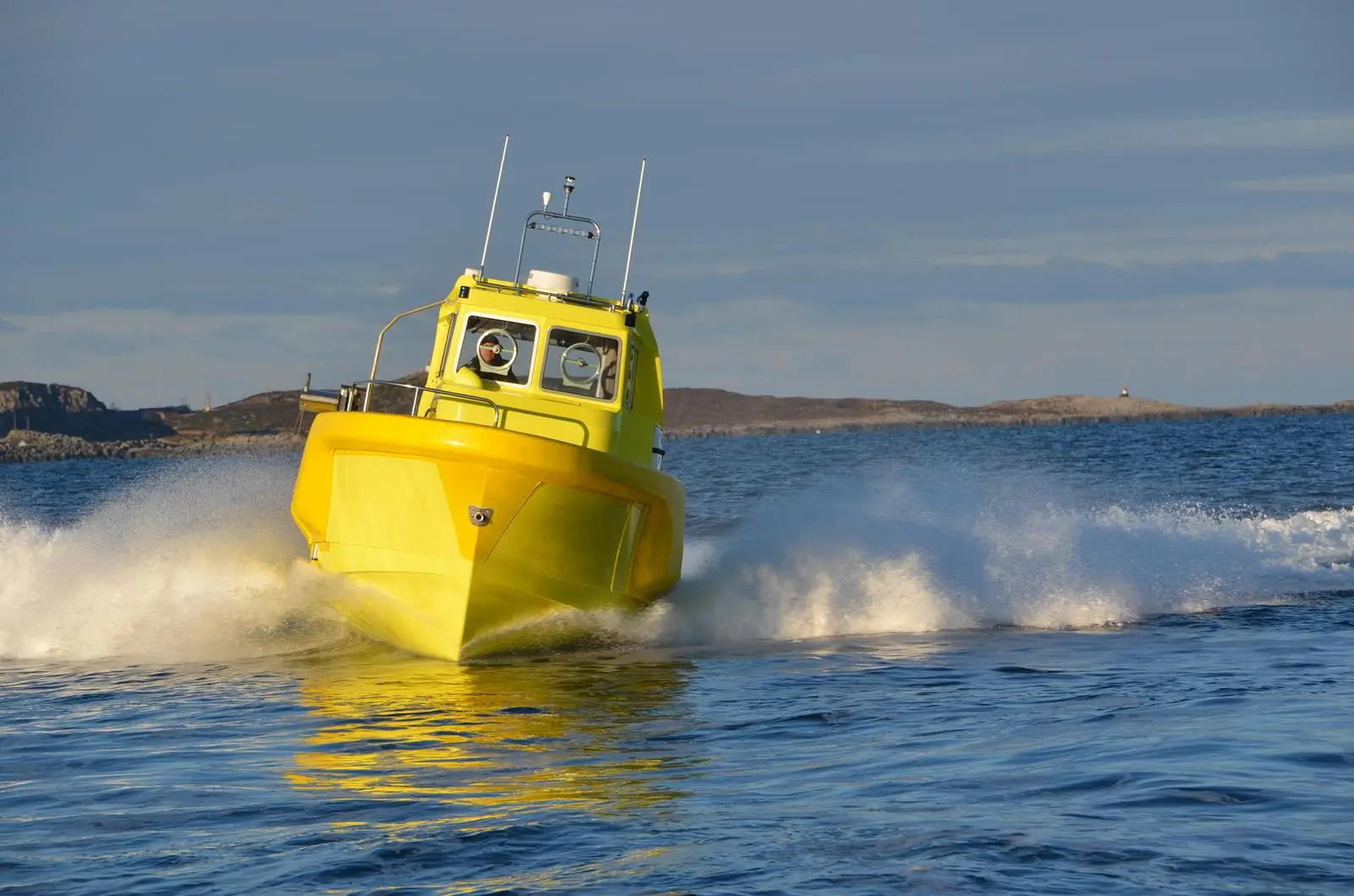
The waterjets delivered to Norwegian shipbuilder Westplast for a series of seismic survey vessels all have an intake knife system. “A previous vessel equipped with a competitor’s jet ingested the tow line, which became entangled around the vessel’s main jet shaft and caused the boat to be towed backwards until it was pulled under,” says NAMJet general manager, Jim Ducker. To overcome this potentially dangerous situation, NAMJet installs a knife system on the aft section of the intake which severs a line should it become stuck in the intake.
The new series of seismic survey vessels, known as the WP950 type, use 15in TJ381 waterjets which provide a top speed of 28 knots and a bollard pull of 2,900kg to the 7,100kg boats. They feature a tube protection system designed to eliminate exposing the rotation shaft as this it can act like a winch and wrap line around itself. This makes the vessels safer and the waterjets more durable, says Mr Ducker.
As the vessels will be launched from the mother craft at speeds of 5 knots, NAMjet designed a grease-lubricated aft bearing system to allow the jets to run in a dry environment. The jets can be engaged and turning prior to the vessel entering the water in order to escape the suction of the larger craft as quickly as possible. “From oil and gas, to wind farm, to patrol and rescue vessels, the ability to launch while underway with the confidence of knowing your vessel has immediate propulsion upon hitting the water is imperative,” says Mr Ducker. NAMJet’s high-thrust propulsion systems are claimed to displace significantly more water than traditional high-speed jets, and to do so at much lower velocities and rpm.
The US Navy’s fifth Littoral Combat Ship (LCS), Milwaukee, will be fitted with new high power density waterjets from Rolls-Royce. Up to 10 LCS vessels may eventually be built by Lockheed Martin. “We believe these waterjets are the future,” said Dr Ki-Han Kim, program manager for the Office of Naval Research’s Ship Systems and Engineering Research division. “Anything that we can do to keep ships ready to go will ultimately benefit our warfighters.”
The new axial flow waterjet Mk-1 can move nearly half a million gallons of seawater per minute at 22MW of power. Four of these new waterjets will enable the LCS to achieve speeds of over 40 knots. The smaller, more efficient waterjets are expected to help the LCS avoid excessive maintenance costs associated with cavitation.
Humphree has released a new interceptor trim tab system ideal for waterjets. The system is installed to improve the course keeping and efficiency of vessels by keeping the waterjet steering buckets in neutral position while the interceptors steer the vessel at high speed. This results in a straighter course, saves fuel and improves comfort and control. It also reduces wear on the waterjet steering gear, says Humphree.
The newly released HCS-5 system features a new control panel with a high resolution colour screen for good readability even in bright sunlight. New brushless servo motors mean that full stroke is achieved in less than a second and new motion sensors have improved the automatic functions including auto trim and list control and active ride control. This feature automatically drives the interceptors to counteract wave induced roll and pitch motion. It compensates for cross winds and uneven loading and it includes an advanced gyro.
Recognising the importance of automation and control systems for waterjets, MJP Waterjets has acquired AWT I Nacka, a specialist in such systems. The merger completes the company’s range after the earlier acquisition of Ultra Dynamics. MJP offers stainless steel mixed flow waterjets in the 350mm to 1,750mm range and Ultra Dynamics provides aluminium axial flow waterjets in the 250mm to 650mm range. The new group is named Marine Jet Power.
The company recently provided waterjets to three new vessels that could not be delivered due to lack of performance. After deliberation, it was decided to replace the existing mixed flow waterjets with MJP DRB mixed flow waterjets. When comparing the two waterjet systems on paper, both claimed to deliver the same thrust, but in reality, the MJP jets consumed 8.5% less power at the same operating speed. Power consumption was measured under the supervision of DNV, guaranteeing the accuracy of the measurements.
Ivan Fossan, managing director of the vessel owner Norled says: “Norled is very satisfied that Oma Baatbyggeri has been able to find the reason why our new vessels didn’t reach the agreed speed. Oma Baatbyggeri builds high-speed vessels with an important comfort-factor and thanks to the MJP waterjets we do not only reach our desired speed, but save a substantial amount of fuel oil at the same time.”
Related Articles
 PROPULSION
 GENERAL NEWS
 GENERAL NEWS