



‘Decarbonisation’ now a priority says LR study
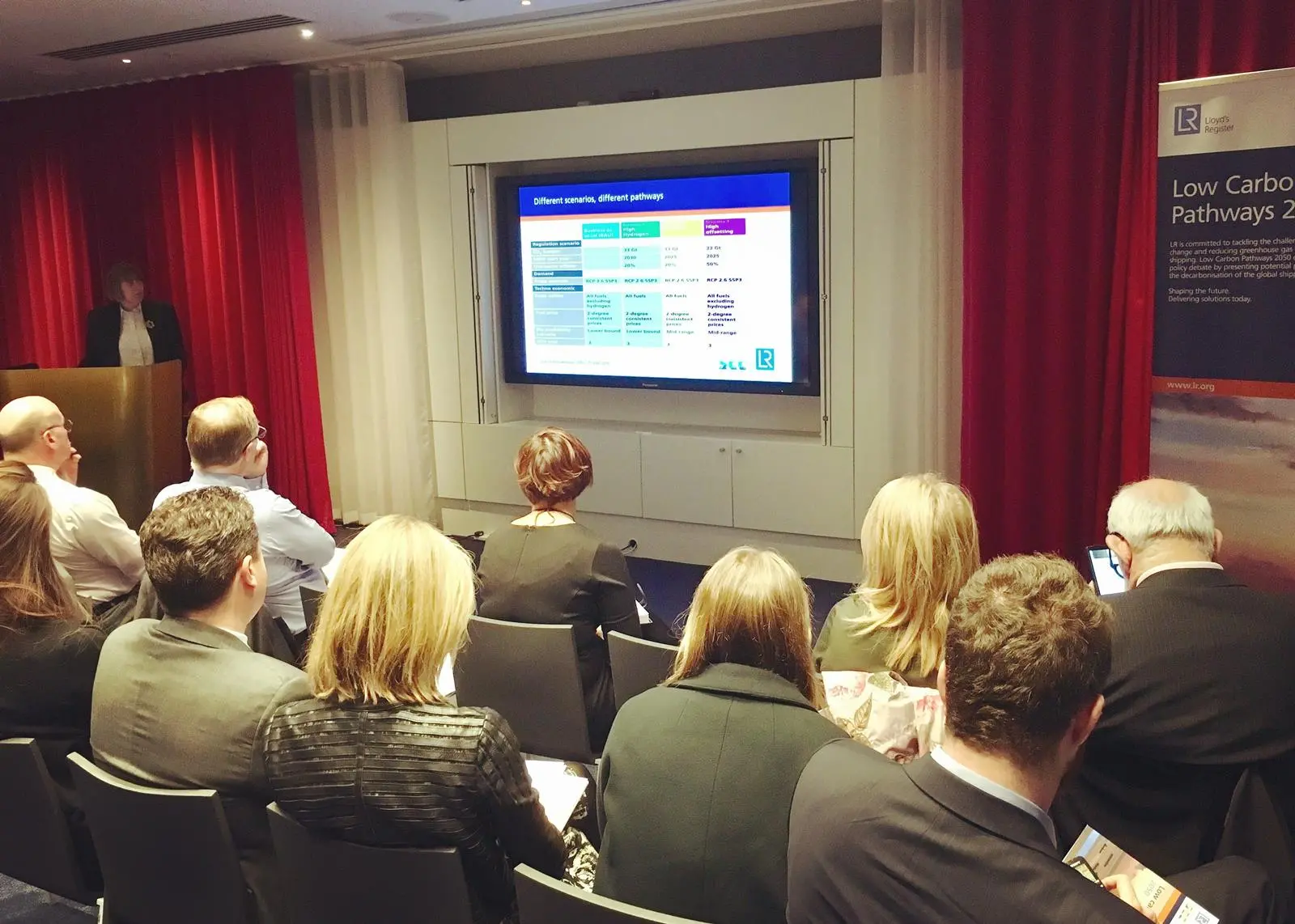
Publication of Low Carbon Pathways 2050 comes at a key moment, as the IMO’s Marine Environment Protection Committee prepares to establish a working group at MEPC 70 next week to address the means by which international shipping can reduce its carbon footprint.
Katharine Palmer, environment and sustainability manager, LR, and Carlo Raucci of Shipping in Changing Climates – a US$4m multi-university and cross industry research project funded by the Engineering and Physical Sciences Research Council – introduced the study. Both stressed the need for the decarbonisation issue to be tackled without delay. The later it is left, the more disruptive it will become for shipping, they warned.
The Paris Agreement has concluded that it was not a question of whether, but how climate change should be addressed. Shipping, which currently accounts for 2.33% of global carbon dioxide emissions, equivalent to about one giga-tonne annually, will be expected to play its part in the decarbonisation process.
Although heavy fuel oil is expected to continue to provide a significant fuel for shipping in the future, the study identifies three potential scenarios and compares them to a ‘business as usual’ backdrop incorporating existing regulatory commitments. The first, ‘high hydrogen’, considers the availability of hydrogen used in fuel cell technology to demonstrate carbon reduction through technology and innovation. A second, ‘high bio’, assumes a mid-range market penetration of biofuels in shipping; while the ‘high offsetting’ scenario assesses the impact of a market-based mechanism.
Palmer stressed that any future regulation will need to provide the right incentives to drive the necessary changes. “We hope that business strategies and consistent policies can be combined to reduce shipping emissions,” she said.
Raucci added that the study has made clear that the shipping industry needs to advance its thinking beyond marginal gains in energy efficiency and alternative fossil fuels if the least-cost decarbonisation strategy is to be identified.
The two organisations now plan to host a round table meeting with shipping industry representatives to discuss the report and the research behind it, including its wide-ranging assumptions and their validation. Palmer said that key clients of the class society representing a diverse range of interests would be involved.
The report can be downloaded here.
Related Articles
 ALTERNATIVE FUELS & LUBRICANTS
 GENERAL NEWS
 GENERAL NEWS