



Design software aids calculation of shaft vibrations
Such vibration issues can be caused by imbalance, propeller forces or main engine-induced fluctuations. The results of excessive vibration include complete shafting system destruction, reduced fatigue life of shafts and shaft elements, fatigue cracks at shaft brackets and foundations, stern tube bearing fatigue damage, and damage and increased wear of seals, while vibrations can lead to excessive noise throughout the ship, and impact on the hull and superstructure. Ships such as offshore support vessels and tugs, which frequently switch from ahead to astern, have been found to be particularly prone to such failures.
Therefore, according to Machine Support, it is essential for designers to adequately specify shafts, and their bearings and seals, to cope with the influence of vibration during operation of the ship in all conditions it is likely to meet.
Prediction, calculation and analysis of shaft vibrations, their causes, effects and prevention make up a highly complex issue. Machine Support has developed its ShaftDesigner software to assist with specifying the correct shaft system. ShaftDesigner is a multi-project, multi-shaft and multi-state 3D computer aided engineering (CAE) system for ship propulsion train calculations. The ShaftDesigner software uses a base model to calculate shaft alignment, whirling vibration, bending (lateral) vibration, axial vibration and torsional vibration.
The main features of the software are as follows:
- 3D graphical environment for easy visual checks;
- Base model for quick recalculations;
- Multiple modelling possibilities for different purposes;
- Various shaft alignment calculation methods;
- Calculations for various types of vibrations; and
- Customisable reports with export options.
Strict environmental rules in certain areas mean that pollution from worn or damaged seals and bearings can have serious consequences, while January 2011 marked the entry into force of mandatory calculation of transient torsional vibration induced by ice block impacts under new classification societies’ rules for ships navigating in ice conditions.
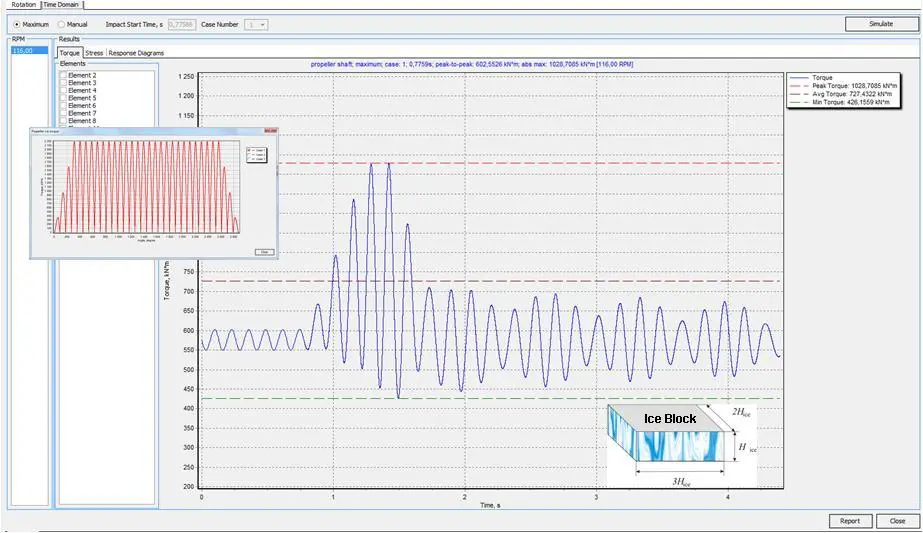
The ice question is particularly taxing for designers. According to Machine Support, conventional propulsion shafting forced torsional vibration calculations have no computational problems because owing to harmonic excitation law the frequency -domain approach can be easily used. In the transient vibration calculation – as in ice conditions – the time-domain approach should be used because of the arbitrary excitation law. The time taken for calculations relating to ice-class propulsion trains can therefore be considerable. Classification societies have recommend reducing real mass-elastic systems to several masses, using special techniques for simplification of the mass-elastic system.
A paper prepared by Dr Yuriy Batrak of Machine Support’s partner IMT, and one of the developers behind ShaftDesigner, looked at an effective method for the time-domain integration of the linear matrix equations of propulsion shafting transient torsional vibration.
The technique employed, says Batrak, may be considered as an advanced version of the least-square algorithm based on the special minimisation procedure of the weighted residual moments in the governing equations. The comparisons of the proposed algorithm with the well-known Runge-Cutta, Adams-Multon and Newmark techniques in the solution of ordinary linear oscillator and Duffing and Van-der-Pol nonlinear oscillators showed good accuracy and amplitude and phase stability of the numerical results.
The calculation module based on this technique has been developed and included in the ShaftDesigner CAE system package, as a resul;t of requests from the industry. Use of this module offers the possibility of avoiding the procedure of mass-elastic system simplification, while also allowing calculation of peak, peak-to-peak and mean torque values taking into account engine and propeller hydrodynamic excitations. The Ice Impact feature allows setting of several parameters including ice class, classification society, accuracy, rotations after impact and number of calculation threads.
Shaft alignment techniques supported by ShaftDesigner are direct calculation, offset exploration, geometric alignment, catenary alignment and strain gauge alignment. Thanks to the reverse engineering capabilities of the software it is also possible to calculate alignments based on measured bending loads, bearing stress, jack loads, sag and gap, and shaft deflections. Machine Support says that combining different measurement techniques and the ShaftDesigner software makes it possible to perform shaft alignment without having to dismount the shaft or any component.
ShaftDesigner stand-alone and network versions are now supported on 64-bit operating systems. The software runs on the latest client and server versions of Microsoft Windows.
Among the users of ShaftDesigner is STX Finland, part of the STX Europe Group. STX Finland uses the software at its shipyards in Turku, which builds large cruise ships, and Rauma, which specialises in ferries, smaller cruise ships, multipurpose icebreakers and naval craft.
STX had previously used third-party contractors for alignment and vibration calculations analyses, but decided to perform these calculations in-house. ShaftDesigner provided a means of calculating shaft line alignment as well as all types of vibration, with, according to Machine Support, none of the limitations found in other software packages. The Ice Impact feature within the Torsional Vibration module is important to STX Finland, which is designing and building a polar supply and research vessel which is scheduled for delivery in 2012.
ShaftDesigner proved the most economical as well as the most technically capable option for STX, which purchased a network license version that allowed sharing between the Rauma and Turku yards. The STX contract included training for its design team in Finland, in using the software efficiently and properly analysing the results. Further training covered the ShaftDesigner Reverse Engineering module, part of which is undertaken onboard ship, to show how to take measurements and to import the data into ShaftDesigner to be able to compare the theory with the actual situation.
SKF Machine Support delivers more than software. The company was already well-established globally in STX, whose subsidiaries in Brazil, Korea, Norway, Romania and Vietnam use the company’s Vibracon adjustable steel chocks. These chocks are intended to save time during the alignment and mounting of any type of rotating equipment. SKF Machine Support delivers complete Vibracon mounting kits that, besides Vibracon chocks, include a set of components which aid quick and accurate installation of propulsion units and auxiliary equipment.
Related Articles
 PROPULSION
 GENERAL NEWS
 GENERAL NEWS