



Digital transformation imperative not optional
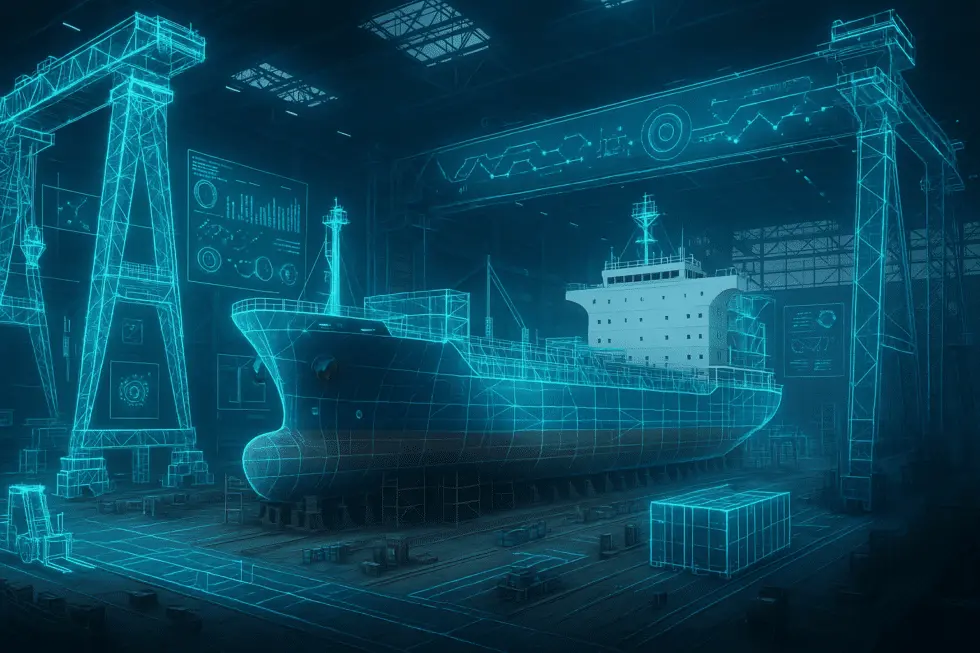
Market distortions, attributable to covert and overt policies of those governments which see ship construction as a key element of national industrial strategy, heighten the challenges facing shipbuilders in other areas where recourse to central support is less or non-existent. But whether or not the ultimate goal is individual, corporate profitability or national economic wellbeing, technological transition is paramount.
Attaining the status of a ‘smart’ shipyard implicitly infers the basis for future viability, realised through the efficiency gains resulting from the application of integrated digital technologies. Smart shipyards represent intelligent manufacturing ecosystems that leverage real-time data to connect and meld design, production and oversight in an industry that has historically proved problematic to automate due to the intricacy of the design work, large-scale structures, generally non-standardised products, and heavy reliance on manual labour.
Cost concerns
The issue of the capital costs associated with wholesale transformation of a shipbuilder’s processes and organisation cannot be understated, especially for yards with limited financial resources. However, it is clear that those who do not make the technological and also cultural shift will in the longer-term increasingly struggle against those who do.
Just as re-working and major changes to design specification, plus any problems leading to long delivery delays, are anathema to all shipbuilders, imposing extra expenses that can wipe out profit on a contract, a smart shipyard programme must, from the outset, be tailored, structured, and properly implemented if the measures are to achieve the promised value over time. This requires a collaborative mindset by all concerned, including a willingness on the part of all yard personnel to learn and adapt.
For decades, shipbuilding has been synonymous with complexity, long lead times, and intricate coordination with equipment suppliers and subcontractors. The challenges have intensified as pressure mounts from global shipowners in terms of demand for shorter build timeframes and designs offering higher value in both economic and environmental performance and construction quality. Digital systems are building blocks in the drive to raise the industry’s game, and central to attainment of the status of a smart shipyard.
In essence, a smart shipyard is one that employs fully integrated advanced technologies and digital systems that optimise every stage in newbuild construction, leveraging virtual simulation of production parts and processes, real-time data and automation, artificial intelligence, and the Internet of Things (IoT) to deliver as designed, on time and on budget.
It is imperative that shipbuilders both technologically and organisationally invest in means to realise new efficiencies, by working ‘smarter’ and faster, without sacrificing quality. Transformative technologies applied to production lines can increase not only throughput capacity and productivity, but also agility in manufacturing operations. Ultimately improved net returns implies improved profitability and financial resilience in meeting future capital investment needs and countering the relatively long project cycle times and market fluctuations endemic to newbuild construction.
Differing definitions
Paris-domiciled Dassault Systemes states that “Creating a smart digital shipyard provides a clear vision of the production status, which enables shipbuilders to understand the present and forecast the future. An integrated, smart digital shipyard includes production automation and connectivity among all shipyard resources. These capabilities support planning and scheduling optimisation as well as efficient manufacturing operations management.”
Texas-based Thinaer defines a digital or smart shipyard as one which “applies real-time data, automation and smart sensors to improve every aspect of shipbuilding operations. Through technologies like Industrial Internet of Things (IIoT), shipyards gain real-time visibility into assets, processes, equipment, and environmental considerations—enabling faster production, fewer errors and improved schedule fidelity. In shipbuilding, where complexity is high and timelines are rigid, digital transformation isn’t a luxury—it’s a competitive advantage.”
Indeed, digital ship construction offers a better way to manage the shipbuilding process. The approach formulated by one of the leading innovators, Siemens, relies on integrating three core systems, identified as product lifecycle management (PLM), manufacturing operations management, and enterprise resource management, to ensure a closed loop between design and manufacture, minimising risk and providing for continuous improvement.
HD Hyundai, in its former guise as Hyundai Heavy Industries, was in the vanguard of the drive towards ‘smart’ shipyard operations, having some years ago implemented the claimed first PLM infrastructure devised specifically for shipbuilding, developed and supplied by Siemens Digital. This provided a single repository for all ship-related data and digital manufacturing functionality for simulation of production processes.
PLM confers integrated oversight and control across the entire process of newbuild sale, design, production and post-delivery services.
Future of shipyards
Early this year, HD Hyundai confirmed that it was taking its transformation strategy to a new level, on track to realising its Future of Shipyard (FOS) project by 2030. Executive vice chairman Chung Kisun emphasised a commitment to building an integrated, optimised and automated shipyard of the future, wherein human intervention is minimised, by leveraging know-how from global technology companies. This includes strengthened cooperation with Siemens and also the involvement of US firm Palantir, a software specialist particularly well versed in areas such as AI-driven decision making.
The initial phase of the FOS endeavour, entitled Visible Shipyard, has been completed, and the second phase, Connected and Predictively Optimised Shipyard, is under way. The final part of the programme, Intelligent Autonomous Operating Shipyard, ultimately aims for a major reduction in physical human intervention. The project’s overarching goal is a 30% increase in productivity, and a reduction of the same order in build time.
A propensity for collaboration with overseas experts has been a characteristic of Hyundai policy from the outset, and the progressive development and deepening of the strategy bears fundamentally the widespread acknowledgement of the shipbuilder as having provided a beacon for the industry in digital transformation.
Focused on safeguarding a market position in the high added-value, specialised vessel sector, the European Commission is underwriting EUR7 million ($8.2m) of the EUR8.6 million ($10m) budget for an extensive research project devised to boost European shipyard competitiveness through digitalisation.
The four-year Smart European Shipbuilding (SEUS) initiative has the ambition of a 30% time saving in engineering and up to a 20% time saving in assembly and construction. The eight partners in the consortium, which includes Finnish-headquartered shipyard and industrial software firm Cadmatic, have teamed to develop novel practices for data-driven AI design elements. Intelligent technology, human-centric knowledge management, and the Industry 5.0 concept tailored to a shipbuilding environment.
Due to be finalised by the end of 2026, the project has already reached the stage of software prototypes integrating CAE, CAD, CAM and PLM, underpinned by AI, being tested across pilot, medium-sized shipyards.
A newly introduced addition to the Cadmatic product portfolio achieves smarter hull design through the use of improved structural modelling and production data tools for the multiplicity of panels, panel properties and plate parts in a newbuild. As well as enhancing production management and precision, the system efficiently accommodates design modifications and helps reduce time spent on manual ‘fixes’.
For shipbuilding worldwide, as vessels become more complex and the shift towards ‘green’ features and higher expectations as to long-term performance accelerate, the development of smart shipyards may be viewed as essential rather than optional.
Related Articles
 METHANOL
 GENERAL NEWS
 HYDROGEN