



Double control for waterjets
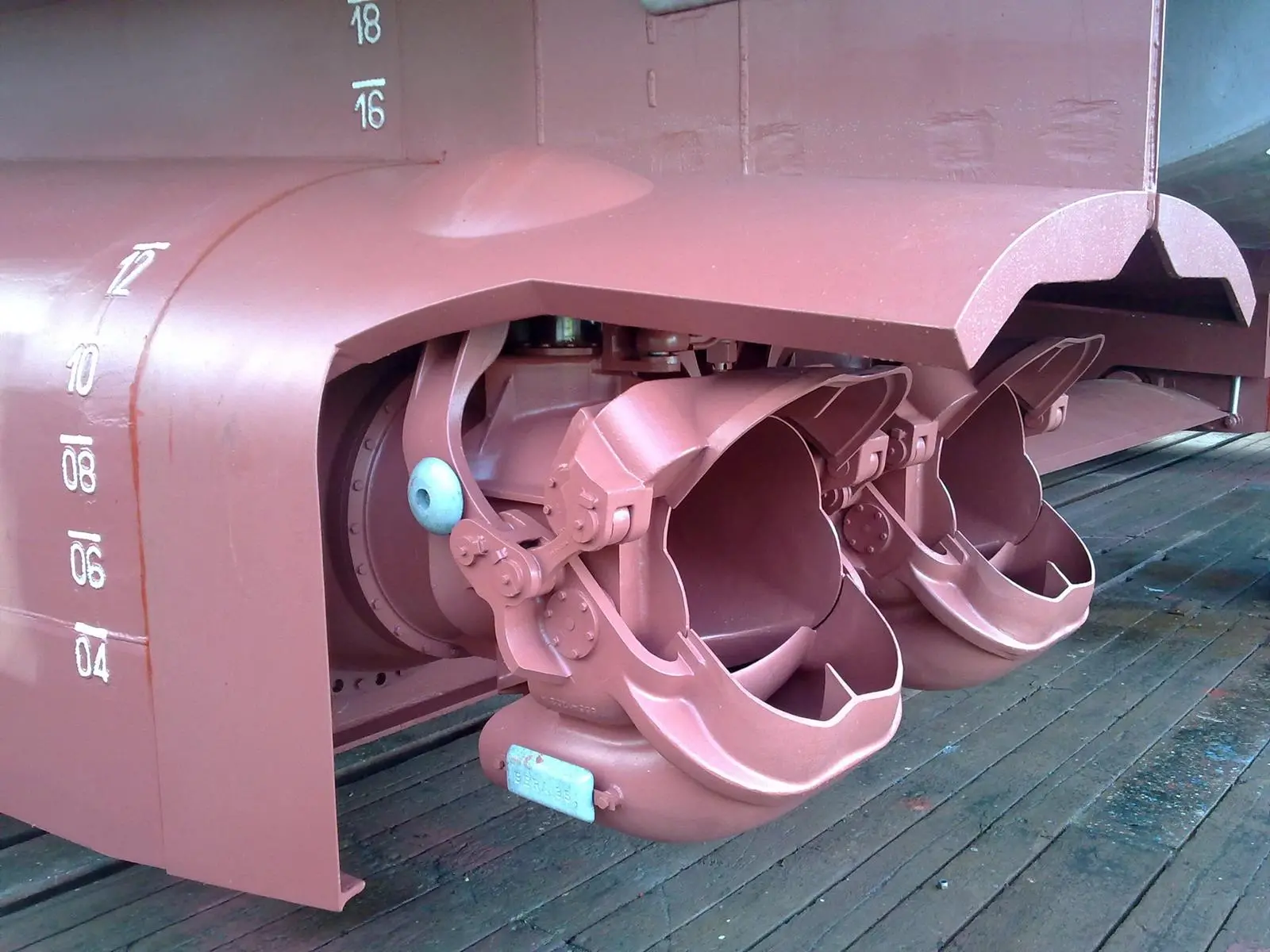
The new steering and reversing unit, known as CSUI, has recently been tested on a French landing craft. The landing craft has an hourglass shaped hull with two very different operating conditions. These two modes are known as catamaran mode and barge mode, with specific design requirements. In catamaran mode, the centre platform is high above the waterline and the jets are consequently very deep in the water. When the centre platform is lowered into barge mode, the jets are in a more usual position. The design needs to fulfill the requirements for both operating conditions.
MJP says that the vessel is equipped with four engines and four jets, which are driven by an MJP 650 mixed flow pump. As usual, the intake is adapted and designed to the constraints given by the hull and its application using CFD. The swath-type hull with a pronounced hourglass shape results in a narrow waist at the waterline, with minimal below-waterline area.
Since the jets are placed very deep in the water in catamaran mode, the hydraulic mechanism is located inboard, above the jets, to reduce drag. With limited space inside the hull, the normal MJP DRB design could not be used.
MJP employed CFD to optimise the flow in the bucket and enhance reversing performance. This is said to be particularly important on landing craft in order to ensure safe disembarkation. Sea trials showed that the vessel can operate at 10 knots in reverse at full load in open seas.
The new CSUI is based on an old MJP design from the 1990s used by the Swedish Defence organisation for a FMV prototype. Due to the narrow waist of the hull, two jets in each hull are controlled through centrally located mechanical equipment between the jets.
Other special features include the engine rpm control, which is used to control the platform hydraulics and the intakes, which are built of GRP in a double mounting to fit the narrow hull shape. The hydraulic system is adapted for extreme ambient temperature requirements with an electrical cooling circuit that can be used for back-up operation of the steering and reversing units. The control system has three complete control stations with a centrally located computer. The scope of supply includes the long intermediate carbon drive shafts including supports.
Recent tests during official sea trials showed that at full load (270t) a speed of 17.7 knots was reached and at light load (190t) a speed of 29.3 knots was demonstrated.
Related Articles
 ALTERNATIVE FUELS & LUBRICANTS
 GENERAL NEWS
 GENERAL NEWS