



Efficiency is the name of the game
However, not only does it just apply to replacement tonnage, there’s a further caveat. There’s also a six and a half year waiver for new ships registered in developing countries, and as many owners might decide to move their registration over, it may well put back the effective date of reform to 2019.
The EEDI improvements are not, by themselves, rocket science. The mixture of optimised engine designs, lighter, hydrodynamic hull structures, better coatings and heat recovery systems is presently being pushed just as much by rising costs as anything else. For example a new supramax bulk carrier has been especially designed to burn less fuel while satisfying the extra strength needed for handling steel coils.
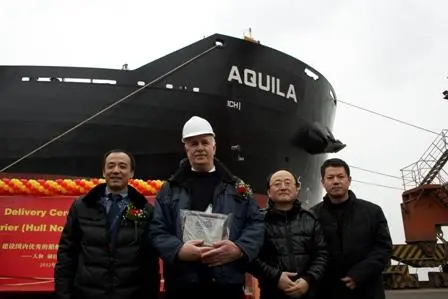
Lloyd’s Register supervised the design appraisal, build and sea trials, verifying the performance of the 57,000 dwt MV Aquila. Ship designers SDARI say it will be able to load about 54,000 tonnes of steel coils, all with little increase to its weight while still satisfying the latest Common Structural Rules for bulk carriers. Nick Brown of Lloyd’s Register, Greater China, points out that owners and operators are looking harder for efficiencies and, following up the chain, shipyards and designers are responding.
The efficiency improvements have been achieved by carrying out a number of straightforward – but effective – changes. The engine’s output has been reduced by nearly 1,000 kW to 8,500 kW, and so the main engine’s daily consumption at 14 knots (ballast draft) has likewise been reduced by around 3.4 tonnes of fuel to about 26 tonnes. There is also a new propeller design to make the most of the de-rated engine, and a mewis duct has been fitted.
Mr Brown says that the two leading factors for change are the emissions regulation and – not least – higher energy prices. But rather than a simple squeeze, he thinks that “new technologies and innovation will play a vital role” in the health of the shipping sector, both in the medium and long term.
However, he is aware that while new fuels, new engines and new designs are becoming available, “the difficulty for shipowners, builders, equipment makers and, don’t forget, financiers is not only what technology to support but when to invest.”
Related Articles
 METHANOL
 MONITORING, CONTROL & DIGITALISATION
 MONITORING, CONTROL & DIGITALISATION