



Electric ship moves closer to reality
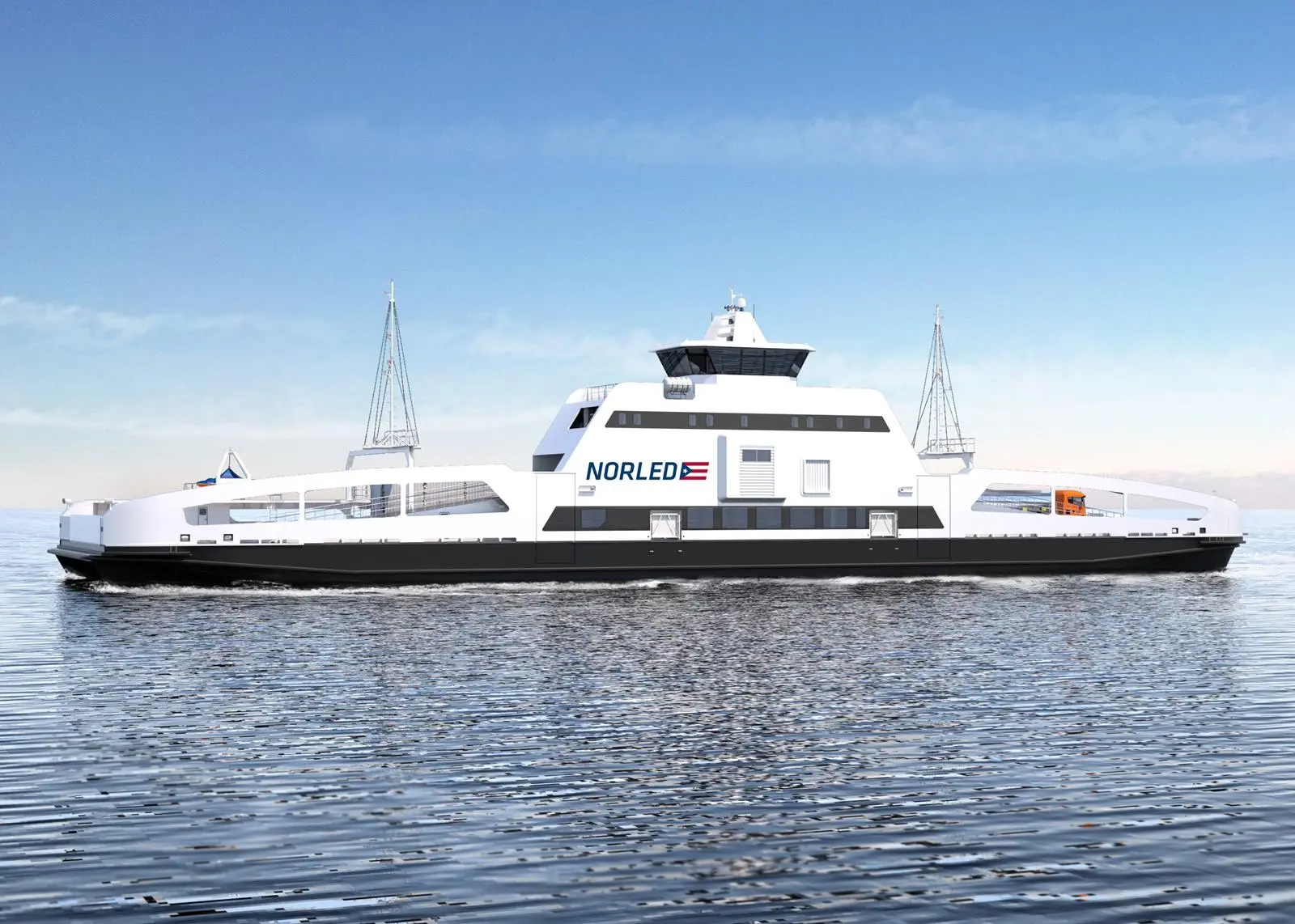
The big problem for battery-powered ships, as with land-based electric vehicles, has been limited range. But as battery technology develops, electric ships will be able to operate on longer routes, at lower cost yet still with high efficiency and zero emissions.
For a ferry like Ampere, which operates a short route across the Sognefjord in Norway, this would not seem to be too much of a problem. However, the busy schedule on the route demands that breaks between crossings are a mere 10 minutes long, very little time to recharge the batteries. And in this remote part of Norway, the local power grid serving the villages at each end of the crossing would have been unable to cope with the surge in power every time the charging system was connected. In this case, Canadian battery company Corvus Energy has provided, as well as the onboard battery bank weighing 10 tonnes, two further banks of batteries onshore. Each end of the crossing they are connected to the ship’s batteries to provide a quick boost charge while the ship is in port, and are themselves slowly recharged while the ship completes its return voyage.
In total, Corvus has supplied 224 AT6500 modules with a total capacity of 1.46MWh. This is split into four battery packs – one at each end of the vessel, and two shore power stations – one at each end of the route. The shore power stations employ advanced liquid cooling, which combined with the low impedance of the batteries and the high output of the Siemens-developed charging equipment, facilitate rapid battery-to-battery power transmission. This replenishes the vessel’s onboard battery significantly, even during short turnarounds.
The 80m vessel can carry 120 cars and 360 passengers, and replaces a diesel-powered vessel which annually uses around 1 million litres of oil, emitting 2,680 tonnes of CO2 and 37 tonnes of NOx. The ferry was designed to accommodate the requirements of an electric drive system, with two slim aluminium catamaran hulls for low drag and light weight. Despite the greater mass of the battery pack compared with a fuel tank, because the electric motors are much lighter than diesel engines combined with the lighter construction, Ampere weighs only half as much as an equivalent conventional ferry. This means that Ampere can operate at 10 knots using only 400kW of battery power – though 800kW of batteries are provided in total. This compares with the 1,500kW output required from the engines of a similar diesel ferry.
According to Siemens, the current technology can easily be applied to any ferry crossing of 30 minutes or shorter in duration.
Corvus has been involved in the refit of a 30-year-old ferry, Folgefonn, for Norwegian operator Tide, in conjunction with Wartsila. The company supplied 221 6.5kWh batteries, a total capacity of 1.4MWh. The bus voltage is 800VDC, and the system includes house power and shore-based fast charge energy storage as well as propulsion. The refit is a demonstration of how existing vessels can gain the cost and emission benefits of a full electric propulsion system.
Li-ion packs
The current favoured battery type for marine propulsion applications is the lithium-ion (Li-ion) cell. But traditional lead-acid cells still find applications. These have been used in submarines for many years, and are still specified by some navies, who like the well-proven technology and the deep discharge capability of such batteries. Both ‘wet’ cells (with liquid sulphuric acid electrolyte) and gel-type cells are in common use, though the latter has proven more suitable for use at sea.
Despite the advance of Li-ion technology, traditional cells are still a viable option for auxiliary systems onboard. The Blue Star Delos Renewable Energy Innovation Project, initiated by Greek ferrycompany Blue Star and Eco Marine Power of Japan, aims to make shipping more sustainable through the use of renewable energy onboard. Blue Star’s Delos ferry has been equipped with an array of photovoltaic cells, monitored by EMP’s Aquarius Management & Automation System (MAS), and providing energy which is stored in a battery bank. According to EMP’s chief technology officer Greg Atkinson, Furukawa Battery of Japan has become a partner in the project. The battery pack used in the trials consists of 12 VRLA batteries of type FC38-12 (12V, 38Ah/20HR) which have a cycle life of around 1,000 cycles at 25oC, at 50% depth of discharge.
Atkinson says that EMP will conduct further lab tests involving the FC38-12 batteries and evaluate other innovative energy storage technologies from Furukawa, not just for this project but for other marine applications. “We are studying in detail the marine applications which are best suited to lead acid or lithium battery technologies, taking into account such things as safety, cost, ease of maintenance and expected lifespan,” he says.
As far as Li-ion cells go, there have been concerns over safety when these are used afloat. Lithium reacts violently with water, so the cells use a non-aqueous electrolyte in a completely sealed container. If overcharging, short circuiting or an internal fault leads to the cells overheating, thermal runaway or cell rupture is a real danger. Marine battery packs include fail-safe circuitry to cut the power if the cell voltage falls outside a safe range.
One of the first Li-ion marine hybrid installations, the hybrid tug Campbell Foss, suffered a fire onboard, with considerable publicity ensuing. This was said to have resulted from a software fault, and Corvus Energy, which supplied the battery pack, says it now employs multiple levels of protection. As its marine batteries are fully certified by class societies DNV GL, ABS and Lloyd’s Register, it seems the powers that be are satisfied as to the system’s safety.
Corvus says its basic 6.5kW AT6500 energy storage module has an integrated battery management system to control cell balancing, report on state of charge and system health, and detect and report faults. These modules can be connected in series to create packs with bus voltages up to 1,100V DC and capacity up to 143kWh; each pack containing a control unit. These packs are connected in parallel to form arrays, controlled through an array manager circuit.
Active cooling
Corvus has supplied batteries for the four Scandlines hybrid ferry conversions, which at 2.7MWh are said to be the highest capacity marine installations to date. It is partnering with EMP on the latter’s Eco Ship projects, which could involve even greater capacities. According to Sean Puchalski, vice president business development, Corvus Energy: “Our most important new developments are new innovations for actively cooling our battery packs. This is in the form of a new racking system that blows cooled air over the battery modules and also a new model of battery module that is liquid cooled. These innovations allow for a smaller battery pack for a given load profile, which translates into better economics and a smaller footprint for customers.”
Various cell chemistries are produced; Corvus favours lithium nickel manganese cobalt oxide technology, said to offer higher voltage, energy density, improved cycle life, charging current and power density than other types.
French supplier Saft’s Seanergy range uses lithium-iron-phosphate electrode chemistry, claimed to be efficient and cost-effective in both full electric and hybrid marine applications, offering compact size and low weight, with increased safety, long life, fast-charging capability and capability for voltages up to 1,000V continuously or in pulses. Saft has supplied Bureau Veritas certified Li-ion modules for several small ferries and passenger vessels.
Lithium iron phosphate batties are offered by Super B of the Netherlands, which was involved in hybrid conversion of BC Ferries’ car ferry Tachek. This uses a bank of 54 batteries, of 114kWh capacity. Super B says that its batteries can be stacked and mounted anywhere in the ship, while the electronics seamlessly allow safe integration into the ship’s switchboard and grid.
With battery technology developing fast in the electric vehicle industry, it is inevitable that innovations should cross over to marine. Nexeon of the UK is developing silicon battery anodes for Li-ion electric vehicle batteries, which, thanks to significantly higher charge density and energy capacity, is likely to find favour in marine propulsion and hybrid applications. Land mobile and sea installations both demand favourable gravimetric energy density (power to weight), long cycle and calendar life, and journey range. In applications such as submarines, where space is an issue, Nexeon says that volumetric energy density will probably be even more important.
“Next generation (non-carbon based) batteries such as those being developed by my company Nexeon – based on silicon anodes – will in future be of interest to the marine sector, although they are not close to being adopted today”, said Nexeon CEO Dr Scott Brown.
Heated cells
The Zebra (zero emissions batteries research activity) battery is marketed by Rolls-Royce for marine applications, currently primarily for submarines, but the company believes it to be equally suited to surface ships and merchant vessels. Energy density is reportedly equivalent to Li-ion, and should the battery enter volume production costs could approach those for lead acid batteries. Rolls-Royce claims high specific power using materials that are relatively inexpensive and plentiful. One disadvantage is that the cell has to be heated to maintain the sodium electrolyte in liquid form and maintain the correct resistance. But Rolls-Royce says that whereas other battery technologies require a cooling system to dissipate the heat resulting from the cell’s internal resistance, the Zebra battery can make use of this phenomenon to convert the resistive losses to heat, maintaining the operating temperature. When not in use, though, external heating is needed, provided through the charging system.
Future technology could see development of hydrogen-bromide cells and ultracapacitor technology (also called ‘synthetic batteries’) for marine use, while in Switzerland, Alcoa, Phinergy and Heig-VD University have demonstrated an electric boat in powered by an aluminium-air battery. This, says Alcoa, uses air and water to unlock energy stored in aluminium, and promises superior energy density, longer range and low cost compared to other battery technologies.
Fuel cells were touted a few years ago as the next big thing in zero-emissions marine technology, but things have gone somewhat quiet recently. The original FellowShip project – undertaken by DNV, Eidesvik Offshore and Wärtsilä – included the installation of a fuel cell onboard Eidesvik’sViking Lady PSV. The 330kW fuel cell successfully operated for more than 18,500 hours supplementing the ship’s auxiliary gensets. However, this was slightly overshadowed during the next stage of the project when a Corvus battery pack was added to the mix to provide a true hybrid system.
DNV GL still believes the fuel cell to be viable – in the case of Viking Lady, for example, the combination of battery and fuel cell power should be able to provide all of the ship’s power when in harbour, as well as provide significant energy savings during dynamic positioning operation. But the technology is bound to advance in the coming years, and once a compact, megawatt-capacity fuel cell comes to fruition, the maritime community should once again get interested.
Related Articles
 PROPULSION
 GENERAL NEWS
 GENERAL NEWS