



Embracing ethane
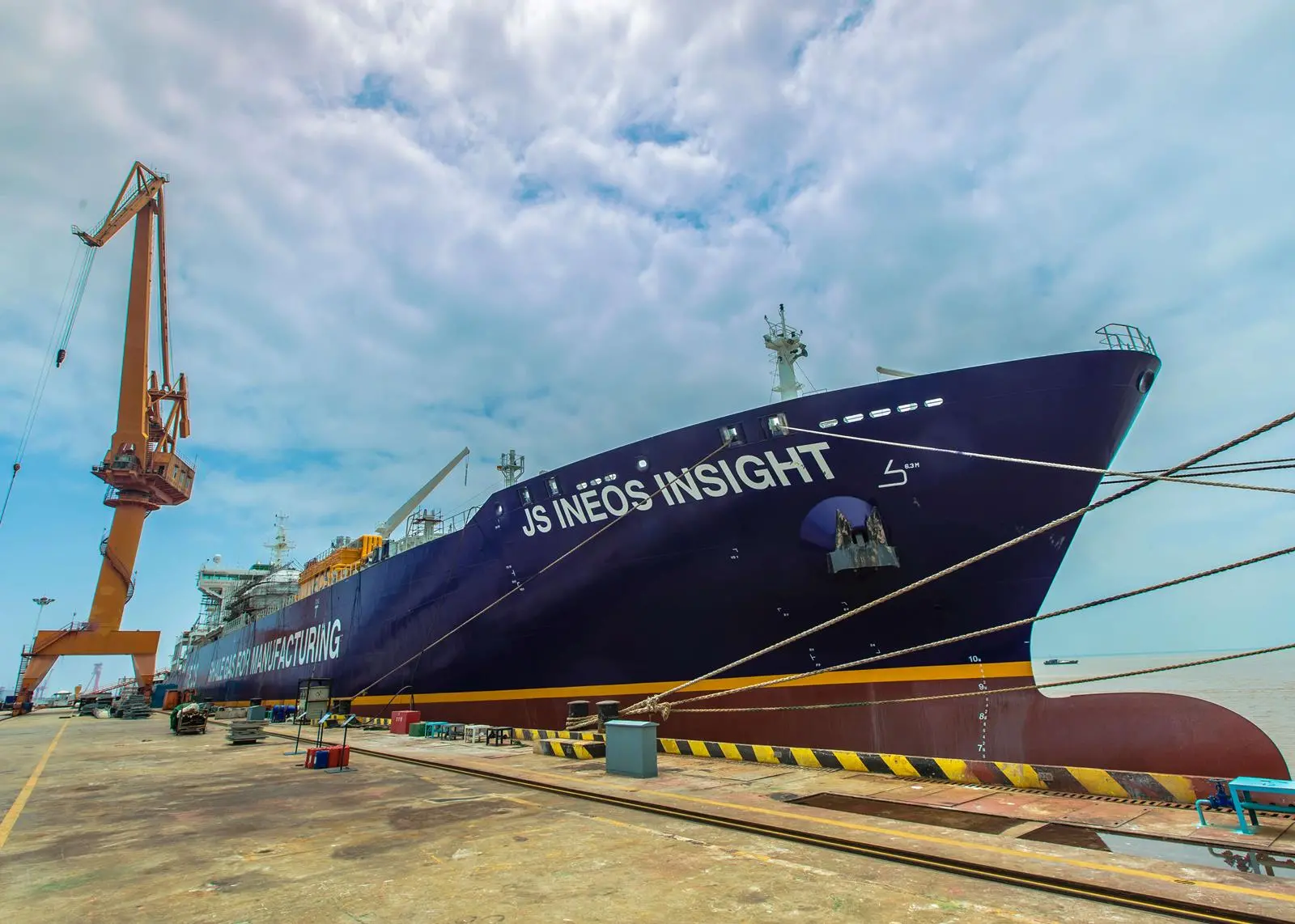
The rapid increase in the production of ethane from US shale has created massive oversupply in the domestic market, and overseas exports are an obvious consequence. Within five years, up to a million barrels per day of US ethane could replace hydrocarbons in the European, South American and Asian chemical industries, as well as being used to fuel the energy sector. Moving such volumes requires dedicated facilities and ships equipped with cutting-edge technology.
The delivery of the first of the new Dragon-class ethane carriers for Evergas, the largest of their type in the world, marked the beginning of a new technology era in the transportation of liquefied gases. The company’s readiness and ability to raise the bar in terms of efficiency, flexibility, and environmental sustainability provided Wärtsilä with a unique opportunity as the integrated solutions provider for the new vessel class.
The ships are being built by Sinopacific Offshore and Engineering in Qidong and are designed to carry LNG, ethane, and other LPG cargoes. Fitted with the Wärtsilä dual-fuel propulsion system, they are ready to meet the most stringent environmental requirements and to comply with Emission Control Area regulations in both European and US waters.
Key features of the vessels include:
- Cargo capacity including deck tanks: 29 500m3
- Deck/fuel tank capacity: 2 x 1000m3
- Main engines: 2 x six-cylinder in-line Wärtsilä 50DF (twin in/single out)
- Auxiliary engines: 2 x six-cylinder in-line Wärtsilä 20DF
- 2 x shaft generators
Wärtsilä’s scope in the project comprises an engineering procurement supervision contract covering the cargo plant, LNG fuel system and dual-fuel propulsion and auxiliary package.
The Evergas Dragon class fleet will comprise eight state-of-the-art 27.500m3 multigas carriers. These vessels, though built for the purpose of transporting ethane shale gas from the US to Northern Europe, are also capable of transporting LNG, and LPG, as well as petrochemical gases including ethylene.
The original propulsion concept was based on two 6-cylinder in-line Wärtsilä 50DF engines mechanically coupled with a controllable pitch propeller. The natural gas supplied could be provided either by natural boil-off when LNG was being transported or, when no natural boil-off was available, by forced regasification of the LNG contained in a separate C-type tank mounted on the weather deck. Since the main purpose of the vessels is to transport liquefied ethane gas (LEG), a request was made by Evergas for Wärtsilä to explore the possibility of using natural ethane boil off as fuel in the Wärtsilä 50DF engine.
The vessel is especially designed to carry C-Ethane produced from US shale gas for use as feedstock in the European petrochemical industry. The vessel is equipped with reliquefaction units to condense the boil off from the cargo tank, in order to maintain a stable pressure in the tanks during the voyage.
The characteristics of C-Ethane require that the reliquefaction plant should condense not only ethane, but also a large portion of methane. The condensation of ethane with a high methane content requires a higher condensation pressure than for a conventional reliquefaction system, and the compressors and related equipment were selected for this special cargo accordingly.
Ethane challenges
Wärtsilä’s four-stroke dual-fuel technology is based on the Otto cycle, which means that a pre-mixed air-fuel mixture is compressed inside the combustion chamber until an external source of ignition starts the combustion. The necessary condition needed to provide full engine power is that the gas-air mixture is able to withstand the pressure generated inside the combustion chamber without pre-igniting, since that would generate the phenomenon known as “knocking”, which would have harmful consequences on the engine.
The Wärtsilä engine was originally tuned to be able to accept gases having a methane number (MN, an index of resistance to self-detonation) higher than 80, meaning that when provided with a gas having an MN less than 80, the power would have to be reduced in order to avoid knocking.
Pure ethane is characterized by an MN of 43 which, following standard derating calculations, would lead to a maximum possible power output of 63% maximum continuous rating (MCR).
Since this output was deemed to be too low to guarantee normal vessel operations, it was decided to re-configure the engine and tune the combustion parameters to mitigate the self-detonation problem, albeit while decreasing the overall efficiency of the system.
After testing and validating the new configuration, the target of attaining 73% MCR while operating on ethane was achieved with no impact on the engine footprint. The engines have the capability to seamlessly switch between LNG, LEG, light fuel oil and heavy fuel oil without the need for any modifications to the hardware and with uninterrupted operation.
Development and validation
Prior to initiating the testing programme, discussions were held with classification societies regarding the consequences, in terms of safety and reliability, of using ethane as fuel and how existing vessels could be modified to accommodate this new concept. The analysis focused on the consequences of using a gas heavier than air (unlike natural gas). This involved finding ways to ventilate hazardous spaces and to modify the safety concept in order to ensure that any gas leak would be detected well before it could create a potentially dangerous explosive mixture. The analysis took some months to complete, during which time a complete assessment was made in cooperation with the class representatives. The programme was completed in February 2015 with the awarding of an approval in principle by Bureau Veritas.
Following that approval, it has been necessary to install a dedicated ethane circuit in the Wärtsilä laboratory in Bermeo, Spain to finalise the approval process and obtain engine international air pollution prevention (EIAPP) certification. The preparation process included the transporting of ethane tanks to the site and the installation of a vaporizer, plus all the equipment necessary to guarantee safe handling of the ethane.
After completion of the laboratory tests, the engine was converted to accept ethane as fuel. Physical tests have been conducted in order to verify that the engine is capable of reaching the calculated power while respecting the IMO Tier III emissions level. These tests were carried out while simulating real life operating conditions, all with the aim of providing a reliable product.
The tests confirmed the correctness of assumptions. In May last year, a successful demonstration of the engine was held for customer and class representatives, and for the purpose of obtaining class approvals, as well as EIAPP certification for IMO Tier III in gas mode, making the engine fully validated for marine use.
Wärtsilä dual-fuel engines are today being utilised in almost any kind of ship, covering all application segments, from merchant vessels to offshore
applications, and from ferries to work boats, including OSVs, dredgers and tugs. Experience has been gained in both electrical and mechanical applications, where the engines are directly connected to the propeller, reaching over 13 million cumulative running hours in the field. With this latest step forward, full fuel flexibility has also been reached and demonstrated in the field, while always allowing the vessel to comply with all upcoming legislation for both SOx and NOx emissions, without need for any extra exhaust gas treatment.
Related Articles
 PROPULSION
 GENERAL NEWS
 GENERAL NEWS