



Enduring Strengths In High-Value Markets
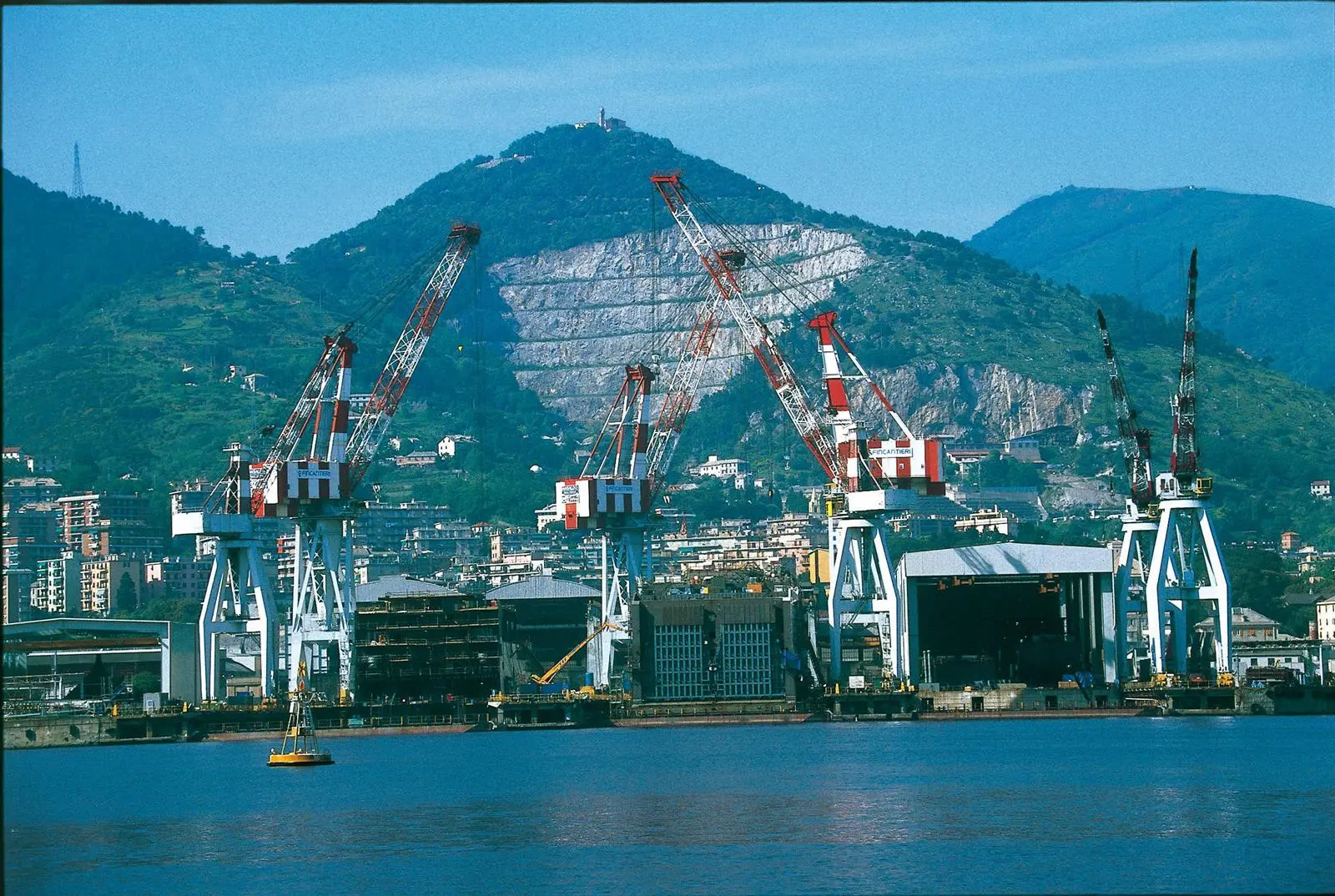
Underpinning this resilience are pragmatic, unified business strategies and supportive national policy, coupled with an unerring commitment to technological progress and retention of artisan skills.
A prime mover in the Italian export economy, and the largest European shipbuilder, Fincantieri’s global organisation spans a network of eight yards in Italy and 10 abroad, although care has been taken to maintain know-how and management centres in the homelands. The group has consolidated its primary role as a shipbuilder while leveraging core strengths to foster business diversification both within and outside the marine sector.
Unbowed by its failure to secure a majority stake in premier French shipbuilder Chantiers de l’Atlantique, due to a ruling by the European anti-cartel authorities, Fincantieri continues to pursue opportunities to extend its international influence, through both acquisitions and collaborative agreements.
By the end of March 2022, the group commanded a backlog of commercial and naval work representing a total value of EUR24.8bn ($25bn), plus a “soft backlog” of provisional contracts and options amounting to EUR9.6bn ($9.7bn). Such is Fincantieri’s status in the luxury passengership sector that the tally of confirmed contracts included 28 cruise vessels.
The combined figure of EUR34.4bn ($34.7bn) for orders in hand plus prospective business was equivalent to just over five times the 2021 revenues. Production volume ramped-up steeply last year. The order intake during the opening quarter of 2022 laid down another EUR500m ($505m)-worth of newbuild commitments, subsequently augmented by several large-scale contracts, including a milestone deal entailing fuel cell-equipped cruise ships. At the time of writing, other business in the offing featured a new stage of fleet investment by one of the US-based cruise entities, an existing client.
The cruiseship programme runs into 2027 and predominantly involves the group’s Italian yards, while certain tonnage in the expedition-type category is the province of Norwegian subsidiary VARD. Seven cruise vessel newbuilds are scheduled to be handed over during 2022.
The economic multiplier effect of high added-value construction, outfitting and engineering is all the greater in an Italian context for the spread of work throughout the country, since yards and suppliers are distributed around the country, on Ligurian, Tyrrhenian, Adriatic and Sicilian shores. Just as the production of capital-intensive and technologically sophisticated commercial and naval tonnage imposes considerable demands on project management capabilities, similar oversight and logistic skills are required for the efficient control of multiple, separate production points.
The geographic dispersal of assets and its combined effect on cruiseship production volume and value is amply illustrated in current activities, as with the launch on March 1 of Norwegian Cruise Line-(NCL)’s 67,000gt Vista from Genoa’s Sestri-Ponente yard, the June float-out at Ancona of the 10th in the 47,800gt Viking Star class, and the recent start to steel-cutting at Monfalcone on the first of a pair of LNG-fuelled newbuilds to the account of a joint venture of TUI and Royal Caribbean Cruises.
Following on from a feasibility study into the design and construction of a hydrogen-fuelled cruise ship, undertaken in concert with Geneva-based MSC Group and Italian energy company SNAM, a provisional order was announced in July this year for newbuilds incorporating the technology. The memorandum of understanding embraces fifth and sixth vessels from Fincantieri for the MSC Group’s Explora Journeys brand.
The prospective additions to the orderbook, dubbed as Explora V and VI, are required for service entry in 2027 and 2028, respectively, and will be specified with LNG-capable main engines and hydrogen fuel cell auxiliary plant. The envisaged 6MW fuel cell installations will produce emission-free power for the hotel load and sustain the shipboard net while in port. Moreover, a revision has been made to the preceding two-ship order, encompassing the 64,000gt Explorer III and IV, whereby each will be enlarged by 19m to enable the incorporation of a new-generation powering system based on LNG and hydrogen.
Corsica Linea’s impending newbuild arrival, the 206m A.Galeotta, testifies to the ongoing refinement of the Visentini ‘product’. Maintaining services all over Europe, the large population of ro-pax and ro-ro ferries built at the Porto Viro (Donada) premises of Cantiere Navale Visentini in northeast Italy, stem from the same efficient design concept.
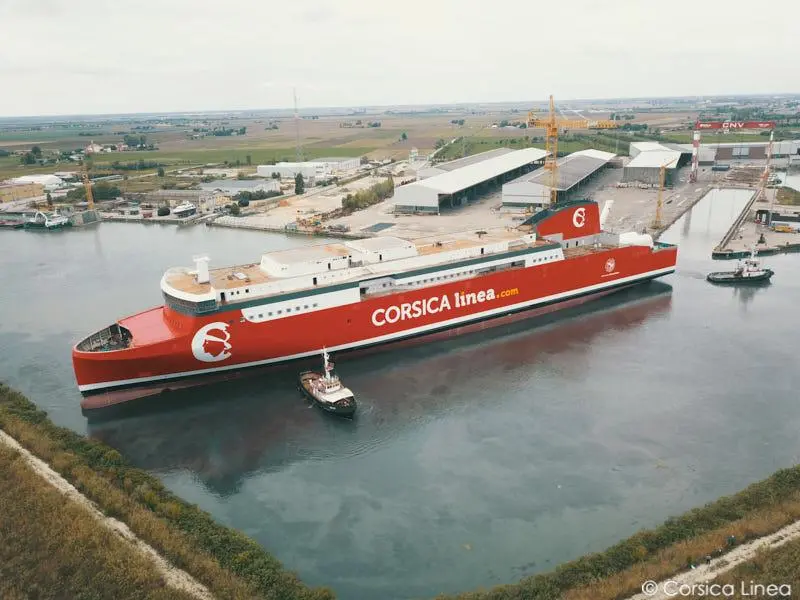
Developed by the Trieste consultancy NAOS Ship & Boat Design, the Visentini series has reached a new level of hydrodynamic performance and environmental standard with the vessel for the Ajaccio-based ferry company. She will be the first large ship in Corsican trade to be fuelled by LNG, with regular bunkering to take place in Marseilles. Furthermore, the powering and fuel systems allow for the use of lower- and zero-carbon LNG derivatives, such as bio-LNG and hydrogen-derived LNG.
A.Galeotta has been built to the maximum beam permissible in the Porto Viro construction dock, on the River Po, and combines capacity for some 900 passengers and crew with a ro-ro intake corresponding to 2,560 linear metres on the trailer decks plus dedicated space for 150 cars.
A characteristic of the Visentini type is the capability for fast transits in laden condition. The Corsican ship’s twin main engine installation directs a total 23,400kW along the two drivelines to controllable pitch propellers, for a specified speed of 23 knots. Two 2,000kW shaft generators will cover the electrical load while under way, including manoeuvring power demand from two bow thrusters.
The NAOS/Visentini breed first appeared in 1995, and the process of enhancement over the years included the adoption of the proprietary FlexBow in 2004. A.Galeotta hosts an improved version, the FlexBow 2.0 design. The yard is no stranger to LNG powering, having completed two 186m ro-pax ferries with Wartsila 46 dual-fuel propulsion machinery for Spanish operator Balearia in 2019.
Shipbuilding remains a cornerstone of the Genoese maritime and industrial economy, vested not only in Fincantieri’s Sestri-Ponente yard, but also in the T.Mariotti and San Giorgio del Porto establishments. The latter two enterprises are founders of the Genova Industrie Navale (GIN) Holding Group, which also includes local fabrication and outfitting specialists Gerolamo Scorza and Ortec Santamaria, rendering a comprehensive in-house capability for newbuild and conversion projects involving passenger ships and other vessels.
A combination of GIN resources, including the CIMAR yard at San Giorgio di Nogaro, south of Udine, was brought to bear in the construction of the 147m rail ferry Iginia, delivered earlier this year for service across the Strait of Messina. After float-out of the hull from CIMAR’s premises on the Corno River, the hull was brought around the Italian coast to Genoa for installation of top superstructure, machinery and rail equipment and outfitting by the T.Mariotti/San Giorgio del Porto partners.
The new ship can transport 27 rail wagons on four tracks, plus approximately 900 people, and has been assigned to the route linking the Sicilian port of Messina with Villa San Giovanni on the Italian mainland. The vessel employs three rudder propellers of the Schottel azimuthing thruster type, plus twin bow thrusters, and the propulsive power system is based on Wartsila 26-series medium-speed diesels, supplemented by two battery packs recharged by solar panels and potentially from the grid when alongside.
Operator Rete Ferroviaria Italiana ( RFI) subsequently awarded a similar, but slightly larger railship newbuild to Hijos J.Barreras, in northwest Spain. However, it is understood that the contract has not taken effect or has been rescinded, and industry sources attribute this to recurring financial problems at the Vigo yard. RFI is still seeking a further newbuild and the launching of a new public tender will create a fresh opportunity for Italian shipbuilders. The template for the Iginia had been the 2013-commissioned Messina, the last commercial vessel from the former Nuovi Cantieri Apuania at Marina di Carrara.
In the meantime, the first of two ultra-luxury expedition-type cruise ships ordered from GIN Holding by Seabourn Cruises has been delivered by T.Mariotti. Designed to Polar Class PC6 standard and intended for deployment in diverse environments, the Seabourn Venture features 132 all-veranda, sea-facing suites. Towards the end of April, the hull of the second ship, Seabourn Pursuit, arrived in Genoa from the fabrication site in San Giorgio di Nogaro, repeating the production process adopted for Seabourn Pursuit and the RFI rail ferry. Service debut is planned for 2023.
Over the years, the expansion of the GIN Group has included acquisition of French repair specialist Chantier Naval de Marseille (CNM) and the purchase, in conjunction with maritime services company Fratelli Neri, of the Piombino Industrie Marittime yard in Livorno.
Related Articles
 METHANOL
 GENERAL NEWS
 HYDROGEN