



Energy efficiency drive benefits noise reduction
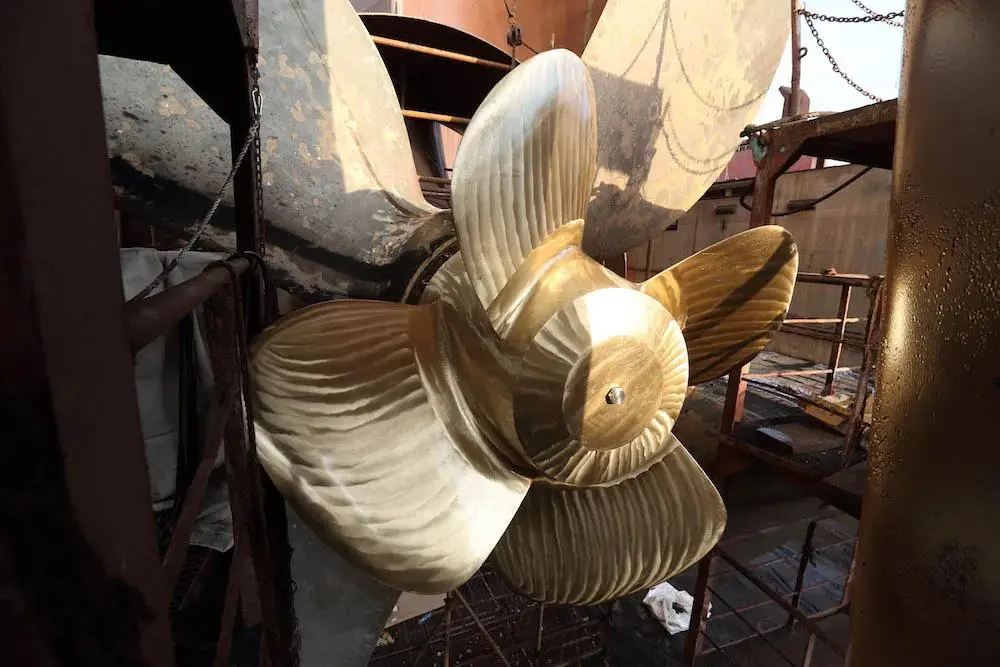
While the complex technical issue has commanded greater attention over the years in acknowledgement of the influence of these elements on structural integrity, equipment malfunction, passenger comfort and crew habitability, the effect of underwater radiated sound on sea life has increasingly come under the spotlight from outside the industry.
The average level of noise in the most heavily trafficked seas has increased by nearly 20dB since the start of the 1970s, signifying 100 times more sound power and 10 times wider range. This considerable upturn in noise impact reflects the growth in the size of the global fleet, as regards both number and tonnage of ships, more than any other factor.
Commercial shipping is seen as one of the main contributors of underwater radiated noise that can harm a wide range of aquatic species. Particularly vulnerable are marine mammals which rely on sound to communicate, and for whom noise is an environmental stressor.
What is now becoming increasingly clear, moreover, is that the focus by the maritime community on emissions reduction and energy efficiency is also contributing to moves to ensure a healthier acoustic environment, thereby yielding a dual benefit as regards emissions and marine life. Most interventions aimed at improving a ship’s fuel efficiency contribute to reducing underwater noise output.
Shipowner participation in collaborative research aimed at protecting underwater ecosystems was exemplified by Grimaldi Euromed’s contribution to the EU-funded Life-PIAQUO project.
One of the Italian operator’s multipurpose ro-ro cargo vessels acted as a platform for the demonstration and testing of solutions proposed by the research consortium to tackle underwater noise pollution. These focused on optimised propeller design, to limit cavitation, and on an onboard decision support system, to allow the master to adapt ship speed in vulnerable areas, using emitted sound radiation and cavitation detection data.
The PIAQUO endeavour was instigated against the backcloth of the push by international animal welfare and environmental protection associations for action to address underwater noise pollution. The partners were able to draw on an earlier EU-sponsored study, the AQUO project, whose main legacy was the identification of efficient technological solutions to reduce cavitation-induced noise, and the development of passive acoustic measures, plus tools to produce real-time and statistical maps of shipping noise.
Noise radiated into the sea from a vessel is made up of three components, the most predominant being the cavitation generated by propellers, far outweighing noise attributable to machinery and hull hydrodynamics.
Cavitation occurs when water vapour bubbles form and collapse explosively on the propeller blade surface due to pressure changes, releasing energy in the form of sound. The constant ‘hum’ of cavitation adds to the ambient noise in the sea. The now widely acknowledged environmental consequences have added another layer of concern over a phenomenon which can, over time, cause severe damage to propellers, rudders and hulls.
Where a ship design involves significant power in relation to a particular hull form or draught restriction, cavitation testing of the propeller in an accurately scaled wake field plus measurement of propeller-induced hull surface pressures, provide a basis for stabilising cavitation and minimising excitation.
Canadian whale protection
A recent Canadian-funded project, dubbed HyPNoS(hydrodynamic propeller noise monitoring system) investigated URN from ship propulsion systems. Project sponsor Transport Canada, together with research partners BC Ferries and Schottel carried out studies at the latter’s facilities in Germany and aboard one of BC Ferries’ Coastal-class, double-ended ro-pax vessels in the waters off Vancouver, where protection of whale species has become a prominent public issue. Seagoing tests were preceded by the retrofit of the ferry with a new, specially developed Schottel propeller.
HyPNoS outcomes included a prototype, on-board URN monitoring system, based on machine-learning technology. This provides live feedback to the crew and shipowner as to the underwater noise emissions of a vessel in service, allowing operational measures to be used to influence the emitted noise.
Schottel engineers developed an algorithm for calculating and predicting URN, which can take into account factors such as propeller speed and pitch, and ship speed. The propeller used for the tests showed an average URN reduction of 5dB, despite a slightly smaller diameter than the unit replaced, demonstrating the effectiveness of retrofitting more modern, optimised designs.
On Canada’s eastern seaboard, an E-Flexer type ro-pax ferry introduced last year by Marine Atlantic featured the first DNV Silent(E) class notation by virtue of the noise attenuation realised by an optimised propeller design. Fulfilling criteria for the accreditation at 11- and 18-knot speeds, the Ala’suinu is equipped with twin Wartsila controllable pitch propellers which enable underwater noise to be minimised, for the benefit of marine life in littoral waters.
Initiatives by the industry to tackle URN include the development by London-based Oscar Propulsion of propeller technology wherein pressure-relieving holes are located in the tip region of the blades, mitigating tip vortex cavitation and resulting noise.
In July 2023, MEPC endorsed IMO revised, non-mandatory guidelines on URN reduction, encompassing a ship’s design, construction, modifications and operation. The organisation has urged owners and designers to incorporate planning for URN management at the earliest stage of a newbuild scheme, and where practical for existing ships. The updated guidelines have been developed both to foster increased industry uptake and to monitor the effectiveness of measures used.
In the latter regard, IMO has approved an experience building phase(EBP), starting already in 2023 and due to run until 2026, to collect information on best practices and lessons learned from the application of the guidelines. Depending on outcomes, the review period may be extended to 2028. IMO has indicated that it will not revise the guidelines further until the EBP has been completed.
To accompany the EBP, BIMCO and other industry associations have said they will track and log the number of vessels that have adopted the updated guidelines and/or applied any ‘quiet ship’ class notations to their certificates.
Guidance provided
The guidelines contain an overview of approaches for designers, shipbuilders and operators to integrate new technologies. These also focused on the relationship between energy efficiency compliance measures and URN. Many of the improvement options to meet energy regulations(EEDI, EEXI and CII) can also result in a better URN performance.
Furthermore, national and regional measures provide focused protection for especially sensitive coastal areas, such as through mandatory or voluntary slow-down zones
Acknowledging the growing concerns around underwater noise, the International Chamber of Shipping(ICS), in collaboration with BIMCO, has taken a proactive step by releasing an Underwater Radiated Noise Guide. The publication(available from www.ics-shipping.org) provides shipping companies with a comprehensive toolkit to address and mitigate noise pollution across their fleets. It outlines practical design and operational measures, and assists with the preparation of effective noise management plans.
The ICS had previously commissioned a study from the University of Southampton, which had shed light on the connection between energy efficiency strategies and URN. For example, research indicated that reducing vessel speed by 20% could result in a 6% decrease in URN for ships with a fixed pitch propeller, while wind-assisted propulsion systems promise reductions of up to 10dB. Moreover, the use of hull air lubrication systems can achieve even greater reductions, upwards of 10dB.
Given the new regime of CII requirements coupled with the ongoing and prospective scale of reinvestment spurred by the age profile of the global fleet, the trajectory as regards adoption of more energy efficient systems and technologies looks set to continue to benefit URN levels.
The study suggested that accomplishing a 3dB reduction in shipping’s contribution to ambient noise by 2030 is an attainable goal, and that the ambitious target of a 10dB lowering in URN over the next 30 years is within the industry’s reach.
Related Articles
 METHANOL
 MONITORING, CONTROL & DIGITALISATION
 MONITORING, CONTROL & DIGITALISATION