



Engine companies consolidate to meet recession
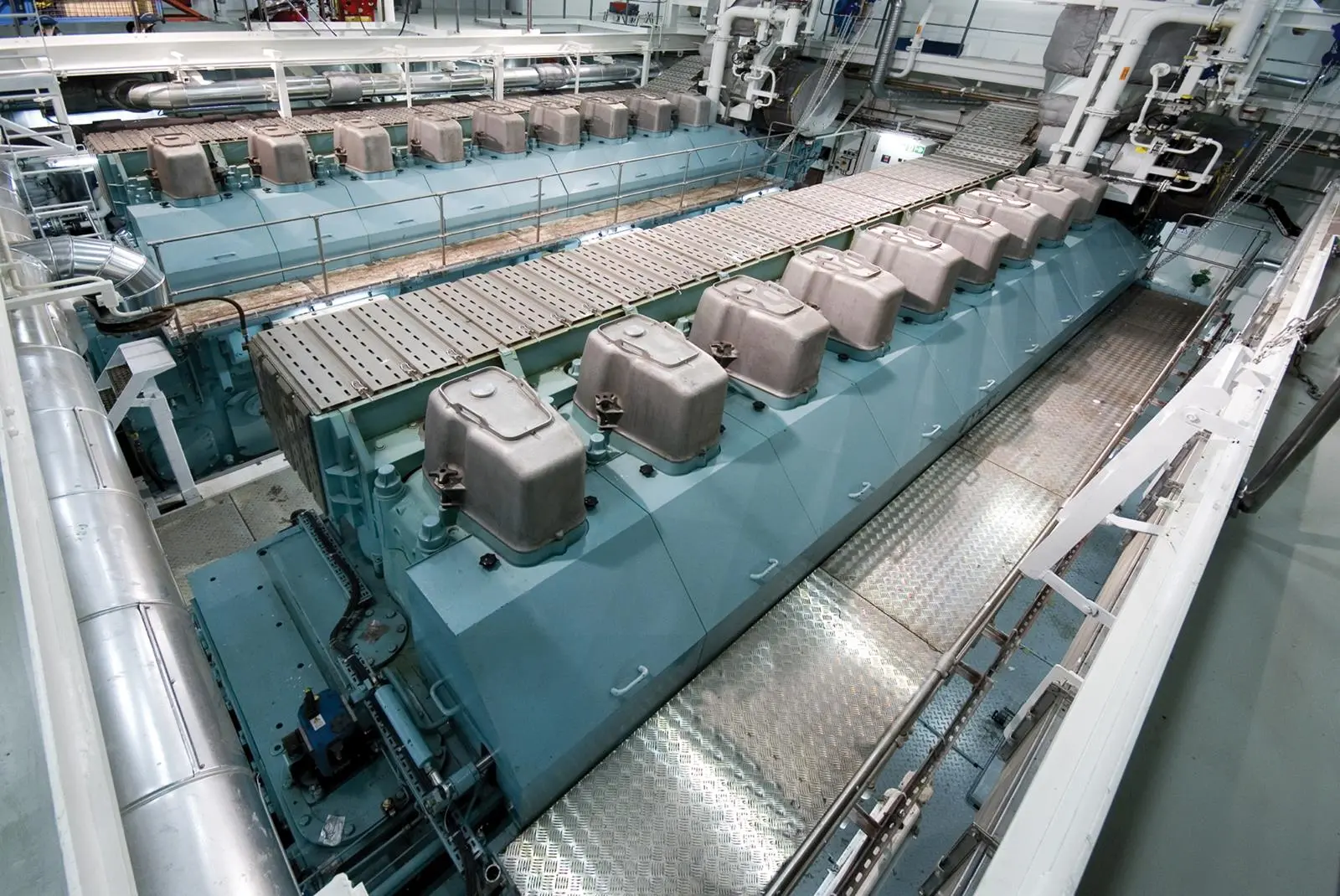
The two biggest names in the business – Wärtsilä and MAN – have both seen a dearth of new orders from shipyards, following what could almost be described as an excess of business – excess, because supply of vital components and spares was proving unable to keep pace with demand. Instead, the majors concentrated on consolidating their business to weather the storm, and proved thankful that there was still business to be won in the power generation sector. Though, unlike previous dips in marine business, this one coincided with a lower demand for power generation plant.
Despite the dearth of new orders, yards are still building new ships to meet their existing backlogs, and new ships need new engines. The large marine engine business could be said to be fortunate in that the effects of the recession will be shared between the licensees and the designers, reducing its impact on the large companies to some extent, and that the demand for parts and service should be maintained.
Shedding jobs
Wärtsilä responded in May 2009 by announcing an adjustment to its ship power business, with plans for shedding some 400-450 jobs across the board, in response to a drop of 86% in new orders. The company expected cancellations and rescheduling of existing orders to further add to the over-capacity, a prediction that was fulfilled.
MAN’s response was somewhat more measured; concentrating on restructuring rather than wholesale losses of personnel. The most significant aspect as far as our industry sector is concerned was the merger of MAN Diesel and MAN Turbo, although this was driven more by the power plant industry than ship power. The new merged company is said to sit alongside the restructured and enlarged commercial vehicle business, with the marine and power plant business counterbalancing the vehicle activities.
The company says that combining the large diesel engine business with the steam and gas turbine and compressor business will allow it to offer solutions such as turnkey combined cycle power plants to its customers. In the maritime sector, the merger should raise the company’s profile in important fields such as waste heat recovery.
Cuts still had to be made, however, and one of the most significant these was the announcement that engine production would cease at Frederikshavn in Denmark, resulting in the loss of about 500 jobs, around half of the workforce there.
Slowing down
Both companies responded to the industry demand for slow steaming with kits that effectively cut out one or more turbochargers, thus re-aligning the engine profile to maintain a reasonable level of efficiency at lower power while allowing the engine to be returned to normal operation. MAN believes that the optimum solution to the slow steaming question is a variable turbocharger, and it is in a comparatively fortunate position of designing and manufacturing its own turbochargers, with a variable geometry unit (VTA – variable turbine area) under successful development. The successful conclusion of sea trials of the first VTA installation coincided with both the 75th anniversary of MAN’s first exhaust gas turbocharger (and Rudolf Diesel’s 150th birthday) and the emergence of interest in engines which run efficiently at part load enabling operators to save costs.
MAN upgraded its V28/33D engine, to include a number of enhancements – including a dedicated gen-set version – to the original Ruston RK270/280 design, most notably a new turbocharger specifically for this engine (previous versions used a competitor’s turbocharger).
Caterpillar Marine Power has also experimented with new turbocharger technology and in 2009 announced the success of the variable radial turbines fitted to several tugs using MaK engines. The system uses a two-part nozzle ring in the KBB turbocharger with either full load or part load rings. Depending on the engine load, either one or the other ring is automatically activated. The technology has since been applied to tugs with Caterpillar 3500 series engines.
Flat market
Generally, the medium speed market was flat in 2009. Licensees were still turning out engines to met the current order backlog – one notable landmark being the first MAN licence-built 9L32/40 from ZGPT’s new Hangzhou plant in China – but with few new orders coming in from the marine sector the future looked bleak.
However, medium speed engines form the basis of most of the dual fuel and gas engines, and the engine designers had been turning their attention to this sector. MAN, for example, launched a multi-fuel 51/60DF engine, with a ‘fuel sharing’ capability allowing it to run on various mixtures of fuel, with either HFO or distillate backing up the normal gas fuel in case of shortfall of boil-off gas, for example, thus opening up new applications in the gas carrier ship power market.
MaK seemed to fare rather better, with a large backlog of orders for cruise ship engines, many driving diesel-electric plant. Unfortunately the order flow for these ships slowed to a mere trickle during 2009, so prospects for the immediate future seem less favourable.
The recession was taking its time to reach the Korean engine companies, which build under licence to MAN and Wärtsilä designs, mainly in the low speed sector. Around the middle of the year Hyundai Heavy Industries, which has claimed two-stroke market leadership since 1988, reached 90 million bhp in its 30-year existence. This was matched at about the same time by Doosan Engine, which claimed 60 million bhp in 25 years. Doosan, though, says that its average output of 35,000 bhp per engine is over 25% larger than its competitors.
The major designers see service and parts becoming more significant in the short to medium term, and both MAN and Wärtsilä invested in new service centres. Both see considerable potential in proving and installing slow steaming kits, and bringing older engines within IMO Tier 1 emissions limits, as will be required under forthcoming legislation. Wärtsilä says that its existing low speed engines can be brought up to standard by engine adjustments and upgrading the fuel system, which may require new camshafts and injectors.
Engines for newbuildings are moving into a more efficient arena. Most owners are opting for either full or partial electronic control, while in the markets where traditional mechanical fuel system are still favoured, new, improved, designs are on offer. Typical of these are the small low speed engines from MAN aimed at the Chinese market, which the company hopes will supplant the old-technology, less efficient, more polluting home-grown designs.
Fuel quality
Lower sulphur fuels and ever-deteriorating fuel quality is another area which the engine designers feel is likely to impact on engine service in the near future, and the effects of these could well be exacerbated by financial pressures on ship operators. The engine companies say that high fuel costs and low freight rates must not result in lower maintenance levels or the use of inferior parts and lubricants. On the other hand, a proper planned maintenance programme backed by careful testing and monitoring can be used to extend service intervals and to reduce oil feed rates, providing a sensible way to save costs.
MAN Diesel reported that 2009 was a good year for its Alpha Lubricator system, with a simplified version for smaller-bore engines added to the range. The milestone of 1000 retrofits was achieved during the year for the system which is clamed to offer 20% to 30% savings in lubrication costs, without compromising engine reliablity.
The engine designers still have plenty to occupy themselves, though, with the forthcoming stricter emissions limits and constant demands from owners for cost savings through lower fuel and lubricant consumption and longer service intervals. But for real savings, owners need to look at the whole ship, rather than just the engine. Wärtsilä and MAN say that they can provide complete optimised propulsion systems rather than just the prime movers, while Wartsila goes a stage further having branched out into ship design, and area of activity which it hopes will grow in the future as owners and shipyards look for more efficient vessels, with more integration between components. With moves on the horizon to bring down shipping’s carbon footprint, most likely through effectively penalising inefficient ships through a fuel levy or a carbon trading/taxation system, efficient ship design seems likely to move from being a desire to a necessity.
Workboats and tugs
In the high speed market MTU, which marked its centenary in 2009, introduced a version of the 4000 engine optimised for workboat use, with the first engine destined for a German state subsidy scheme aimed at re-powering Rhine river craft for higher efficiency and lower emissions.
Caterpillar announced the start of development of its next generation high speed units; the C145 series will be a completely new range of v-format engines between 700bhp and 2,700 bhp.
Cummins continued to provide propulsion and auxiliary ship power, particularly in the towage and offshore support markets, where its larger low emission high speed units provide an alternative to the traditional smaller medium speed units in these markets.
Although, with the focus on fuel saving rather than ultimate power-to-weight ratios, it was not surprising that gas turbine power was not the most favoured option in 2009, GE Marine still found cause for celebration. Its LM2500 racked up 40 years with the US Navy. The first installation was in a naval cargo ship, commissioned in 1969 and still in service with the reserve fleet. Since then, some 175 ships in the US Navy fleet have benefited from LM2500 power, and the engine has continued in production, with some significant improvements, and current versions are still being specified for projects like the Independence class LCS-2 and the X-craft.
The future is green
Lower emissions from ship power remain a major target for engine and component manufacturers, as well as ship owners. With this in mind, MAN Diesel, Aalborg Industries and the A.P. Moeller group joined forces in 2008 in the ‘Green Ship of the Future, project, the first fruits of which were unveiled in 2009. The founders have been joined by 12 more partners in the project, which aims to cut SOx and NOx emissions by as much as 90% with a 35% decrease in carbon emissions. It is looking, among other technologies, at exhaust gas recirculation (EGR), waste heat recovery, and exhaust gas scrubbers. An EGR system was installed on a test engine at MAN, with a full-scale sea trial on a Maersk ship due to get under way by the end of 2009.
Alternative propulsion concepts were another important focus area in 2009, mainly for military and paramilitary vessels, but all designed with an eye towards commercial applications. In the USA, Northrop Grumman Corporation successfully tested a 36.5MW high temperature superconductor electric motor developed for the US Navy’s future submarines and surface ships. The major advantages of these motors are found in the compact dimensions and high efficiencies, benefits which the Navy believes can be transferred to ships like cruise vessels and gas carriers.
Related Articles
 PROPULSION
 GENERAL NEWS
 GENERAL NEWS