



Engine designers confront new challenges at CIMAC Congress
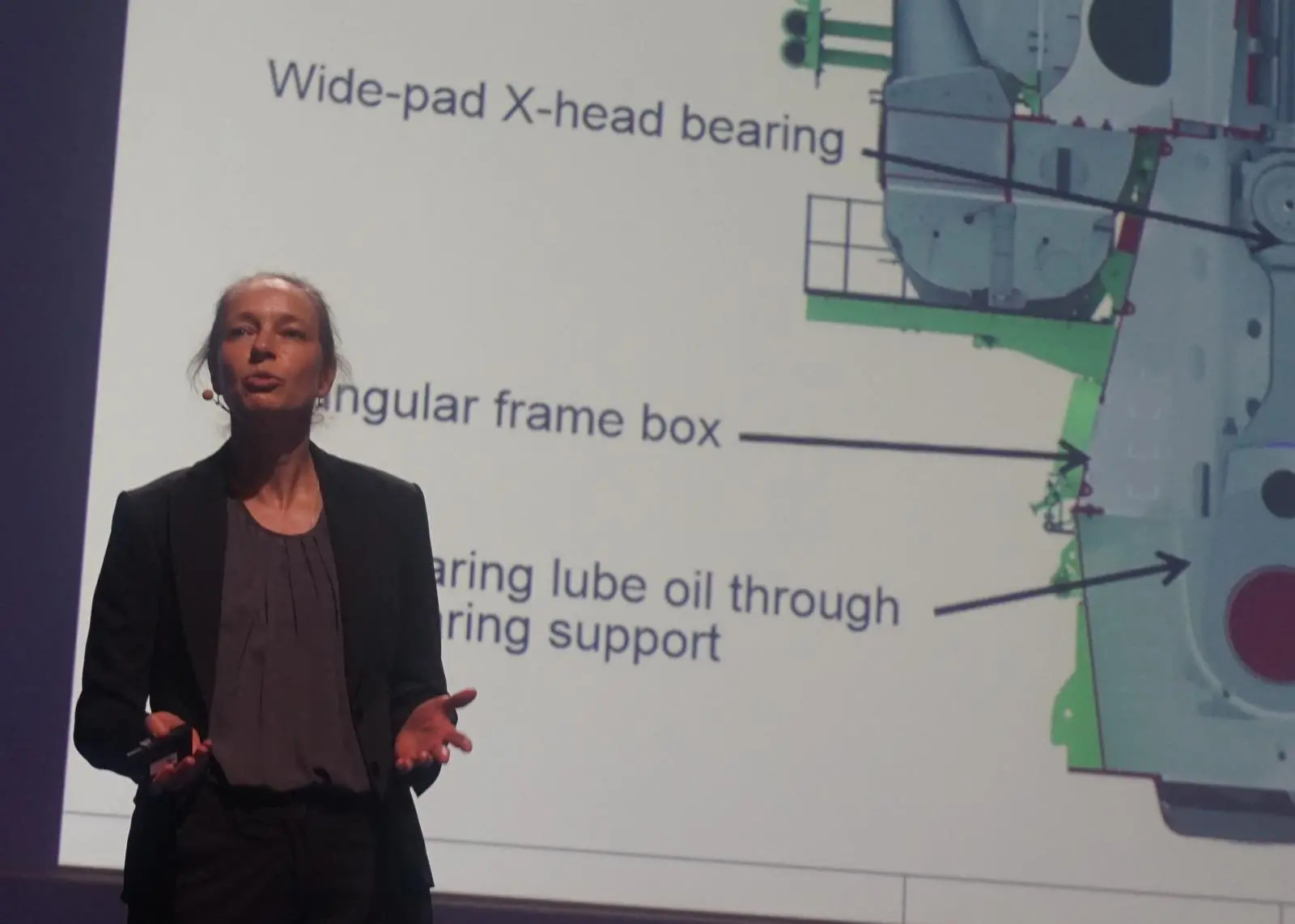
Cylinder wear
Modern operating practices and engine designs are presenting new challenges to engine condition. Slow steaming, ultra-long stroke engines and modern engine tunings can increase the risk of cold corrosion and, as we learnt today from Märkisches Werk, variable valve timings also have a potentially underestimated impact on valve wear. Lean-burn gas engines and potentially duel-fuel engines may be particularly susceptible to valve damage.
Winterthur Gas & Diesel is developing several cylinder condition solutions and has formulated an index measuring differences in oil film distribution around the circumference of cylinders. It can be used to compare lube distribution against other cylinders and thus indicate potential problem areas.
Also on oil distribution, Hans Jensen Lubricants presented the results of a test of its Lubtronic Swirl Injection Principle (SIP) injector on a modern MAN Diesel & Turbo engine. Interestingly, the system was able to maintain engine condition using a much lower feed rate than that recommended by MAN until the engine design’s lower limit was factored into the control system algorithms.
Piston ring coatings also have a role to play in preventing engine damage and a new coating formulation was presented by Riken Corp, based on a complex structure of chromium carbide at the right particle size and ratio, with high-energy thermal application.
Two-stroke engines
The weight and size implications of emissions abatement technologies are encouraging two-stroke engine designers to work harder than ever on reducing the footprint of their units and allowing for easy, compact integration of SOx and NOx reducing systems. For example, MAN Diesel & Turbo has used a new iterative development concept to reduce the bedplate weight on its latest S90 engine by 700kg. A new rod design has reduced crank pin bearing width by around 15%, increasing the stiffness of the crankshaft and reducing cylinder distance by 100mm, thus reducing the overall size of the engine. The concept will be employed as MAN develops its latest generation of other engine designs.
Similarly, Mitsubishi Heavy Industries has increased piston stroke length by 12% on its new UEC50 LSH ECO electronically controlled engine, first deployed into service in September last year, while keeping the engine compact and light. Stiff and light materials have been used for the engine jacket, wall structures and bedplate, while the combustion chamber features a new heat resistant material and a bore cooling piston, reducing thermal load in the engine.
Alongside increasing power density, there are plenty challenges ahead for two-stroke engine designers. Among them – as illustrated in a paper by WinGD – are the impact of higher firing pressures and modern technologies including multifuel operation, control systems, condition-based maintenance and big data acquisition.
Four-stroke gas engines
Several interesting trends were evident in papers presented by designers of four-stroke gas and dual-fuel engines. Chief among them were efforts to monitor and counter the knocking effect caused when engines burning a rich mix of LNG and air are subjected to rapid acceleration or sudden high engine loads.
MTU’s high-speed 4000 series (with a power of around 2MW) is the manufacturer’s first engine design to feature in-cylinder pressure sensors, which allow for knocking to be detected as well as allowing for greater control of combustion and ignition. The added expense of sensors is offset by a reduction in other equipment needed, including knock detection systems.
Daihatsu’s DE28DF dual-fuel engine, sized 280x390mm and offering around 2.3MW at 720rpm, also uses pressure sensors to detect knocking, as well as variable valve timing in order to improve NOx emissions and increase power output. Yanmar’s EY26DF dual-fuel engine features fuel/air mixture controls and a load prediction algorithm in order to avoid knocking and misfiring.
All three manufacturers report that dynamic response in gas mode, if kept free of knocking by the above measures, is similar to that of diesel engines.
Engine consultant AVL List also proposed a unified development concept that would allow four-stroke engines (gas or otherwise) to be developed in a unified manner, taking into account all their diverse applications, operational profiles and regulations governing different markets. Rather than building a lead engine optimised for one application and then adapting it to others, a joint approach could significantly reduce development costs and improve standardisation, it was suggested.
Day three schedule
The Motorship is reporting live from CIMAC Congress. On Wednesday 8 June, the following agenda items will be covered. Visit our live blog at the appropriate time to view minute-by-minute highlights (all times are Eastern European, BST +2)
0900-10.30 Two-stroke engine tribology field experience
‘Cold Corrosion on MAN B&W Tier II Engines and solutions in spirit of mutual cooperation between COSTAMARE and MAN Diesel & Turbo’, Henrik Rolsted, MAN Diesel & Turbo
‘In-service monitoring of 2-stroke low speed engines with automatic on-line cylinder lubricant analyzer – A key added value for users in 2-stroke engine management’, Jean-Philippe Roman, Total Lubmarine
‘Safe and Cost-effective Operation of Slow Speed 2-Stroke Diesel Engines with Scrape Down Oil Analysis (SDA)’ – Steffan Bots, OELCHECK
‘Handling cost accuracy and the analysis methods of Drain Oil Onboard Test
Jörg Erdtmann, NSB Niederelbe Schiffahrtsgesellschaft
1100-1200 Keynote speech: Future engine design
Harry Robertson, technical director, Stena Rederi
1200-1330 Exhibitor interviews
1330-1500 New two-stroke designs, test results and user input
‘Performance and Emission results from the MAN B&W LGI low-speed engine operating on Methanol’, Stefan Mayer, MAN Diesel & Turbo
‘The 2-stroke Low-Pressure Dual-Fuel Technology: From Concept to Reality’, Marcel Ott, Winterthur Gas & Diesel
‘Service Experience With the First MAN B&W Diesel ME-GI Engines Onboard LNG Vessels’, Lars Ryberg Juliussen, MAN Diesel & Turbo
‘The New ACD Medium Speed Gas & Dual Fuel Marine Propulsion Engine’, Gareth Estebanez, AVL List
1530-1700 Engine users’ reception
Related Articles
 PROPULSION
 GENERAL NEWS
 GENERAL NEWS