



EU pledges support package for wind power
The heavily-trailed announcement by the EU Commission president Ursula von der Leyen on 24 October contains a series of actions to strengthen the sector, amid concerns that rising raw materials costs in a higher interest rate environment were slowing the pace of new developments. The EU has identified the wind sector as a key component of ambitious plans to generate 42.5% of the bloc’s energy needs from renewable energy sources by 2030.
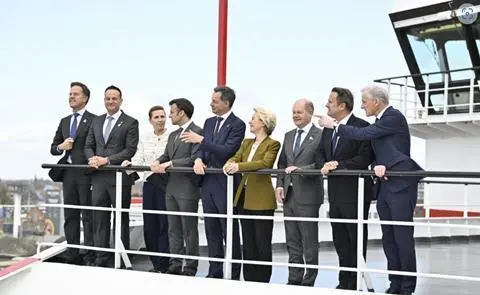
The announcement reconfirmed ambitions for the North Sea announced in April 2023, when seven members of the EU along with Norway and the UK announced plans at the Belgian port of Ostend to increase offshore wind capacity in the North Sea to ‘at least’ 120GW by 2030.
The announcement was intended to address obstacles to accelerating wind installations, identifying bottlenecks in permitting and developing wind developments after approval.
Measures in the plan include:
- Rolling out digitalisation of the permitting process across all member states and extension of an emergency regulation to accelerate permitting
- Establishing an interactive EU digital platform where member states’ planning for auctions will be published
- Overhauling auctions design to include a set of pre-qualification criteria relating to cyber-security, sustainability, and ability to deliver
- Identifying cybersecurity risks with respect to wind energy installations and infrastructure
- Expanding support for wind energy under the Innovation Fund by doubling the budget for financing clean technology manufacturing projects to €1.4 billion
- Working with the European Investment Bank to deploy by the end of the year a dedicated instrument to counter-guarantee commercial banks’ credit exposures to key wind industry suppliers
Offshore wind
From a maritime perspective, the announcement of significant financial support for EU wind manufacturers was accompanied by a less reported report focused on the offshore wind sector, Delivering on the EU offshore renewable energy ambitions, released on the same day. The report provides significant detail about plans to incentivise collaboration between littoral states to encourage cross-border offshore wind developments, along with a detailed approach to incentivising the development of electricity transmission network capacities for ports, and more widely.
The report identified the port sector as a critical sector for the expansion of offshore energy installations, owing to their role as bases for offshore installation and maintenance vessels, as well as fabrication and assembly hubs for components.
The Commission will address the role of ports and their challenges related to both their own environmental footprint and their ability to help decarbonise industrial activities and maritime transport. These challenges are addressed by a pilot project called Port Electricity Commercial Model to be finalised in the first half of 2024.
A study is being carried out within the NSEC framework to address the capacity of ports to support the fast roll-out of offshore wind by mapping, categorising and prioritising port infrastructure needs relating to offshore wind developments.
Interestingly, the report failed to provide any detail about measures to support the bloc’s shipbuilding sector.
Related Articles
 ALTERNATIVE FUELS & LUBRICANTS
 GENERAL NEWS
 GENERAL NEWS