



Exhaust gas scrubbers move into carbon capture
Alfa Laval, for example, says that its first PureSOx scrubber began operation in 2009. Wärtsilä offers three different scrubber families, to suit various shipboard applications. In addition, Wärtsilä’s lifecycle agreements can include scrubber equipment, such as a recent six-year agreement signed with Malaysia-based Nautica Ship Management, covering two vessels, and ensuring the equipment is maintained at maximum efficiency.
Leading up to the 2020 IMO deadline, scrubbers began to make commercial sense. The IMO rules allowed ships to continue burning high-sulphur HFO if the sulphur oxide gases in the exhaust could be removed so that the smoke stack emissions were reduced to the equivalent of burning 0.5% (or 0.1%) sulphur fuel. The alternative was to switch to lower sulphur fuels, such as distillates (MGO or MDO), which were not only more expensive, but had many other implications such as wear of fuel pumps and systems (the high viscosity and sulphur content associated with HFO offer inherent lubrication properties) and choice of cylinder lubricant (lower alkalinity, i.e. base number, is required for low-sulphur fuels). This latter point proved of particular concern if changing from high- to low-sulphur fuel in ECAs.
The disadvantages of exhaust gas scrubbers were that they were heavy and bulky, potentially taking up space that could be used for cargo or passengers, as well as costly. Whether the sums added up for fitting them to ships depended mainly on the price differential between HFO and low sulphur alternatives. The early adopters of scrubbers found themselves at a financial advantage, such was the cost difference. Although oil prices, and the residual/distillate differential, varies, the economic case was made, and ships continue to be fitted with scrubbers.
Scrubbers have not proved to be the ‘one type fits all’ solution that many of the manufacturers envisaged. Although effective at removing sulphur oxides and particulate matter from the exhaust, environmental attention has switched to carbon emissions – i.e. burning less fuel, or switching to an alternative, potentially lower-carbon, fuel such as LNG or bio-fuel.
Scrubbers in hot water
Another problem has been dealing with the wash water. Earlier scrubbers were of the open-loop type; the sulphur residues being discharged into the ocean. This may be acceptable in the open sea, but higher sulphur concentrations in some busy ports and coastal areas have given rise to concern. This has been partially addressed by development of closed-loop scrubbers, where residues are collected for safe disposal on shore, and hybrid scrubbers which can operate in either mode. As a result, many ports have imposed bans on the use of open-loop scrubbers, or a complete ban on scrubbers in port, so ships have had to switch to low-sulphur fuels anyway.
Among the latest countries to prohibit scrubber use is Denmark. From 1 July 2025, open-loop scrubbers are prohibited in Danish territorial waters, followed by a ban on all scrubbers from 1 July 2029. This is a controversial issue; although states are keen to show that they are taking positive steps to clean up their waters, the scrubber industry disputes the environmental risk.
According to Capt Michael Kaczmarek, chairman of the Clean Shipping Alliance: “The Danish members have seen this coming but now they have a timeline. The full news release has claims about risks to the environment but there does not appear to be any risk assessment. These are disappointing news from Denmark”.
The industry is gearing up for the future, looking at how carbon capture systems (CCS) can be integrated with exhaust gas scrubbers. The CCS being developed by Wärtsilä is based on solvent technology, used in land-based industries. This method uses either a liquid solvent (or solid sorbent) to absorb CO2 from the exhaust gas, and then uses pressure and/or temperature to release the CO2 from the solvent or sorbent. Onboard storage of the captured CO2 can be achieved in various ways.
Kashif Javaid, Wärtsilä sales director said: “Two of the main technical qualities we’re looking for in solvents are their lifetime and the heat demand associated with stripping the CO2. Different solvents require different temperatures, which also leads to cost implications. Our goal is to find a solvent that operates at a lower temperature so that the heat demand is lower.”
Although the Wärtsilä system is being developed separately from the standard scrubbers, the aim is to add carbon capture modules to the scrubbers in the future. With this in mind, the company say its has already received orders for carbon capture-ready scrubbers which are being installed on four newbuild container vessels.
According to Scott Oh, Wärtsilä director exhaust treatment Asia: “We are very excited to announce this world-first order for our CCS-Ready scrubber solution. By investing in a CCS-Ready scrubber, ship owners will future-proof their assets and enable a smooth transition to CCS adoption once the technology is mature in the very near future. CCS is one of the key solutions to enable maritime decarbonisation in a short timeframe, and we look forward to progressing our technology further.”
Previously, Norwegian shipowner Solvang signed a letter of intent with Wärtsilä to test CCS for shipboard installation. The companies are testing a CCS system in the Moss research centre, in a simulated ship environment before installing a full-scale CCS onboard Solvang’s ethylene carrier Clipper Eos. The resulting liquid CO2 will be transferred to deck tanks, ready to be processed for re-use in industry (e.g. to produce synthetic fuel), or long-term storage.
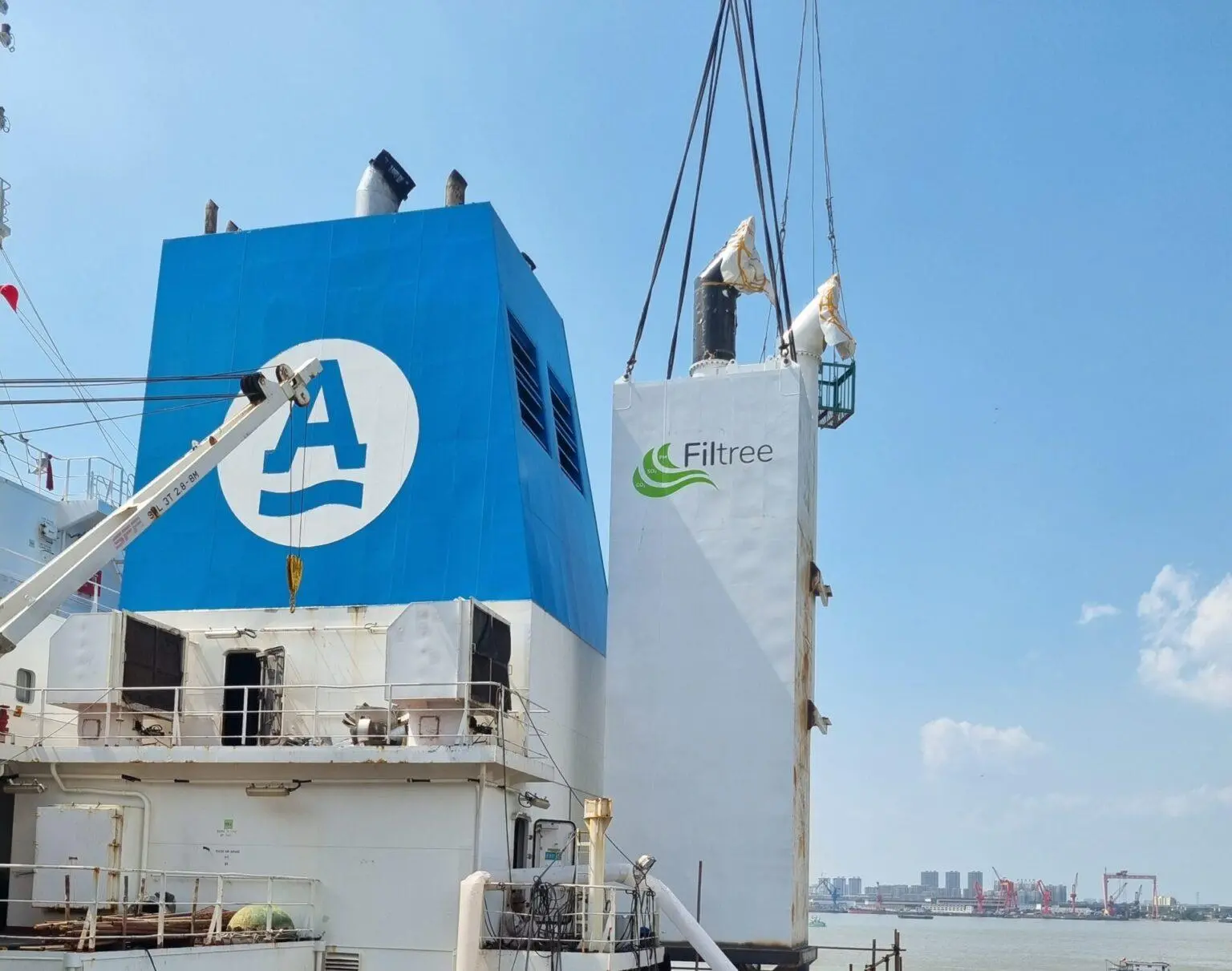
Another company active in marine CCS is Value Maritime (VM), in the Netherlands. The VM scrubber, known as ‘Filtree’(pictured), has been designed as a combined exhaust gas scrubber to remove sulphur and fine particulates, with the option for a patented CCS unit to be incorporated. Aimed initially at engines with output in the 3MW to 15MW range, though two systems can be combined for higher power applications, VM reports several successful installations for companies including Mitsui OSK Lines (MOL) and Ardmore Shipping.
The MOL installation is notable, not only as the first of what VM hopes will be many orders from Japan, but at 75,000 dwt, the vessel in question, LR1 product tanker Nexus Victoria, is the largest vessel to be equipped with the Filtree system.
VM commercial director Yvette van der Sommen said: “We have supplied a total of 54 emission systems for capturing sulphur oxides and soot. Of these, 24 are also equipped with a CCS module, for capturing and storing part of the CO2 emissions from the ship’s engines.”
Exhaust gas passes first through the closed-loop scrubber, where it is cleansed and cooled before flowing into the exhaust gas boiler of the CCS module. The gas comes into contact with a stream of descending amine droplets. Thanks to the low exhaust temperature, part of the CO2 from the exhaust gas binds to the amine particles. The CO2-saturated amine is stored in a tank, and discharged onshore where the CO2 and the tank recharged with fresh amine.
The Filtree system typically removes around 10% of the CO2 from the exhaust, but can be uprated to remove around 30%.
Co2 storage
Greek company Erma First has developed an amine solvent CCS system which has received approval in principle from LR and DNV, and which will be fitted to a Capital Gas newbuild 22,000m3 liquid CO2 carrier under construction at Hyndai Mipo. Babcock is supplying a system to liquefy the CO2 gas for storage.
Earlier this year, ClassNK granted an ‘SCCS-Full’ class notation to Ever Top, a Neo-Panamax container vessel owned by Evergreen. The vessel has been equipped with an onboard CCS system, designed and developed by Shanghai Marine Diesel Engine Research Institute. The installation was carried out by Huarun Dadong Dockyard. ClassNK reviewed the system components, installation plan and risk assessments in accordance with its Guidelines for Shipboard CO2 Capture and Storage Systems.
Finally, US company Stax Engineering offers a solution for removing sulphur from the exhausts of non-scrubber equipped vessels while in port, enabling compliance with local emissions regulations in areas such as California.
According to operations manager John Holmes: “What we do is capture and control. It’s one of the two options to comply with the at-berth regulations. One is cold ironing, which is plugging into the electrical grid, and the other is capture and control. Capture and control is an option that doesn’t require the ship to do anything. They don’t have to do any engineering modifications or retrofitting.”
The system uses an emission collection system mounted on a mobile barge, employing a vacuum system attached via a boom to the ship’s funnel. The system is powered by renewable diesel, for a lower environmental footprint, and removes virtually all particulate matter, NOx and SOx while capturing some CO2. The gases are processed through a patented catalytic converter treatment syst
Related Articles
 EMISSIONS REDUCTION TECHNOLOGY
 EMISSIONS REDUCTION TECHNOLOGY
 EMISSIONS REDUCTION TECHNOLOGY