



Ferries lead, tugs may follow
With recent oil field developments looking at baseline prices of anything up to $80 a barrel, it is not surprising that tug and ferry designers are looking at alternative powering options. For harbour tugs, the alternatives to diesel still represent a poor return on investment, so innovation is being pushed forward with harbour ferries and, with new land-based bunkering infrastructure established, a new generation of tugs may follow.
“It is a chain reaction and we have really not seen more than the beginning of this,” says Arnstein Eknes, segment director for special ships at Det Norske Veritas. Eknes believes that, within the next 10 years, many tugs and ferries will combine dual fuel or electric hybrid propulsion systems with batteries. “What if you run a ferry on battery during the day when the energy cost on land is high and then, when the energy cost is low during the night, you recharge the batteries? That is a very efficient mode of operation.”
Eknes’ vision for the future doesn’t stop there. “I can even envisage a setting where if you have a battery combined with an LNG turbine, a ferry becomes a kind of power plant and gives power back to the grid while it is at berth.” In Europe, wind power for land-based electricity consumption is a rapidly expanding industry. Additional clean and reliable power sources are required to provide base load when the wind is not blowing and contributions from such ferries could be an option, but the potential link between power infrastructure and fuels for harbour vessels is clear elsewhere as well. Indonesia, for example, a country with thousands of small islands where oil is burnt for power, is now looking seriously at local air pollution. For small island communities, a switch to LNG could provide a much cleaner energy source for the inter-island ferries they rely on for local trade and communication.
Australia too has great potential for the adoption of LNG as bunker fuel. Anticipated to be second only to Qatar in LNG exports by 2020, the port infrastructure being built to support new gas trains could also include LNG bunkering facilities. “It is a unique opportunity,” says Eknes. Currently, most of Australia’s land-based power generation involves the burning of coal so if harbour vessels were to recharge their batteries there it would reduce local SOx and NOx emissions but would not bring a dramatic overall environmental improvement when the entire carbon footprint of the solution was considered. LNG bunkering infrastructure could change that.
“We need more governments taking a position and saying that the industries that intend to compete in their waters need to demonstrate that they are using cleaner technology and moving towards the use of cleaner fuels. We need these kinds of visionary statements,” says Eknes.
The problem with implementing this vision for harbour tugs is that fuel consumption is comparatively low so the capital investment of say, switching to LNG propulsion, does not provide operational paybacks. Fuel consumption features more strongly for ferries so they could lead the way, says Mr Eknes. Once the new bunkering infrastructure is available and once governments and port authorities have set the goals, harbour tugs could follow.
Tug designers globally are under pressure to do more with less but Eknes’ vision for hybrid solutions is shared. Michiel Wijsmuller, managing director of Ijmuiden, Netherlands-based Offshore Ship Designers, says that as designers, they are having to cram more functionality into smaller hulls for both onshore and offshore tugs. The need to come up with designs that are simultaneously less polluting and cheaper to operate is also growing. “Standard designs should be less costly than thought-through designs for specific tasks but they are much more costly to build and operate as they rely on a larger hull and simple lines. A specific tailored design will deliver all the operational tasks required on a smaller, less capital intensive hull with lower fuel costs and emissions,” he says.
Meeting fuel costs and environmental pressures go hand in hand and are hard to achieve with older designs as effort needs to be put into hull form and machinery choices to suit each task. “All these factors push in one direction: towards smaller hulls which are cheaper to build with flexible hybrid power plants which are as efficient as possible in a variety of roles,” says Wijsmuller.
Engine manufacturers are supporting LNG with the development of new lean burn mono and dual fuel gas engines in a range of sizes. For example, Wärtsilä’s 20DF is a medium-speed dual fuel engine claimed to be ideal as a mechanical-drive prime mover for small vessels. It can run on LNG, MDO or HFO and can switch smoothly during operation without any interruption or reduction in speed or power output. It can be started or stopped in either gas or liquid-fuel mode.
Suitable vessel designs are being advanced. In 2011, Rolls-Royce signed a contract to supply engines and propulsion equipment for four gas-fuelled ferries for Norwegian operator Torghatten Nord. The vessels will be the first to feature the Rolls-Royce Hybrid Shaft Generator which produces electrical power with reduced fuel consumption and emissions.
Hybrid solutions with batteries offer the potential to move away from burning fossil fuels as bunker. Plans are underway in Norway to introduce battery-powered ferries on up to 100 local routes with vessels designed and built by Norwegian shipyard Fjellstrand. The use of hydro-electric power for energy generation on land in Norway means that the use of shoreside power to charge the batteries will reduce CO2 emissions as well as SOx and NOx.
Even without full battery power or burning LNG as fuel, battery hybrids result in lower emissions because the diesel engine can always be run at optimal load. French battery system manufacturer Saft is supplying advanced lithium-ion battery systems for two hybrid diesel-electric ferries that will operate a shuttle service across the Garonne River in Bordeaux, France. Keolis, France’s largest private sector transportation group, will launch the new hybrid ferry service in 2012 to help the Urban Community of Bordeaux meet its stringent environmental targets. Each ferry will be equipped with a 140kWh battery system that will supply power both for its electric propulsion motor and auxiliary loads such as lighting and communications. The battery will work in conjunction with the ferries’ diesel engine, storing power produced by the generator and providing additional propulsion power when required. The batteries will be charged overnight from the local grid and also when the diesel engine is running. They will provide the ferries with six hours of autonomous, fully-electric operation.
Battery technology is gaining interest in Asia and engineering consultancy BMT Nigel Gee in the UK is designing a 25m all electric, 150 passenger ferry for use in the estuaries and coastal waters of China. Batteries will provide power to the electric drive motors and solar cells will be incorporated into the roof structure to charge the batteries.
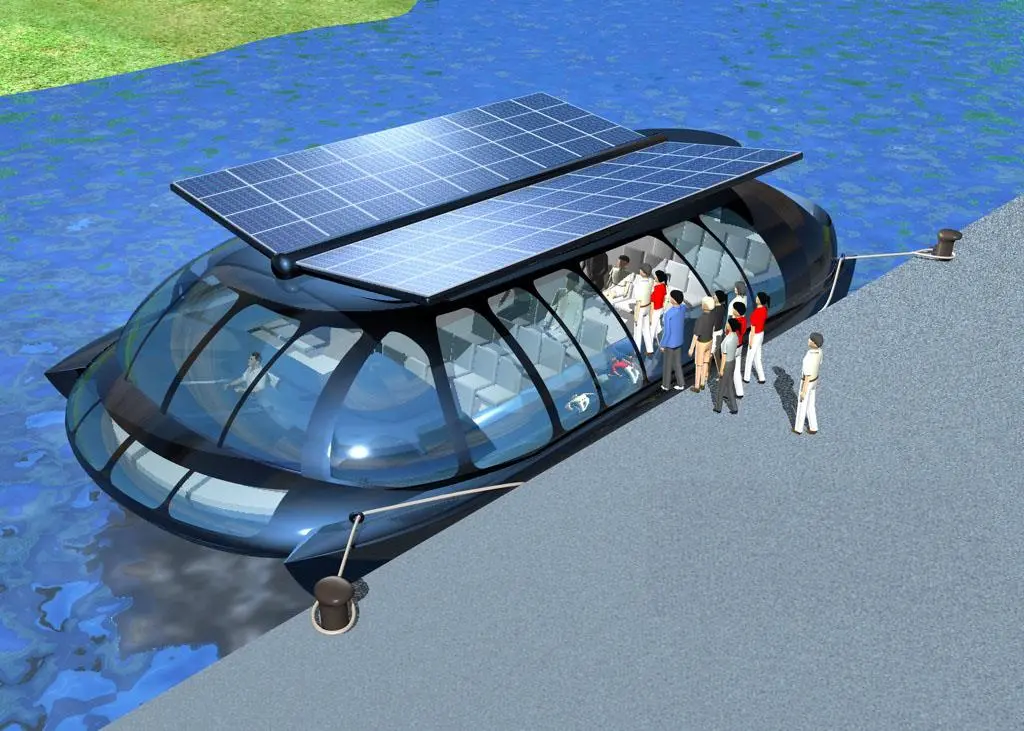
In Japan, the combination of solar cells and batteries has been adopted by designer Eco Marine Power. The company is using Corvus Energy battery systems in its renewable energy vessel designs. The Medaka is an urban solar-electric commuter ferry design that incorporates an array of rigid but movable sails to collect wind and solar energy.
The Solar Albatross, a 24m, 100 passenger catamaran ferry operating for the Hong Kong Jockey Club’s Kai Sai Chau Golf Club, features a solar sail concept developed by Solar Sailor of Australia. Solar Albatross is the first true commercial hybrid vessel in operation for Solar Sailor that is propelled by wind power, solar power, stored electricity and fossil fuel. The vessel features solar cells which are fitted into two rigid sails that also harness energy from the wind. The SolarSails stow flat on the roof of the ferry when not in use although they continue to collect solar energy and store it in batteries located in the two hulls of the catamaran.
Imtech Marine is supplying a hybrid diesel-electric and battery system to two new ferries owned by Scottish company Caledonian Maritime Assets and being built by Ferguson Shipbuilders of Glasgow. Imtech’s delivery includes two 700kW lithium battery banks which are estimated to reduce fuel consumption and CO2 emissions by a minimum of 20% (see The Motorship, February 2012).
Fuel cells offer a compact, zero emission solution that Bristol City Council in the UK anticipates will meet its goals for reducing local emissions and aiding local job creation. The council has sponsored the construction of the UK’s first hydrogen ferry which is scheduled to commence operation this year. Builder, Bristol Hydrogen Boats, is a consortium formed between No 7 Boat Trips, the Bristol Packet and Auriga Energy and the 12-passenger ferry is designed to demonstrate the commercial advantages of fuel cell technology.
The ferry’s fuel cell uses hydrogen as fuel and, analogous to batteries, the system converts chemical energy to electrical energy without combustion. Using oxygen from the air, the fuel cells produce water as their only waste product. Adoption of the technology could mean a big reduction in air and water pollution for Bristol as well as less noise and Bristol Hydrogen Boats expects the design and construction of harbour tugs to follow the successful launch of the passenger boat, sooner rather than later.
According to local councillor, Neil Harrison, “The council is now starting to look at ways of producing hydrogen locally from renewable energy, which would mean a cut in carbon emissions too. Hydrogen cars will be commercially available in the UK from 2014 and we are aiming to ensure that they will be able to refuel here, alongside the ferry. The hydrogen economy will be a major employer by 2020 and I want to make sure that Bristol is at the chalk face.”
There is potential for the concept to expand across Europe as Germanischer Lloyd has developed a design for a hydrogen bunkering station that uses wind energy to produce liquid hydrogen. A lack of mature storage technologies for offshore wind farms means that as much as 30% of their potential energy output is lost. An estimated 10,000 tonnes of liquid hydrogen could be produced from this surplus power each year from wind farms in German waters and GL estimates that its hydrogen solution could be commercially attractive as early as 2020.
Related Articles
 PROPULSION
 GENERAL NEWS
 GENERAL NEWS