



First 20V175D high-speed engines are now in production
Initial production models of the 20V version of MAN Energy Solutions’ 175D engine are under construction and the first unit is expected to go to sea in the first quarter of 2022, Benjamin Andres, Head of High-Speed, Marine Four-Stroke, at MAN Energy Solutions, told The Motorship in early March.
These first machines are the heavy- and medium-duty versions of the 20V175D engine, offering up to 3,700kW, with the first of its light-duty engines, delivering a record-breaking output for a high-speed engine of 4,000kW, due for production at the end of this year.
An even more powerful variant offering 4,400kW is listed in MAN Energy Solutions’ online engine fact sheets and Mr Andres promised more details about its capabilities later this year.
This is the latest version of the established 175D engine to be built at its Frederikshavn plant in Denmark, which is its expert centre for high-speed engines and marine propeller systems and its introduction is the latest step in the engine’s development programme, Mr Andres said.
Even when the engine was first announced as a V12 machine in 2015, both V16 and V20 variants had been planned for future development, but their introduction has followed a careful sequence of technology upgrades, as Mr Andres recalled.
“We started with a number of 12V cylinder variants as genset configurations followed by the diesel mechanical propulsion configurations,” he said, since when the existing units have accumulated more than 30,000 running hours in the field.
Along the way, the engine builder introduced IMO Tier II variants and later developed its own selective catalytic converter (SCR) exhaust gas aftertreatment system, making the engine IMO Tier III-compliant. That SCR has been available for 2.5 years “and is very much appreciated by many of our customers,” he said.
Only then did the company turn its attention to extending the range to larger models, with the 16V being announced in 2019 and the 20V in 2020, which introduced the record-breaking upper power rating for light duty installations.
MAN 20V175D engine data
|
Engine model |
20V175D-MH |
20V175D-MM
|
20V175D-ML |
||||||
|
Rating definitions |
Heavy duty |
Medium duty
|
Light duty |
||||||
|
kW |
2,500 |
2,500 |
2,900 |
3,100 |
3,400 |
3,700 |
3,700 |
4,000 |
4,400 |
|
rpm |
1,600 |
1,800 |
1,800 |
1,800 |
1,800 |
1,800 |
1,900 |
2,000 |
2,000 |
|
Average load (%) |
100.0 |
100.0 |
85.0 |
80.0 |
70.0 |
40.0 |
65.0 |
60.0 |
60.0 |
|
SFOC at 100% MCR (Tier II) |
189.5 |
196.0 |
194.0 |
192.5 |
192.0 |
193.0 |
196.5.0 |
199.0 |
199.0 |
|
SFOC at 100% MCR (Tier III) |
190.5 |
197.0 |
195.0 |
193.5 |
193.0 |
194.5 |
197.5 |
199.5 |
– |
|
TBO (Time between major overhaul) |
30,000h |
30,000h |
30,000h |
30,000h |
24,000h |
24,000h |
24,000h |
18,000h |
16,000h |
This light duty option was introduced across the whole 175D range, made possible by the commonality of parts, Mr Andres said. “It was a logical step” that, while new models were being added to the range, light duty ratings with a higher output power should also be introduced.
Across the whole 175D programme, he added, there has been a significant increase in demand, with naval and governmental applications contributing a particularly important part. There has been interest across the entire 175D output power range for genset applications in complex naval platforms, he said, often for use in situations where noise enclosures or double-resilient seating with shock-absorbing capability are required, or for diesel-mechanical applications in offshore patrol vessels and fast patrol vessels.
It is also popular in non-naval craft because of its “versatility and configurability … with features fulfilling a vast bandwidth of demands,” he said. This makes it suitable for a wide range of applications, ranging from standard to special-purpose vessels with a high degree of complexity. These include workboats such as tugs, shallow water anchor handlers, wind turbine installation vessels, trawlers, live fish carriers and research vessels, but also passenger vessels including high-speed ferries and megayachts.
These ship types are suited to the 175D because it is a compact engine with a very good power-to-weight ratio, he said. This is typical of high-speed engines in general but especially so for the 175D, he believes, which can often be specified in its 12-cylinder version where competitors have to offer 16-cylinder equivalents.
He hinted at further development work in this area, saying that MAN Energy Solutions “will certainly further identify the needs of an even higher power density of our 175D” and promised to report updates on that ambition later this year.
He also stressed the engine’s other credentials, saying that the 175D “is designed to deliver its highest output power continuously, even under tropical ambient conditions” and that it gives operators “longer vessel endurances due to its best-in-class fuel consumption.”
In addition, the engine allows long maintenance intervals between major overhauls, which can be carried out in-situ, “which keeps the vessel in operation longer and keeps operational expenses low.” These parameters are reflected in reduced operational costs, which is important in selecting “the right propulsion solution,” he said.
Environmental strategy
MAN Energy Solutions is “continuously improving and optimising engine efficiency,” Mr Andres said, in response to “the ever-growing demand for lower emissions,” in particular CO2, NOx and PM.
He drew attention to the SCR designed for use with the 175D, which has a closed-loop design and a temperature control system that remains active over the engine’s entire load range to ensure low urea consumption and low NOx emissions. It has been certified in line with Marpol Annex VI’s Scheme A approval guidelines, which require an initial certification of exhaust gas cleaning performance, followed by periodic surveys and continuous monitoring of key system operating parameters, backed up by daily emission checks.
This approach “reduces the commissioning and certification efforts on board,” he said, but stressed that the engine had been designed from the outset to accept exhaust gas aftertreatment to ensure that its specific fuel oil consumption “can be kept on a best-in-class level even when running in IMO Tier III.” He also indicated that, because the 175D has a high back-pressure capability, further aftertreatment systems, such as diesel particle filters, could be added while maintaining output power.
More than half of its European and North American orders for the engine have been specified with the SCR system, which Mr Andres attributed to the engine’s compactness “and the variety of possibilities to integrate its components into the engineroom.”
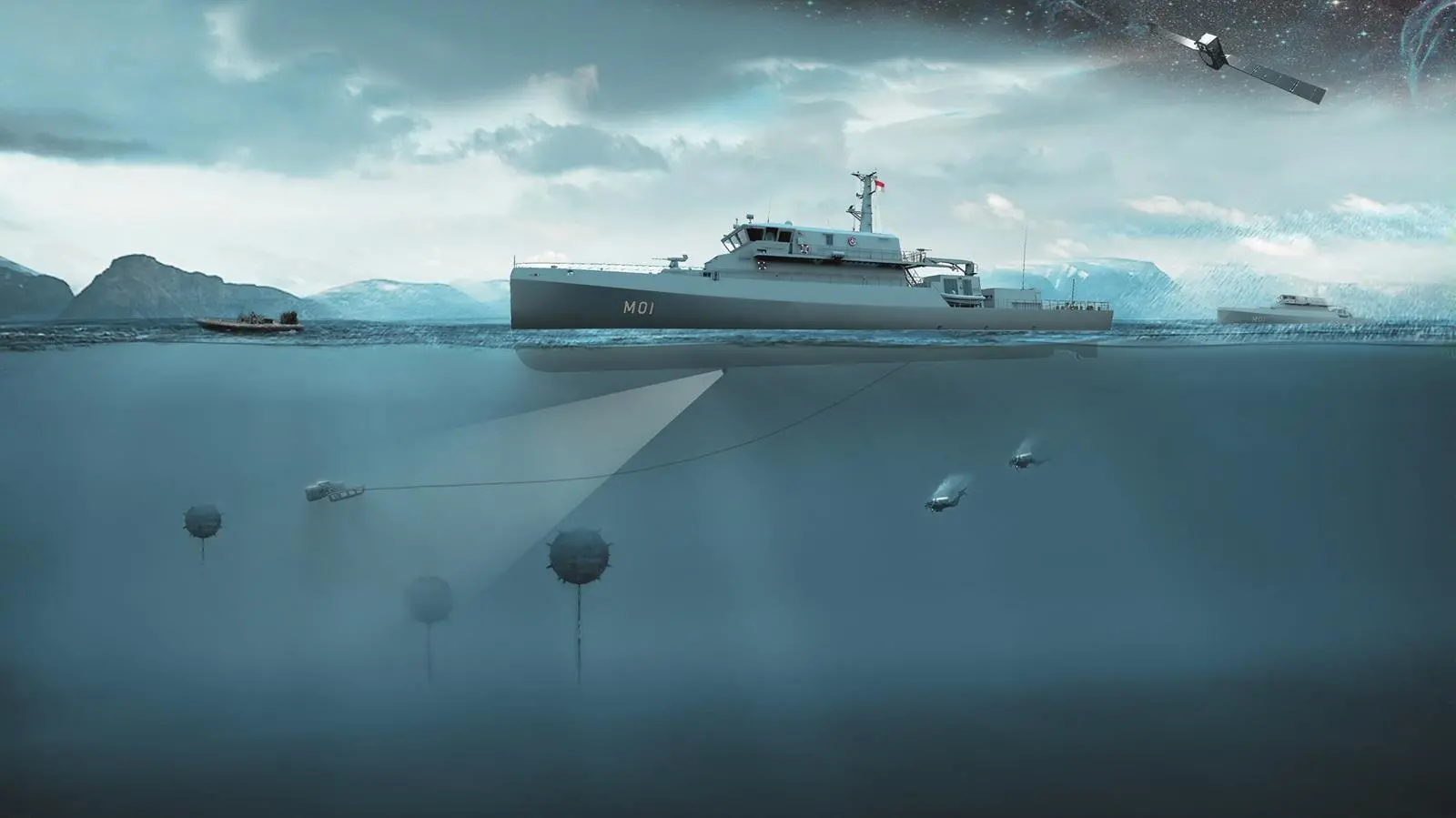
Hybrid installations feature among the 175D’s references, the latest being for two mine hunters to be built at Abeking & Rasmussen in Germany for the Indonesian Navy. The contract also illustrates the significance of a link forged in 2018 with the hybrid specialist Aspin Kemp and Associates (AKA), which is supplying a hybrid PTI system to allow the ships to operate silently while minehunting, during which they will operate at slow speed with electric propulsion.
MAN Energy Solutions’ supply to these ships will include two 12V175D-MM engines, each delivering 2,220kW at 1,900rpm, and an MAN Alpha CPP twin screw-propeller system, including an Alphatronic 3000 propulsion-control system intended to provide efficient and flexible manoeuvring.
In a statement issued when the order was announced, Mr Andres said that delivering propulsion packages to these two minehunters “fulfils our ambition to increasingly becoming a supplier of complete solutions.”
Fuel options
A range of fuels can be used in 175D engines, in addition to marine gas oil. It can also use ultra-low sulphur EN 590, NATO’s F-76 distillate fuel, B30 biofuel (a blend containing 30% biofuel), gas-to-liquid (GTL) fuel derived from natural gas and hydrotreated vegetable oil (HVO), which is a pure biofuel.
In the future, other fuels may be suitable for the engine, Mr Andres indicated. “Liquid fuel will play a major role for the time being on board small craft due to its density and availability, but we believe fuels should come from renewable sources to reduce CO2 emissions,” he said. With that in mind, MAN Energy Solutions is working on several concepts to apply future fuels such as biomass-derived products and synthetic fuels based on H2.
Related Articles
 PROPULSION
 GENERAL NEWS
 GENERAL NEWS