



Fleet Renewal For China-Japan Service
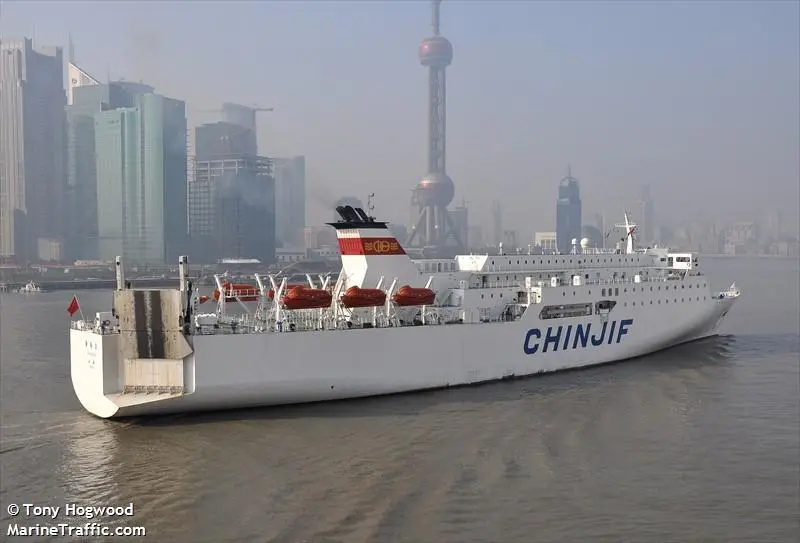
Provisionally named Jian Zhen, the ship has been contracted by China-Japan International Ferry Co (Chinjif), part of the state-controlled COSCO Group. Chinjif maintains a schedule linking Shanghai with Osaka and Kobe, using two ferries dating from the early 1990s, one of which will be replaced by the new vessel on her expected service introduction in June 2024.
The freight payload of the newbuild will be substantially in excess of that of each of the current, Japanese-built Chinjif ferries, which can load around 200 teu, but the passenger capacity will be significantly lower. The 157m Xin Jian Zhen, delivered by Onomichi Dockyard in 1994, is certificated for around 350 passengers, while the 155m Su Zhou Hao, completed by Shin Kurushima in 1992, provides for about 320 passengers. In both cases, freight is handled by ro-ro method across a starboard quarter ramp.
European design know-how has figured prominently in Chinese shipbuilding’s rapid rise to a position where it now dominates the global market for ro-ro and ro-pax construction. The latest contract, by contrast, is entirely home-grown in technical as well as commercial origin, attesting to the industry’s growing self-reliance across-the-board. The ship has been independently developed by Shanghai Merchant Ship Design & Research Institute (SDARI), incorporating many advanced features.
At 167m x 25m, the Jian Zhen will be longer and beamier than her forebears, and will be among the fastest in the short-sea trade. It is understood that the specification calls for a speed of 24-25 knots from a twin-engine, twin-screw installation. Freight will be accommodated on two decks, accessed over the main deck threshold via a quarter ramp, and the layout will allow for up to 60 reefer teu within the maximum cargo manifest of 334 teu or otherwise mixed freight intake.
The design fulfils SOLAS 2020 damage stability and safe return to port requirements, and also meets the criteria governing EEDI Stage 3 compliance. Environmental protection measures include arrangements for drawing on shore power when alongside, ballast water treatment, and noise and vibration abatement. SDARI has also placed emphasis on conferring ‘intelligence’ in shipboard management and operating systems throughout.
The standard of passenger accommodation and facilities as a whole also signifies progression from the earlier generation.
Related Articles
 METHANOL
 GENERAL NEWS
 HYDROGEN