



French Operator Shows Green Commitment
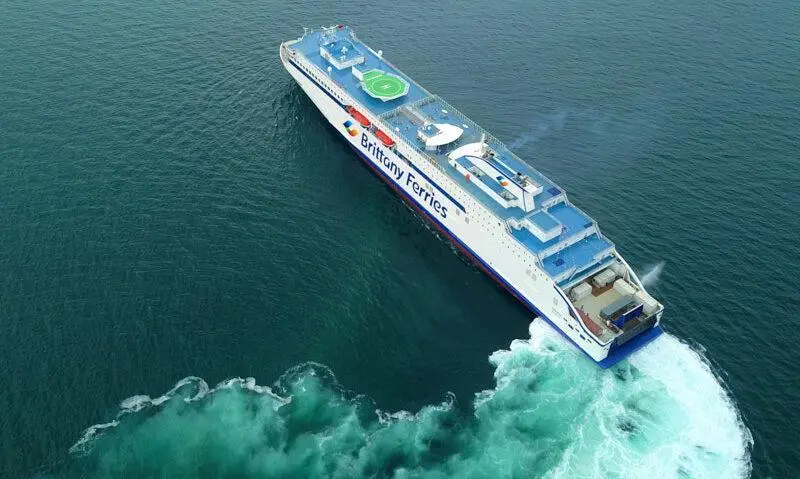
The nature of the French company’s tonnage renewal investment has had a signal bearing on the latest award since the ro-pax series involved embraces features that include LNG dual-fuel propulsion, large-scale battery installations, and provision for cold-ironing in port.
Green Marine Europe is a voluntary scheme in which participants must demonstrate continual and measurable improvements, year after year, so as to maintain certification. Assessments are conducted annually, and only those operators that are able to achieve a step up the ladder on at least one of 11 performance criteria continue to receive the award.
The programme addresses priority environmental issues related to air and water quality, waste management, community impact, and protection of biodiversity.
Brittany Ferries, the foremost operator of services crossing the western and central English Channel, is currently in the midst of the biggest investment in ship replacement in the Breton company’s 50-year history. Between 2019 and 2025, five new vessels will have joined the fleet, replacing time-served, less environmentally-friendly ships.
New and incoming tonnage consists entirely of E-Flexer type ro-pax vessels, conceived and ordered by Stena RoRo and secured by Brittany Ferries under long-term bareboat charters. The shipbuilding contractor in each case is CM Jinling Weihai in China.
The three 215m ro-pax ferries commissioned to date started with the diesel-engined Galicia in 2019. The second and third ships, Salamanca and Santona, were introduced in 2021 and 2023, respectively, and have LNG dual-fuel main machinery. This has had a fundamental influence on performance with regard to overall NOx emissions in particular, whereby the company achieved the highest level 5 for the specific criterion under Green Marine requirements, contributing to the success in retaining accreditation. The cleaner-burning LNG fuel also leads to significant reductions in cumulative SOx and particulate emissions produced by the fleet.
“Investing in cleaner ships is one thing. But you need investment in infrastructure to be able to re-fuel them,” asserted Vincent Coquen, Brittany Ferries’ head of sustainability. “The port of Bilbao has embraced that challenge, facilitating the construction of a fantastic LNG facility by energy provider Repsol with the support of EU funding, and the benefits are being felt as a consequence,” he added.
The prospective fourth and fifth E-Flexers assigned to the French operator are shorter variants of the design, at some 195m, and differ again from the preceding vessels by virtue of the specification of an 11.5MWh battery installation for propulsion and manoeuvring in port, complementing LNG dual-fuel power and preparedness for alternative fuels such as biogas and ammonia. Furthermore, each will be equipped with an 8MW electric shore connection.
The fourth ship in the programme, Saint-Malo, was floated out by CM Jinling Weihai on October 7, hull fabrication having reportedly been completed in a record time of only 75 days, thereby well on schedule for the vessel’s entry to the St Malo/Portsmouth service in early 2025. She will be closely followed by near-sistership Guillaume de Normandie, destined for the intensively-utilised Caen (Ouistrehamn)/Portsmouth route.
Chiming with the Green Marine philosophy, Brittany Ferries has a broader agenda than emissions reduction on its path to a more sustainable future. For example, the company is looking to demonstrate an improvement next year in oily water management, and thereby climb from 2 to 3 ranking in the specific category of the Green Marine requirements.
The technical team’s sights are set on making it five years in a row when the next round of awards is made in 2024.
Related Articles
 ALTERNATIVE FUELS & LUBRICANTS
 GENERAL NEWS
 GENERAL NEWS