



Gas turbines – poised for renewed interest?
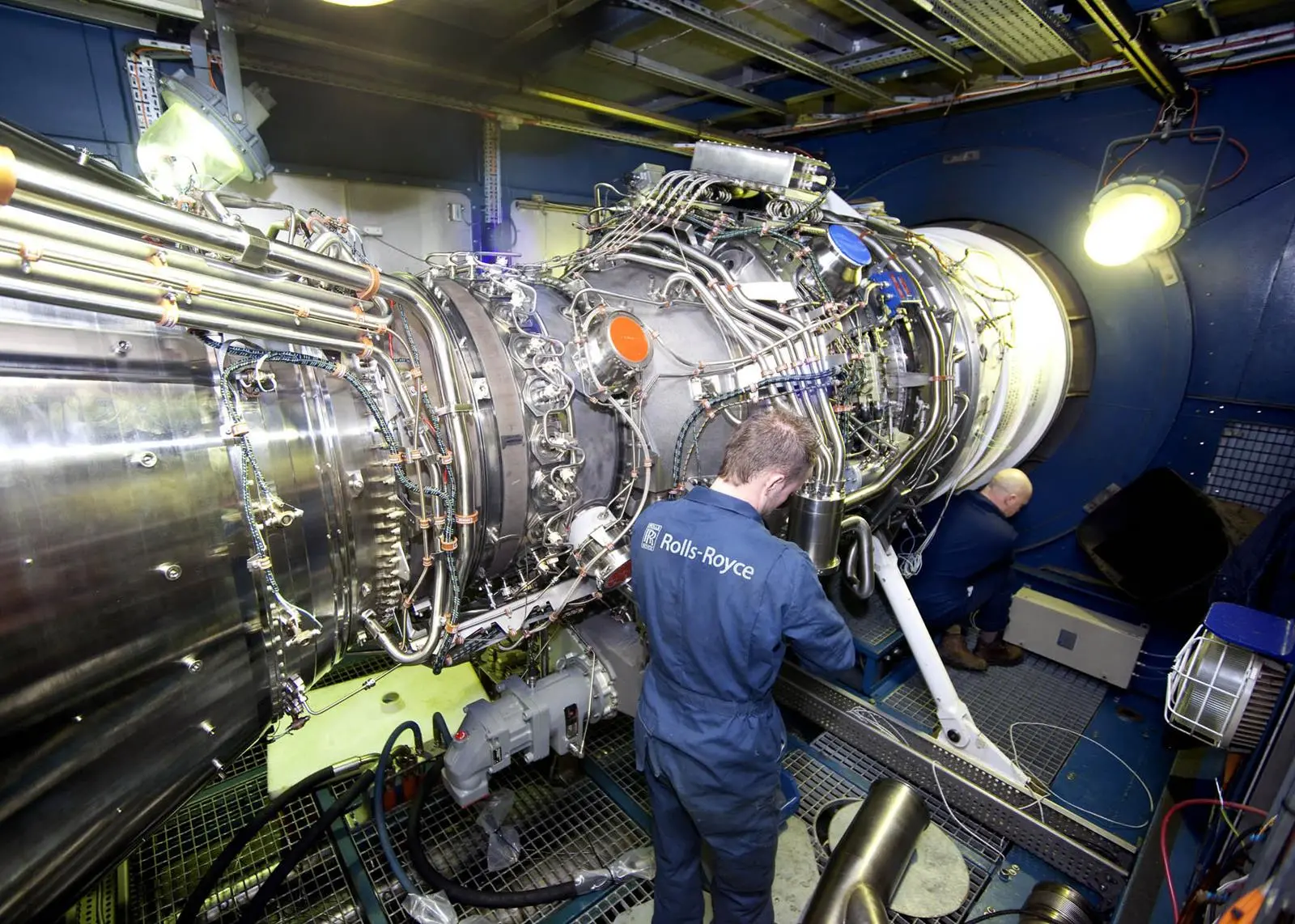
Rolls-Royce’s current emphasis for its marine gas turbines is wholly on the naval market, but the company remains aware of possible commercial applications, as the group places increased emphasis on the importance of its the merchant and offshore marine division..
Rolls-Royce claims the market leading position in integrated power systems for naval vessels, most of which feature gas turbines at their core. The company’s gas turbines cover the 3MW to 50MW range of power outputs. There are many examples from the Olympus, Tyne and Spey ranges of aero-derivative prime movers in service worldwide, many in ex-Royal Navy ships or warships replicating, or influenced by, RN ship designs. After the Royal Navy, Japan is the second biggest customer, with component manufacture licensed to R-R’s long-term Japanese partner Kawasaki Heavy Industries.
The current range is headed by the MT30, which is built in Bristol, UK, based on the Trent aero engine. The new QE class aircraft carriers for the Royal Navy have a diesel-electric system using two MT30s per ship, alongside Wärtsilä diesel gensets. A twin MT30 installation is also featured in the Lockheed Martin version of the US Littoral Combat Ship (LCS), in a mechanical CODAG drive installation alongside two Pielstick diesels, which power a total of four waterjets (also of Rolls-Royce supply). The initial contract covered two ships – USS Freedom and USS Fort Worth – and an order for a further 10 hulls was announced in 2011, providing Rolls-Royce with its largest ever Naval surface ship contract. The company expects further ships to be ordered. The MT30 is also to power the US DDG1000 (Zumwalt class) destroyer, with two MT30 main gensets and two RR4500 auxiliaries in each ship in the class. The original multi-vessel order was cut back to three, but R-R is hopeful that additional ships will be ordered by US Congress.
Rolls-Royce sees further US opportunities in the replacement for the LCAC (air cushion landing craft). None of the three contenders for building the 72-vessel class has yet decided on the propulsion, but Rolls-Royce proposes its MT7 gas turbine, four per ship.
The WR21 was regarded as very much the gas turbine of the future during the collaborative development involving USA, UK and France. However, the US and French sides of the collaboration changed plans, with the result that the sole reference for the WR21 – at least at present – is the Royal Navy Type 45 destroyer. The WR21 is based on major components from the Rolls-Royce RB211 and Trent families, and differs from other marine gas turbines in that it incorporates compressor inter-cooling and exhaust gas recuperation, in order to deliver reduced fuel consumption across the power range – standard-cycle gas turbines tend to lose efficiency at part load.
In the Type 45, two WR21s rated at 21MW (up to 35°C) drive alternators to power electric propulsion motors. The effectiveness of the advanced cycle technology is such that during sea trials of the first-of-class Type 45, HMS Daring, recorded fuel use was around 25% of that consumed by the older Type 23 frigate design.
As well as low environmental impact, the WR21 offers increased operational range, a useful benefit for naval vessels. Rolls-Royce says that the success of the WR21 so far has reawakened interest from other quarters, including the USA.
GE Marine has been a supplier of LM aeroderivative gas turbines to the commercial and military marine markets for over 50 years, with a range of power output from 6,000 to 57,330 shaft-horsepower. These engines are claimed to suit diverse ship applications thanks to their characteristics of high power, small volume, light weight, low emissions and fuel flexibility. GE Marine sees potential applications in the commercial sector for cargo ships, fast ferries and high-speed yachts as well as the core military vessel market.
GE Marine’s general manager Brien Bolsinger says: “Trends may come and go in the commercial marine industry, but what has remained a constant, reliable choice for ship owners and operators is the LM aero-derivative gas turbine.” He believes that the LM series, following a brief rise in popularity before rising fuel costs became a major disincentive, is poised to re-emerge as a prime power producer offering emissions-friendly technology — especially for new natural gas applications such as fast ferries, LNG tankers and FPSOs.
Since 1995, more than 90 LM gas turbines have been delivered for commercial marine applications on 17 cruise ships, four high speed yachts and 18 fast ferries. Over 1200 LM gas turbines power ships for 31 navies worldwide. The LM gas turbine fleet has logged more than 13 million hours in marine service.. In the mid 2000’s, MGO burned in the engines experienced a significant price increase versus HFO, moving the market back toward diesels.
Fast forward to today and gas turbines are worth another look, says Bolsinger. “LM gas turbines are more cost effective than diesels, especially considering pending 2014 and 2016 IMO and US EPA regulations,” he says. “These new requirements will undoubtedly usher in increased use of gas turbines burning alternate marine fuels such as LNG.”
GE claims the following benefits for its LM gas turbine range:
- Emissions of LM gas turbine emissions are inherently low compared to diesel technology, meeting today’s IMO (global) and EPA Tier III levels (using GE’s standard single annular combustor burning natural gas fuels). With GE’s dual-fuel dry low emissions (DLE) combustion system, LM gas turbines currently meet the stringent pending 2016 levels when burning either MGO or natural gas fuels without exhaust after-treatment.
- LM engines can operate on a variety of fuels, including MGO, bio diesel, bio-synthetic paraffinic kerosene blends and natural gas, a feature which could prove particularly beneficial as commercial ship operators adopt dual-fuel operating scenarios to meet new emissions regulations.
- Gas turbine combustor and hot section turbine repair intervals can double to more than 25,000 hours when burning natural gas, significantly reducing maintenance costs.
- LM gas turbines offer high power-to-weight ratios, allowing for smaller, more compact engine rooms; when coupled with alternate hybrid and electric propulsion architectures, gas turbines can result in increased revenue and more cargo capability.
- Ease of maintenance for gas turbines, and quick engine change-out over diesel technology, ensure the highest ship availability.
- Incorporating the latest design technologies and corrosion resistant materials, and based on proven aero-engines, LM gas turbines are claimed to provide maximum reliability and component life along with high performance, the LM2500 having demonstrated 99% reliability in military applications in harsh marine environments.
Related Articles
 PROPULSION
 GENERAL NEWS
 GENERAL NEWS