



Gas turbines show the way forward for Navy ships
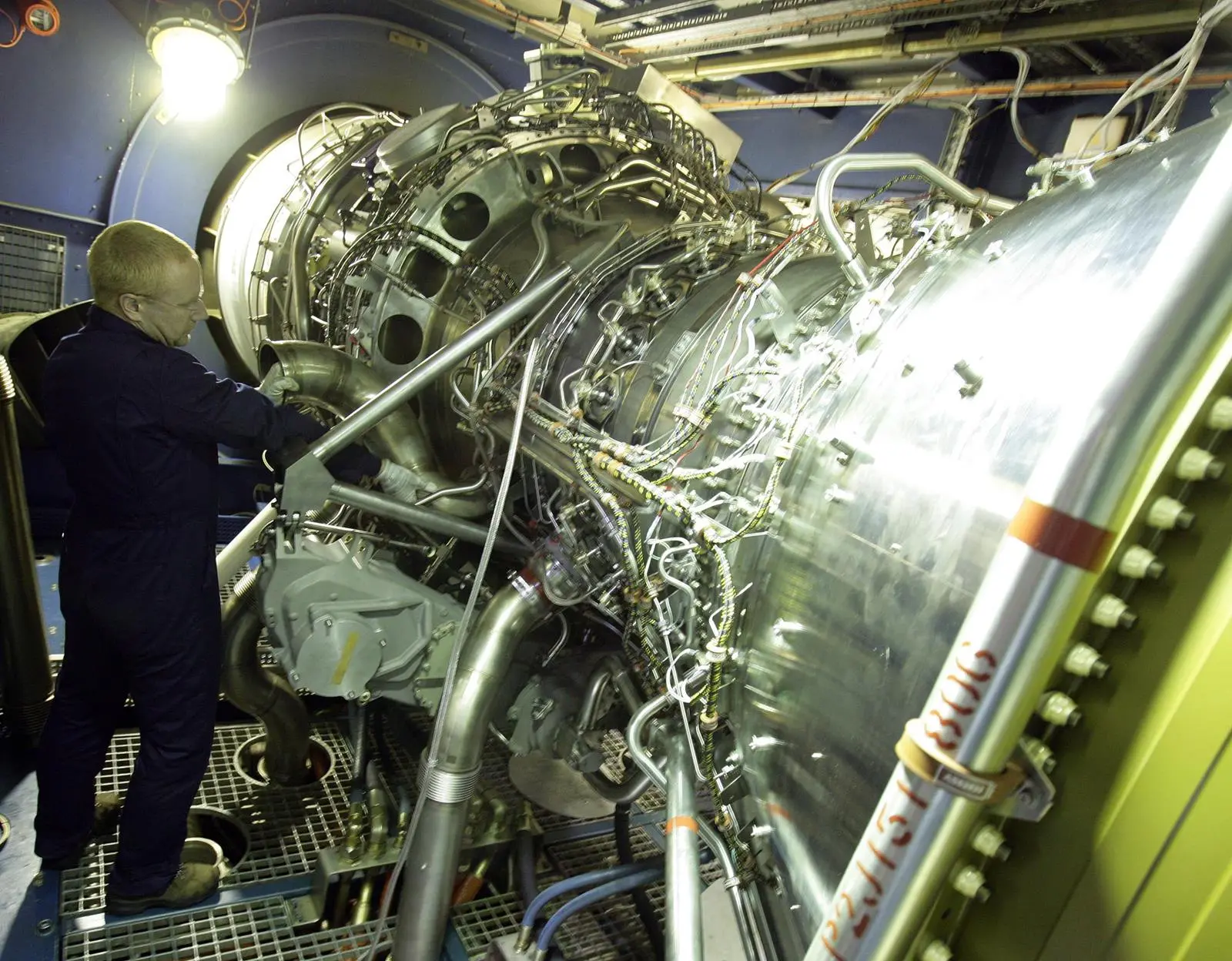
The WR21 gas turbine has been adopted as the prime mover for the Royal Navy’s Type 45 D class destroyer, the first of which is now in full Naval service and the next two undergoing trials. Three more ships are being completed and fitted out – reports as we went to press said that the fourth in class, HMS Dragon, was commencing initial four-week sea trials.
The ships employ an integrated electric propulsion system, with two WR21 gas turbines, each rated at 21.5MW, supplemented by two 2MW Wärtsilä 12-cylinder type 32 diesel gensets, providing a high voltage supply to two Converteam 20MW induction motors driving FP propellers. Such a system is said to depend on prime movers able to operate efficiently over a wide load range, and the WR21 is designed for just such an application, thanks to its compressor intercooling and exhaust heat recuperation, which makes it significantly more efficient at medium and low load than conventional marine gas turbines. The ships’ long waterline length and high power density allows it to operate at sustained high speed. The 29 knot design speed is said to be reached in about 70 seconds by the first-in-class HMS Daring, with a 31.5 knot maximum reached in two minutes. The relatively high efficiency of the WR21s allows a range of about 7000 nautical miles at 18 knots.
The WR21 has a footprint said to be no larger than current simple cycle marine gas turbines and offers a 25%-27% fuel saving. The engine is of modular construction, based on components from the RB211 and Trent aero engines. Standardisation of components and modular design are said to offer ease of maintenance and reduced through-life costs. The gas generator and power turbine consist of 12 interchangeable pre-balanced modules. Because of their size and low weight, the modules are easily and quickly removed and replaced.
The intercooler, located between the compressor sections, cools the intermediate-pressure compressor (IPC) air before it enters the high-pressure compressor (HPC). This reduces the HPC inlet temperature and therefore HPC work to deliver a significant boost in engine power. The intercooler also enhances recuperator effectiveness, as the inlet temperature is reduced thereby increasing exhaust heat recovery.
The recuperator recovers and transfers heat energy from the hot exhaust, which is used to preheat combustion air, therefore less fuel is required to reach the same power turbine entry temperature, and thus less fuel is used to achieve the same power. Recovering heat energy from the exhaust gas reduces its temperature, giving a lower infra-red signature.
Variable area nozzles located at the entrance to the power turbine, open and close on command to control the air mass flow rate through the engine. This provides a means to manage and optimise the power turbine entry temperature, and subsequently the exhaust gas temperature into the recuperator, optimising fuel efficiency across the power range, and particularly at partial load.
The other gas turbine in the current Rolls-Royce marine range is also an aero-derivate unit, the MT (marine Trent) 30. It was developed to meet the growing demand for higher powers in the 34-40MW range, and can be configured for mechanical or generator drive.
Now at sea powering USS Freedom, the US Navy’s monohull Littoral Combat Ship (LCS1), the MT30 has been selected for other naval programmes, including the Royal Navy’s Queen Elizabeth class aircraft carriers and the US Navy’s DDG 1000 multi mission destroyers.
The engine is American Bureau of Shipping (ABS) type approved at a maximum continuous rating of 36MW up to ambient temperatures of 37.8°C and 40MW at 15°C (ISO), and is Lloyds approved and DNV design assessed.
The company says that the MT30 was designed with some 50%-60% fewer component parts than other aero-derivative marine gas turbines in its class, which, combined with the modular construction, is said to offer ease of maintenance. The annular combustor is designed to burn commercially available distillate fuel to DMA standard, ensuring the MT30 meets all current and anticipated legislation on emissions and smoke. The engine is also being marketed as a dual-fuel version, capable of burning LNG (including boil-off gas lost from the vessel’s main gas storage tanks) as well as DMA standard fuel.
Further Rolls-Royce products for naval vessels include adjustable pitch propellers, including the bolted propellers, just under 7m diameter, for the two MT30-powered Queen Elizabeth class aircraft carriers for the Royal Navy.
Related Articles
 PROPULSION
 GENERAL NEWS
 GENERAL NEWS