



GE outlines data-driven marine potential
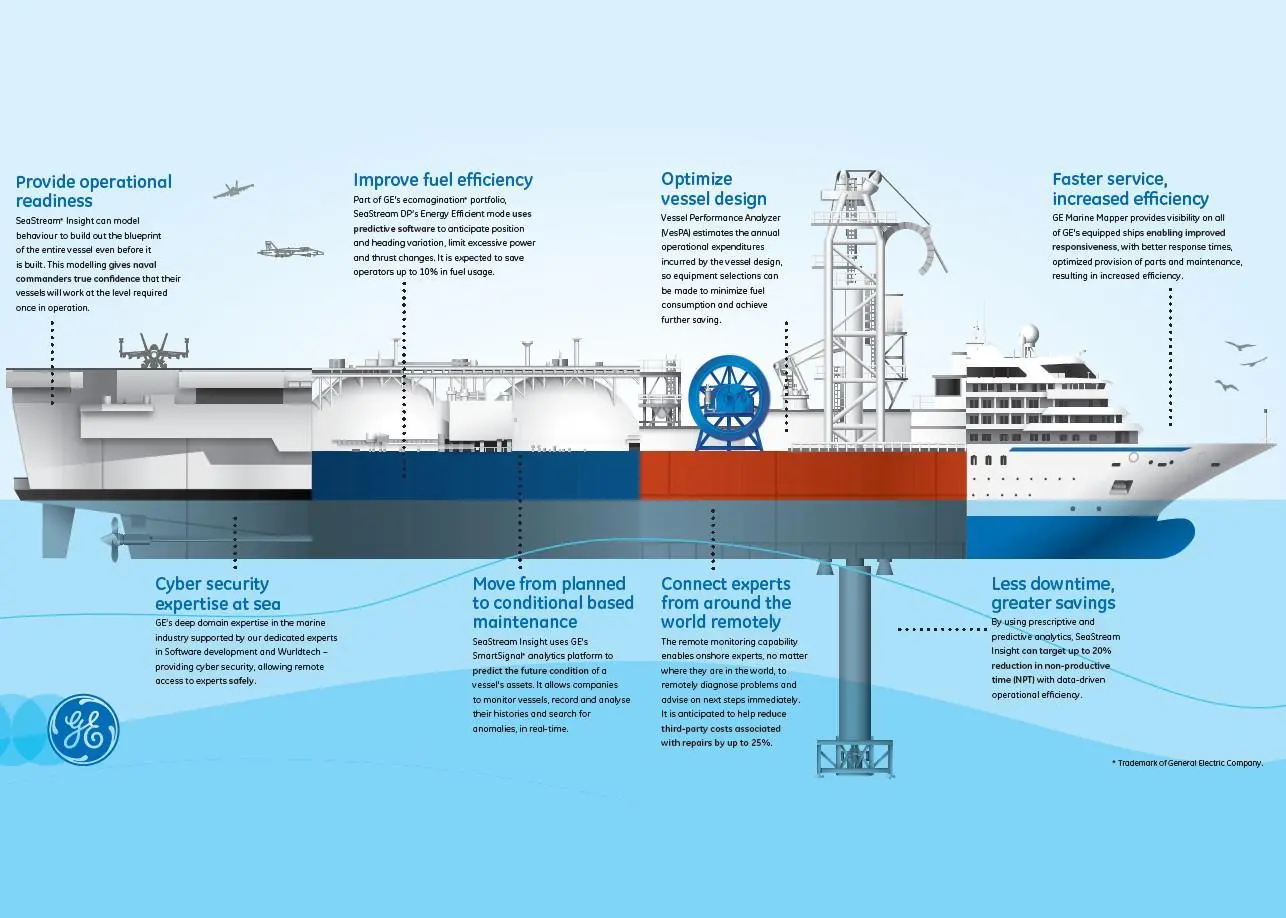
Citing a lack of industry optimism in new technology, the company has predicted that the merging of digital and physical technologies in the data age will prove more powerful and transformational than the Industrial Revolution. The forecast was made in a white paper released at the industrial group’s annual ‘Minds + Machines’ event.
Annunziata highlighted three broad areas in which the rise of the industrial internet, advanced manufacturing and enhanced global information sharing can be applied to the marine and offshore sectors: Optimising asset performance and onboard system performance; designing and building vessels; and optimising fleet operations.
Quantifying the opportunity, Annunziata wrote: “We know from the industry that up to 50% of downtime can be taken up with analysis to get to the root cause of a failure in order to fix it. If we take the offshore mobile drilling example, an improvement in unplanned downtime of 20% could be worth over US$500 million to the industry every year.”
GE notes that the marine industry is already developing and deploying many data-driven technologies, including sensor-driven condition monitoring, vessel performance optimisation, predictive maintenance and intelligent route planning. Industry players are also aware of the ‘pain points’ that need to be addressed to harness these benefits, and must begin dedicating resources to integrate new technologies at a faster pace.
Many GE Marine solutions already employ data-driven technology. Based on its industrial internet platform Predix, Sea Stream Insight gathers data on the condition and performance of a vessel’s equipment to enable predictive maintenance and reduce unplanned downtime. The Vessel Performance Analyzer (VesPA) enables ship designers and builders to virtually test different power, propulsion and electrical arrangements for a vessel against specific performance requirements. And GE’s Marine Mapper tracks the company’s installed base of 1,000 ships, allowing for further operational insights and ensuring faster repair and maintenance.
“As the magnitude of the potential benefits also becomes clearer, efforts to develop and adopt digital solutions will accelerate,” the report concludes. “We are just at the beginning of a process that can deliver tremendous benefits to the industry.”
The GE Marine white paper, titled ‘Marine’s Digital Revolution’, can be downloaded here.
Related Articles
 ALTERNATIVE FUELS & LUBRICANTS
 GENERAL NEWS
 GENERAL NEWS