



German owners confront challenging market
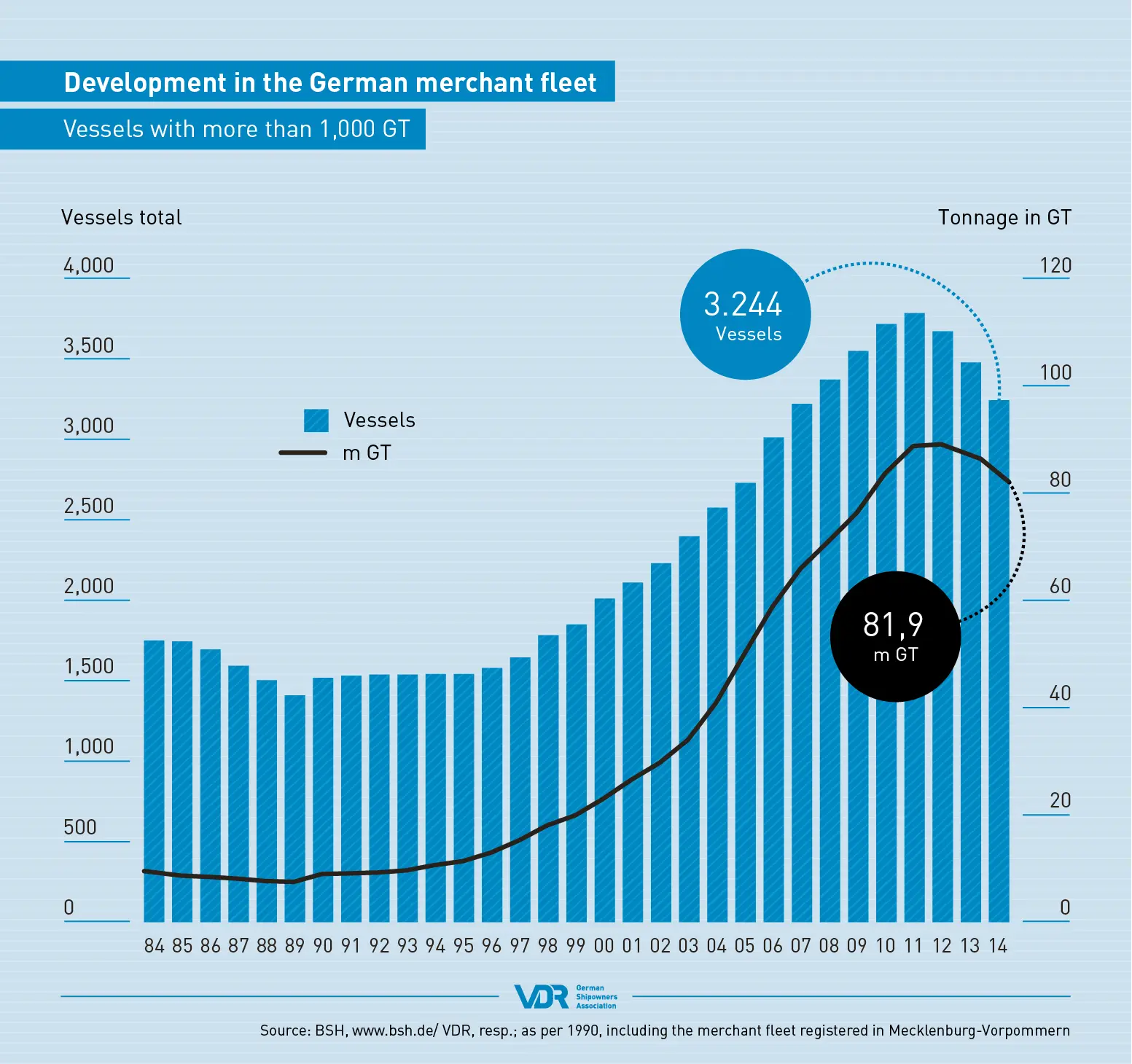
Representing around 90% of the gross tonnage of the German fleet – itself the biggest container ship fleet and fourth biggest merchant fleet in the world – VDR serves the interests of a diverse and influential membership, including some of the world’s biggest liners but also several charter companies. As such it has a broad perspective on the challenges facing the shipping market.
Helping members meet those challenges, be they economic, regulatory or technical, is a key concern for Kröger. A trained maritime lawyer with deep experience of running trade associations (he was previously head of the German seaport operators association ZDS), in the interview below Kröger offers a pragmatic perspective on the challenges facing an industry that must invest heavily – both for regulatory compliance and simply to keep abreast of a rapidly developing market – while navigating a period of significant financial upheaval.
Could you summarise the market situation your members are facing today?
We are in eighth or ninth year of the crisis and it is difficult for most markets. Charter rates are of high importance to the container market – they are at the level hey were in the 1990s, but companies are operating in a very different market today. Shipping has changed completely since then, which makes it very difficult to actually cover operating expenses from those charter rates, let alone serving your loans.
What helps is the low oil price, because the fuel is such a high percentage of operating expenses. Having said that, the most profit from the fuel price lies with liner companies and not the tonnage provider, because it is the charterer who pays the fuel bill. The price of crude seems to be stabilising now at a very low level, but there have been difficult times.
On top of that we have seen deteriorating international trade. If you look at the bulker trade it has a major impact for example that China is not importing raw materials in the quantities that it used to. The only sector doing fine is the tanker sector, and unfortunately there are not too many tankers in the German market.
Asset play is also a major part of the shipping market and the situations has been getting more and more difficult. Commerzbank used to be the third biggest ship financing institution in the world, and announced in 2012/13 that it would withdraw from the market completely. We had a similar situation with HSH Nordbank, also a very big institution. So there is a trend for the classical ship financing banks to withdraw from the market in Europe, and that is putting pressure on the German fleet ownership structure.
Then there are other challenges emerging around environmental legislation, which requires new technical standards and equipment. The Ballast Water Management Convention is one example.
Why is ballast water management regulation a challenge, and how does that relate to the market situation?
The equipment costs a lot of money, and when you have to install them on ships which have low value in today’s market, it is difficult to get the necessary financial loans from your institution. For example if you imagine that you have a container ship which is worth US$5 million and you have to install equipment for US$2.5 million, it is very hard to justify this investment.
It is a very difficult convention to deal with, on the one hand due to the technical developments that are or are not taking place, and on the other due to the large investment that shipowners have to make. They are very difficult and do not offer any benefit other than compliance – on the contrary you make your ship heavier, therefore burning more fuel and emitting more CO2 emissions.
Regarding the convention itself, we are at a atage where we don’t oppose it, but we see clear need for change within the regulation. But changes can only be made once it comes into force so the lesser evil might be that the convention now comes into force and then we can focus on what parts of it work and which don’t.
What approach are your members taking to installing their equipment?
I think everyone is waiting for the convention to come into force, and for the majority it will take another five years after that until their next drydocking. It’s difficult to plan because the convention has been coming into force next year since 2013! So it is a somewhat speculative game to try to optimise drydocking schedules.
How do you view the other emissions regulations – on SOx and CO2 in particular?
The global sulphur requirements in either 2020 or 2025 will be quite a challenge because it means the end of heavy fuel oil for shipping. We have had a training period with the European ECAs. We see a very high compliance rate in Europe, which is good news. We are at 95% compliance in European waters.
But on the global level, we will have to wait and see how it works. Of course there is an issue with compliance and enforcement in international waters and we will just have to see how the global community handles that. Meanwhile we are waiting for the IMO study on fuel oil availability, and it is hard to predict what will follow after this research project.
One of the subjects we worked on thoroughly with members was whether or not scrubbers should be a solution. I think this is a good example of how an association works. We bring the actors together and share information.
On this topic it turned out that crew training is absolutely crucially. It’s not only the engineering or installation of new technology, but how to enable the crew to deal with it. Fuel switching was not a problem as it has been around for some time, but in general if we look at all the new technology coming into the sector, be it sensors for monitoring emissions, BWM systems, it is essential to look at training and competence of crew. It is half the job to train them correctly.
And what about CO2 reduction?
We are very much in favour of the approach taken by the IMO, the so-called ‘three-step approach’ where you collect data first, then analyse it and out of this database start discussions about what measure we might need to take and when.
But of course the first step is to collect the data, and the system is under development. We expect some steps forward in the next MEPC meeting [this month’s MEPC 69 – Ed]. We hope it will be a compulsory, worldwide system. We don’t believe in regional systems or voluntary systems when it comes to collecting data.
Shipping needs to play its part in reducing CO2. But once you introduce a measure it can be a very costly exercise so it needs to be thought through very carefully beforehand. I think the right way forward is to frame the discussion, to define what the future steps are and how much time we give ourselves. We are at that stage now and I think it is a very healthy way forward.
That leads us to the European MRV regulation. What stance do you take there?
We are still in the process, together with the European Commission, of formulating definitions and seeing how the regulation will work. There are still a lot of unknowns and problems with the publicising of certain data. Cargo data is sensitive and commercial,s, together with the European Commission, of formulating definitions and seeing how the regulation will work. There are still a lot of unknowns and problems with the publicising of certain data. Cargo data is sensitive and commercial, not environmental, and we don’t want to see it out there.
Looking at information such as cargo carried and container weight, it’s easy as a competitor to get this data once it is public, and combine it with other easily accessible information. Then if you have a little industry knowledge you can calculate how your competitors are performing economically. That is data you just don’t want to give out because of the fierce competition between the international liner companies, but also between charter owners.
We don’t see why this is necessary, and we hope for a strong international system at IMO level so that the European Commission can align itself with a later global procedure. The IMO has decided already that such data will be anonymised and handled confidentially by member state, and we think that is a fine solution.
How do you and your members view the development of LNG as a marine fuel at present?
It hasn’t reached maturity in the market yet but I am sure we will see a lot of movement in the future. Singapore will be ready for LNG bunkering nest year, which might be a game changer for the international trade. In Germany we have one barge mainly for providing power to cruise ships, and there is a ferry plying the island routes.
There is not a single LNG project out there which hasn’t been heavily supported by state aid. There is a high financial risk as a ship owner if you opt for LNG today – especially in retrofitting because you are essentially investing the same amount as the vessel’s value in the current market. So it’s something that needs to be carefully analysed.
We see a lot of vessels coming on the market being ‘LNG ready’, so there is a certain tendency towards LNG in the market. I think it is important for the German government and we are working with them to promote LNG. But a major factor will be whether the government Is ready to have a funding programme, and we are in dialogue with our government to draft such a mechanism.
The funding opportunities today are generally from European funds and research projects. Pilot project funding is fine but the problem lies not with those projects but with equipping the existing fleet for LNG. It’s important to invest in research, but if you want to achieve the widespread acceptance of a new fuel you need to broaden your state aid approach a little. The European rules on state aid do allow for countries to offer such support, but you need engagement to help buffer the financial risk that a shipowner is taking.
Are there any other important initiatives you are conducting regarding new technologies?
Sensor technology is something we are beginning to look into and is something you will see more of in the mid-term future. We also have a couple of companies who are investing heavily in fleet optimisation centres on shore. We see this especially in the cruise sector but also for the big liners, who are monitoring every detail of a vessel to be able to judge the efficiency, safety, economic performance of every single ship in the fleet.
With that comes big data management of course, a subject of the future maybe, but it is starting right now. Every ship is generating a lot of data already and it really needs trained personnel and the abilities on shore to analyse them.
We are working with Fraunhofer CML, a German think tank, on an internal project to determine the exact fields of innovation that we want to drive forward as an association. We are thinking about what innovation in shipping really is and what sectors we need to work on more. It could be the investigation of more energy efficient ships or new technologies, but it could also be mechanisms that can be applied to manage fleets more efficiently, enable data exchange, and so on. That project will drive how we address innovation in the future.
Related Articles
 ALTERNATIVE FUELS & LUBRICANTS
 GENERAL NEWS
 GENERAL NEWS