



German yards show pallet versatility
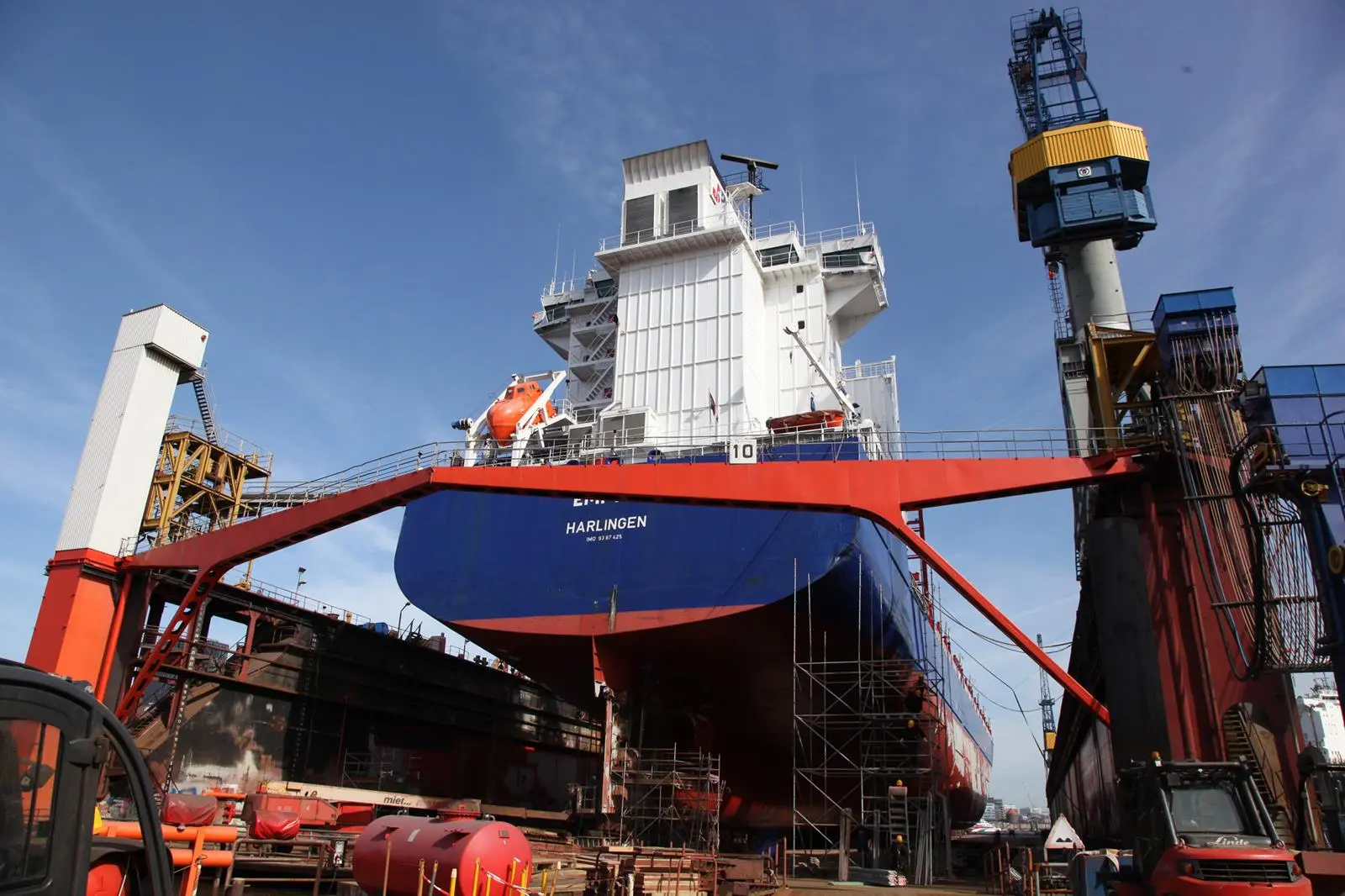
Tom Todd writes: This demonstrates that German yards still have their feet and much of their expertise firmly planted in the merchant ship sector, even as lucrative high-end passenger and cruise ship refurbishment makes the running.
About three quarters of the more than 20 ships listed as calling at the Hamburg yard in the three months from March to June were merchant vessels, many of them container ships, lending credence to the B + V motto “we repair anything that floats”. The work has for the main part been very routine, almost humdrum it seems, but it also clearly reflects better shipowner fortunes and a more positive business climate as recession appears to ease.
The 55,954gt container ship Toronto Express followed sister Montreal Express and they in turn followed the similarly-classed OOCL Montreal. All called for outer hull work and cleaning, general repairs and class inspections. The 75,590gt MSC Ilona came in for the same treatment with general repairs at the top of the list while the 20,316gt container ship Empire came in under tow via the Kiel Canal for propeller repairs after breaking off her journey into the Baltic. The 16,023gt container ship A LA Marine was in for unspecified work and the 18,166gt boxship CMS CGM Maya underwent general repair and class work as well as outer hull conservation.
Three reefers called in April and while details of the work on the 15,600dwt Baltic Clipper were not listed, the 9,891dwt Spring Delhi docked for rudder work. The third reefer was the 10,582dwt Chile Star, in for docking and propeller swap.
The 3,854dwt seismic offshore vessel Ramform Challenger called early May for general repairs and hull work as well as for overhaul of her seismic equipment. The 43,000dwt fruit juice tanker Premium do Brasil was booked in June for outer hull cleaning and conservation along with repair and class work.
The biggest ships recorded this past quarter have been the 161,192dwt bulk carrier Royal Oasis, which underwent more than a week of general repairs alongside and the 115,091 dwt crude oil carrier Penelop, which also called for general work including the repair of prop damage.
Finally the 10,107dwt Hamburg-based museum ship Cap san Diego paid her latest visit, this time for her five year class renewal. Work on the nearly 50-year-old cargo ship included external hull conservation, shaft and loading gear overhaul, tank cleaning and general overhaul.
Among the cruise ships docking at the Hamburg yard of late have been the 8,378gt Hanseatic, a regular customer, for cleaning, repairs and class work and the 68,870gt Crystal Serenity. It was understood that the scope of work on the latter, eight-year-old French-built ship, covered general maintenance, overhaul and conservation of interior areas, including machinery, and cost a reported $25 million.
Docking and general repairs were carried out on the 69,203gt AIDAluna in May. The 38,557gt AIDAcara (the original AIDA and the first ship in the AIDA fleet) came in earlier for general repairs and classification work, painting and extensive pipe work.
Reports said her engines and equipment were overhauled, interior fittings replaced and bars, restaurants and other public areas repainted or renovated. Propeller and hull cleaning was undertaken as a fuel-economy measure and the hull’s silicone coating freshened up. Among other recent passenger ship callers was the 15,187gt passenger/train/vehicle ferry Schleswig-Holstein for outer hull cleaning and conservation, repair and class work.
More cruise work
Lloyd Werft Bremerhaven (LWB) was completing its second major cruise ship refurbishment of the year in late May. Almost a month of work was carried out on the 44,588gt cruise ship Artemis, now renamed Artania. She was getting new balconies and being redesigned to suit German tastes in a project which reportedly involved an investment of more than €20 million.
More than five years ago, LWB refurbished the former Royal Princess, renaming her Artemis, and the yard only finished updating the technology of the ship in May 2010. The Artania work was won over strong competition, according to LWB and Phoenix Reisen MD Benjamin Krumpen said the crucial factors in selecting LWB were that it not only “knows the ship very well” but also “provides German shipyard work to schedule”.
Artania was getting 96 new balconies on decks 5 and 6. Bars, restaurants and spa areas were being redesigned and modernised along with standard passenger cabins and suites. Propellers, shafts, steering systems, stabilisers and bow thrusters were being overhauled and maintenance work carried out on the underwater hull. Machinery, superstructure and engine room repairs were also listed.
Officially completed just a day before Artemis arrived was the €50 million conversion of the 76,522 gt Mein Schiff 2, the former Meyer-built Celebrity Mercury. She was still berthed at LWB when Artemis came in.
Mein Schiff 2 is TUI’s second ship and, like Artania, is designed exclusively for the German cruise market. Her conversion was similar to that of sister, Mein Schiff 1 (ex Galaxy), converted in 2009 also at LWB.
The latest four-star plus ship was given 430 new balconies and verandahs. Because of the extra weight, a 220 ton stern ducktail was added from Bremen steel engineering firm BVT. The ship’s bridge arms were also extended to give a better bridge overview during manoeuvering. When Mein Schiff 1 was converted, LWB said she had undergone extensive overhaul of her MAN B&W main diesels and equipment. That appeared likely also on her sister, but TUI did not say so.
Elsewhere, Bremerhavener Dock (Bredo) joined the big yards in the cruise ship sector. It beat tenders from a number of north European yards to book the 22,496gt Deutschland in late May and early June.
The new owners of the German TV ‘love boat’, built by HDW in Kiel in 1998, invested a “multi-million Euro sum” in a complete revamp of the ship at Bredo. That included renewal of interior decorations, floor coverings and furnishings and furniture. New teak decks were installed and the pool renovated. The air conditioning system on the five-star ‘nostalgia’ ship, along with the passenger lifts, the loudspeaker system and engines, were also being overhauled and painting was also on the list.
Sail cruiser completed
Another smaller yard with a prominent passenger ship job has been Motorenwerke Bremerhaven (MWB). In May it completed the six month refurbishment of the German four-masted cruise sailing ship Sea Cloud.
The brief was to bring the 80 year old steel-hulled ship up to the latest SOLAS regulations while retaining her original wood interior character.
Wooden interiors were insulated with flame-resistant materials and wooden ladders replaced with metal ones. Flame resistant flooring was also installed.
The work, costing close to €10 million, also included gutting the old crew quarters and installing new, fire-proof ones as well as the replacement of the old electric system. Two new fuel-economy auxiliary diesels were also installed and the main engine overhauled. The bridge was widened and radar and navigation equipment renewed. Masts and rigging were overhauled and replaced where necessary.
Ferry overhaul
The first big Baltic ferry to call at Kiel shipyard HDW in ten years did so in April. However The Motorship understands that the giant 75,000gt ferry Color Fantasy – a familiar sight in the port city on the Oslo-Kiel ferry run – did not commission work from HDW but simply leased alongside berthing space at the yard. Apparently it organised its own overhaul and the installation of new plant to enable land-based electrical supply during berthing. Sister Color Magic meanwhile underwent similar conversion at Denmark’s Fayard.
Former HDW subsidiary Nobiskrug, inland on the Kiel Canal, often leases repair facilities at HDW, even though the Rendsburg facility now belongs to Abu Dhabi MAR. However, it used its own Dock 2 to house the 83.35m Bundesmarine intelligence and reconnaissance service ship Oste in early May for work the yard said would last until mid July.
It includes conservation and the repair of living quarters and the renewal of deck coverings. Technical changes were also listed, among them work on the pumping system and the “comprehensive” overhaul of propulsion, electrical system and drive and rudder plants.
Small yards survive
Business remains good for many of Germany’s small ship and boat yards – the driving force behind much of the country’s routine coastal repair and seasonal overhaul industry. Many of these yards along Germany’s now extended North Sea and Baltic coastline, have just a handful of employees yet continue to keep most of the country’s official and private local workboats and ferries afloat. Without that regular, if routine, maintenance work they would die.
One of the busiest is still the Schiffswerft Diedrich in Oldersum which reportedly overhauled or repaired 30 workboats and passenger ships between January and May. Half a dozen boats on the slips at the same time is not uncommon at this yard.
German media quoted yard chief Jens Diedrich saying the future of the small facility was secured by routine annual overhauls and repairs, with local authority workboats among the main customers. He reportedly noted however that with tenders now EU-wide, competition was harder.
Among the latest ships calling for routine seasonal overhaul, repair or machinery inspection were many regular customers, among them the 51.9m Frisia V11, which also came for the installation of sound suppressors, and the 32m Baltrum 111, which also underwent underwater coating and prop and shaft inspection. Other visitors included the 44.1m Baltrum 1, the 13.4m Baltrum 1V and the 38.8m Wappen von Borkum – the latter also for changes to her main engine cooling system.
The Elsflether Werft also spruced up two small local ferry ships for the coming season. The 30.3m long, 250-300 pax Jens Albrecht got a complete interior make-over while the 45.3m long Wangerooge got new propellers as well as an overhaul.
Conversions broadened the recent work pallet at a few yards like Sietas subsidiary Norderwerft in Hamburg. In work during the last few months the yard converted and modernised the 20-year-old former Deilmann river cruise ship Dresden and renamed her River Allegro for new American owners.
External plates were renewed on the 98m long ship and her Schottel drives and bow thruster were overhauled. Water tanks were sandblasted and a new sprinkler system installed while the number of passenger cabins was reduced from 108 to 90 and interiors renovated. The ship was converted for regular Elbe river cruises between Hamburg and Prague.
Finally Rickmers Lloyd in Bremerhaven tackled repairs on the 3,300dwt oil/products tanker Zapadnyy after she was involved in a collision with a floating dock. MD Uwe Beck was quoted as saying 20 tons of steel were renewed. The work was carried out alongside because the ship was undamaged below the waterline.
Related Articles
 EMISSIONS REDUCTION TECHNOLOGY
 ALTERNATIVE FUELS & LUBRICANTS
 ALTERNATIVE FUELS & LUBRICANTS