



GETTING A HANDLE ON METHANE SLIP
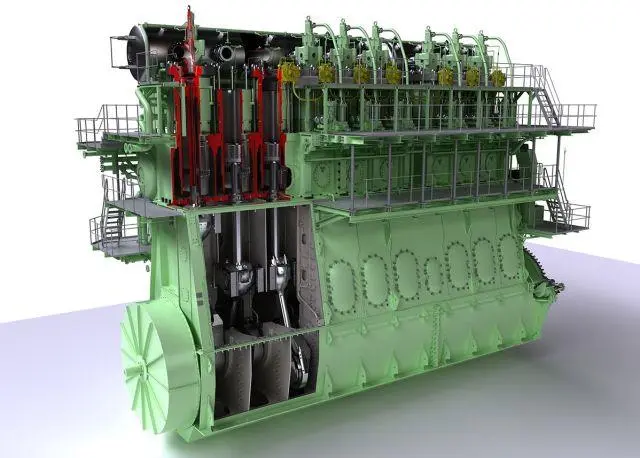
Methane slip values have been set across the entire load range, and incorporated into the proprietary Computerised Engine Application System (CEAS) calculation tool. “We are prepared to accept the methane slip as guarantee figures in newbuilding contracts,” confirmed MAN.
Notwithstanding the efficiency and low greenhouse gas footprint of ME-GI technology, the company’s move has been prompted by rising concerns over the potentially deleterious affects of the release of unburnt methane into the atmosphere.
These escaped emissions are potentially highly significant, as methane has a global warming potential which is 28 times higher than that for CO2 over a 100-year perspective, and 84 times higher over 20 years. The impact of methane slip from international shipping has drawn the attention of the IMO. MAN Energy Solutions has therefore decided to make methane slip part of the performance predictions and guarantee values issued for its ME-GI portfolio.
The company had signalled its intent last year. In the introduction to the 2019 Marine Engine Programme, it noted that IMO was considering legislation relating to other greenhouse gases besides CO2, with the immediate focus on methane. It stated then that “In order to be prepared for possible legislation on methane emissions, especially from GI engines, MAN Energy Solutions will, for the complete two-stroke programme, be prepared to guarantee a maximum methane slip of 0.35g/kWh.”
With the ME-GI portfolio being the initial focus for the new initiative, it is noted that “Methane slip is highly dependent on the type of engine process, performance, and load, which must therefore be reflected in the regulations.” Calculated figures over the total load range of ME-GI models, taking account of the various factors involved, have been based on detailed evaluation of methane slip measurements on a number of ME-C-GI engines.
In the meantime, it is anticipated that continuous optimisation of the injection system will lead to further reductions in methane slip.
LNG has become the industry’s predominant choice of marine fuelling alternative to fuel oil or distillate, on the strength of properties resulting in considerably lower emissions of NOx, particulate matter (PM) and CO2, as well as virtually no production of SOx.
Unburnt methane release has been shown to increase at lower engine loads. This could be due to slower combustion at lower temperatures, allowing small quantities of gas to avoid the combustion process.
MAN Energy Solutions is developing a low-pressure, dual-fuel, two-stroke engine, the ME-GA type, to supplement its successful, high-pressure gas-injected, ME-GI low-speed engine series. The timescale for the ME-GA engine project gives the potential for an initial installation in an LNG carrier during the first half of 2022. The low-pressure engine is seen as filling a gap in the portfolio, akin to the way in which the ME-LGIP type expanded the list of fuels which the ME-LGI series can exploit by allowing operation on LPG.
The company attributes the rationale for the ME-GA design to capital cost considerations relative to the high-pressure ME-GI family, obviating the need for certain auxiliary elements in LNG tanker installations to boost boil-off gas to high injection pressures.
MAN is adamant that the ME-GA type will complement rather than supplant the high-pressure ME-GI concept, which will remain as one of the pillars of its engine portfolio. That commitment has subsequently been expressed in the unveiling of a Mark 2 version of the ME-GI.
The upgrading has accomplished objectives as to more competitive operating and capital costs, and features a reduced pilot oil requirement, an ability to run at lower load on gas, and a simplified design.
Meanwhile, for the ME-GA project, one of the technical challenges is to ensure that methane slip remains on a par with other pre-mixed, two-stroke gas engines.
Related Articles
 EMISSIONS REDUCTION TECHNOLOGY
 EMISSIONS REDUCTION TECHNOLOGY
 EMISSIONS REDUCTION TECHNOLOGY