



GL studies design of offshore windfarm installation and supply vessels
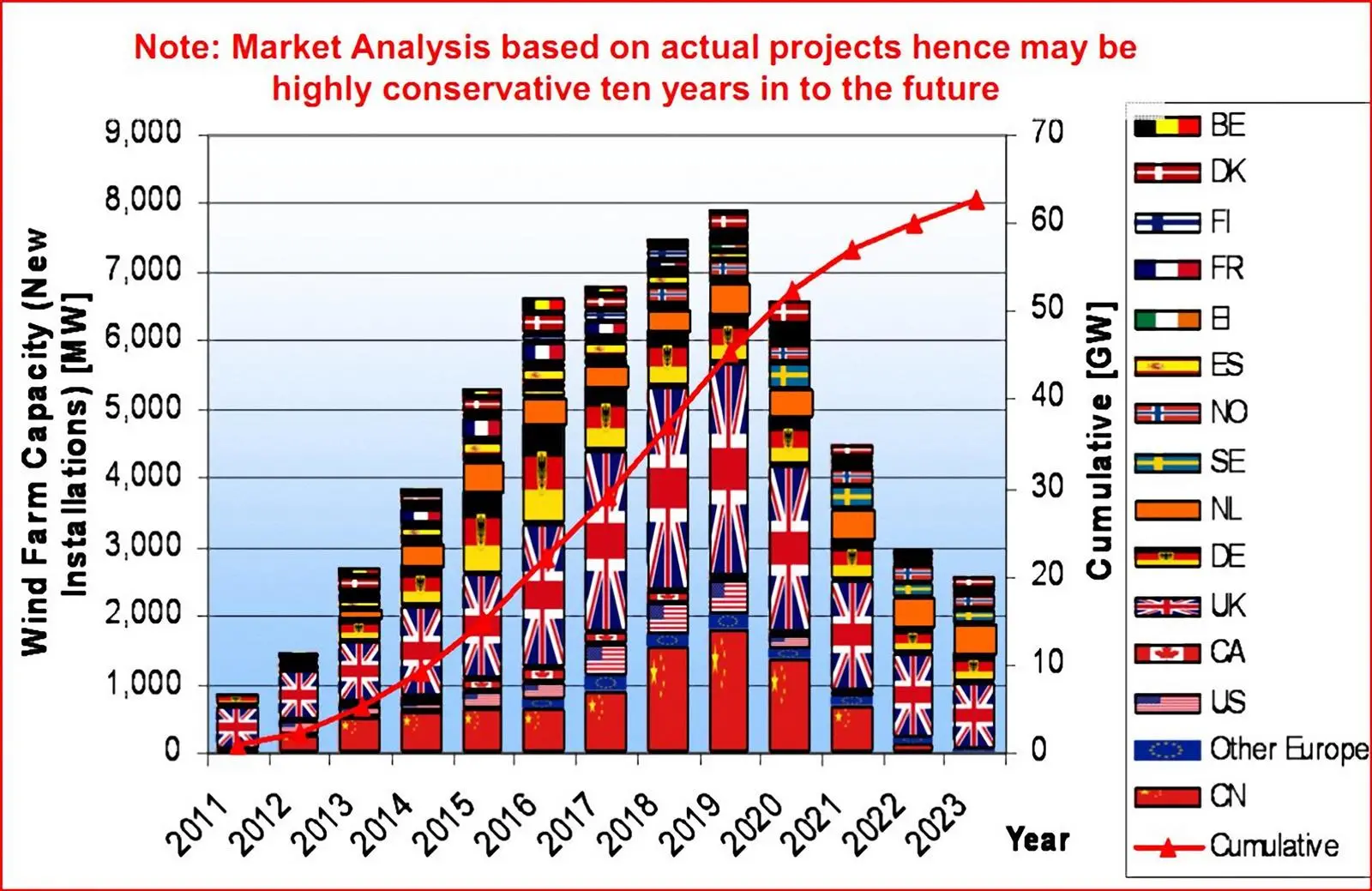
According to deputy head of the project management department at Germanisher Lloyd, Teena Tillessen: “Most of the windfarm development projects take place in Europe, but also China is growing, and US growth has been significant. The figures are really conservative, showing only real projects, not what we suspect might happen.”
Ms Tillessen mentions that $43 million has recently been awarded for offshore windfarm projects in the US, “a chunk of which” is expected to go to a study where also GL is participating.
“What we expect in terms of real growth will be up to 1,000 new turbines per year, to be able to provide 1GW offshore rig (power) per year. That represents one average nuclear power plant,” she adds. “There will be a need for lots of cable installation, up to 700km. Depending on how you define the vessels that you need, one could for example take one big vessel that could do everything at one time, you would need up to 20 vessels to install the pod structures with foundations, 14 vessels to install the turbines, and this does not necessarily have to be the same vessels. The further we get we will see more specialisation of the vessels. You would need up to eight vessels to maintain the turbines. What is mostly forgotten is that, just for Europe alone, you would need 300 to 500 support vessels, crew transport and offshore support vessels. These are just normal numbers for normal maintenance,” Tillessen points out. She also notes the prices of windfarms appear to have plateaued, “so we see a very good basis for the development here.”
The analysis of the development until 2023 might be conservative, as it is based on actual projects., but experience has showed also earlier that some projects agreed on have a tendency to be put forward by the politicians, why GL’s curves might not turn out that conservative in the end. We will see.
TECHNICAL CHALLENGES
Ms Tellessen notes that until now mostly monopod structures have been installed, which cannot be used in deeper water. “The deeper the water gets, we will see more jacket and tripod foundations. Gravity based foundations are difficult, due to their much bigger weight and the corrosion risks.”
The size of the turbines is also increasing. “Even though 6MW turbines are not there yet, there is already talk about even bigger rotating machines. With an increasing hub height, the weight of the tower increases. GL expects to see a growing number of specialized vessels.”
Ms Tillessen shows a graph with current and planned projects in Europe, indicating distance to shore and water depth. Currently, according to Tillessen, the projets are in the so called ’20-20 envelope’, 20km offshore and in 20m deep water. Planned projets are already in the ’60-60 envelope’ going further offshore and into deeper water. “In the deeper waters of Southern Europe, you would have to use floating turbines, as is the case also in Japan. We have the first test sites, but that technology is still to be developed to be cost effective as well,” Ms Tellessen points out.
The significance of designing the installation vessels for the right conditions is also pointed out by Ms Tillessen, providing as an example a location outside the German coast in the north Sea, where weather data has been recorded by the FINO 1 weatherbuoy. “If you have a vessel that can operate in a significant wave height of up to 1m you would have about 40% uptime with your vessel. 60% of the time you cannot use the vessel in that area of the North Sea. Increasing the capability to 2.5m significant wave height you would have 80% uptime, earning money.” A typical cost breakdown for an offshore turbine installation shows that 19% of the time the vessels are waiting for good weather.
DESIGN OF WTIS
The wind turbine installation ships will have to be able to carry even bigger structures. Ms Tillessen separates these ships into three generations, the first being vessels with cranes, and working barges. They have relatively low lifting and deckload capacity. “They have a working deck but that is about it,” Ms Tillessen says. These barges are used very close to shore, where other vessels are not available. The second generation, would be similar to Thor, designed by Hochtief Solutions and built in 2010, or earlier jack-up platform Odin, built by Hochtief in 2004. They have everything that the first generation has, with the addition of larger accommodation, a helicopter deck and self-elevating capability.
The third generation vessels, as defined by GL, have, additionally, DP capability and are self-propelled. As an example of a third generation installation ship Ms Tillessen presents the WTIS for Swire Blue Ocean, the Pacific Orca, the first unit being built by Samsung Heavy Industries for delivery in July, and classed by GL. The scope of work by GL included analysis and verification, newbuilding classification, plan approval, newbuilding supervision, and also fleet in service. GL Noble Denton carried out detailed engineering for the jacking system as well as failure mode effect analysis for the DP2 system. The Pacific Orca measures some 155m x 50m. The deck area is about 4,300m2. The jack-up unit has six lattice type legs and a rack and pinion jacking system, it can travel at 13 knots, has DP2, a 1,200t main crane and has accommodation in 111 cabins. This unit is capable of operation in water depths up to 75m, with leg extention.
As sophisticated projects aimed for challenging interdisciplinary conditions, wind turbine installation ships carry a very high price today, in the range of €100m to €115m. They are designed for operation in high wind speeds and rough sea conditions. According to Ms Tillessen, key sucess factors for designing WTIS are reliability and flexibility.
LEGS AND JACKING SYSTEMS
Cylindrical legs operated with a hydraulic pin and hole arrangement feature on Hochtief’s Thor design, built by Crist shipyard in Gdansk in 2010, after a first contract was cancelled with the Hellenic Shipyard in 2008.
A heavy-lift jack-up vessel, Innovation, was commissioned by HGO InfraSea Solution, with Hochtief and GeoSea, part of the Belgian DEME Group, and is due for delivery, also from Crist in Poland, in the next few months. This has lattice legs and a jack-and-pinion jacking system. Although the lattice system costs more and requires more maintenance, it is lighter and has a smaller hydrodynamic resistance, and thus induces smaller forces on the jack-up structure at sea. The lattice legs can carry higher loads than cylindrical legs, and despite occupying a greater space, have a higher jacking speed. The cylindrical legs can, in practice, be produced with a maximum diameter of 3.5m to 3.7m. According to Ms Tillessen, the maximum water depth which can be accommodated by cylindrical legs is some 40m to 45m. Thus the lattice legs and rack and pinion system is mostly used on vessels constructed today.
RULES AND REGULATIONS
For a classification company the windfarm installation vessel provides a challenge, according to Ms Tillessen. “Is it a ship, or a jackup or a heavy lift vessel or a passenger ship?” she asks. In response, she says: “It is all of these at the same time.”
The problem is that all these different vessel types have different, sometimes contradictory, sets of rules and regulations, developed over time for ships and offshore units. Somehow one has to merge these together, and decide how to proceed. In the past this proved difficult, having to discuss with flag states about decisions on issues of safety and marine pollution, among other considerations. “We did that for a number of vessels and have found our way through this jungle,” says Ms Tillessen
IMO is currently working on a common set of regulations covering the questions the industry has on this issue, while GL has recently published new rules for Offshore Wind Farm Service Craft including class notation “Crew Boat”, a vessel type which previously had no clear sets of rules.
Related Articles
 METHANOL
 MONITORING, CONTROL & DIGITALISATION
 MONITORING, CONTROL & DIGITALISATION