



Google applies for wind-assisted propulsion patent
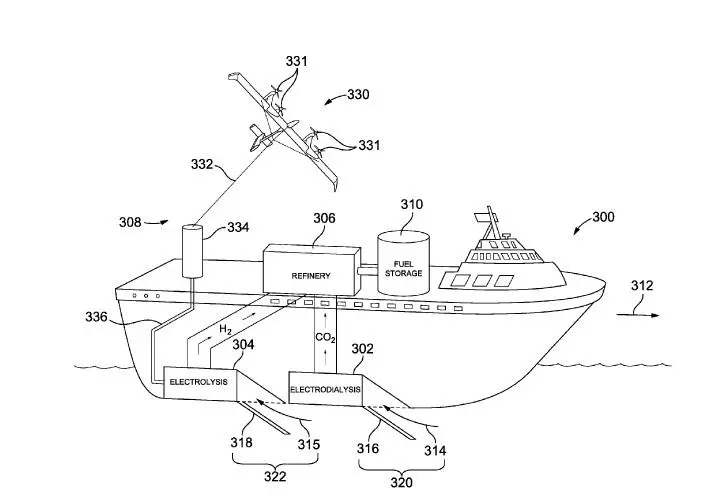
The application, filed with the US Patent Office on 22 September, envisions a kite carrying several turbines, tethered to a vessel by an electrically conductive wire. Propulsion power will be provided by electricity generated by the kite rotors and transferred to the vessel, and also by a mode in which the kite itself is powered to provide a pulling force through the tether.
The patent authors indicate that the airborne wind turbine (AWT) system can be operated in three different modes. In fair conditions, it can be powered by stored energy to provide a pulling force, with the authors claiming that such propulsion can be more efficient than propellers in the water. In good conditions, the AWT is propelled by the wind, transferring a pulling force to the vessel. And in very good conditions, the AWT is propelled by the wind while generating electricity to be transferred back to the vessel.
The application indicates a further use that would harness energy generated by the kite for the creation of clean hydrogen fuel onboard the vessel. This set up would incorporate electrodialysis and electrolysis systems on the vessel to extract CO2 and H2 from seawater respectively, with hydrogen used for the creation of fuel or chemicals.
Google has already developed the Makani energy kite, consisting of turbines fitted to an aerial wing and tethered to a ground station. The project was initially designed with the aim of harnessing wind energy at a lower capital cost than traditional wind turbines and with a greater operational range.
The application can be viewed here.
Related Articles
 PROPULSION
 GENERAL NEWS
 GENERAL NEWS