



Green issues impact on machinery insurance
When The Motorship celebrated its 85th anniversary in 2005, an editorial on the event noted that a report in that (April) issue dealt with future thinking on ship propulsion concepts when oil became scarce or too expensive.
It was a prescient appraisal at the time as it turns out, given that the oil conundrum is still with us. But now ship propulsion is also greatly affected by the ‘green’ world we are coming to accept, by default if not by desire, witness the recent news that
Mitsubishi Heavy Industries is competing with Wärtsilä and MAN Diesel to develop a range of slow-speed two-stroke engines to run off natural gas as well as oil. There is now a powerful lobby for gas-powered vessels aplenty in the future as shipowners brace themselves to meet the challenges of emission regulations and the possibility of high fuel costs.
Some of the biggest boxship lines are encouraging their charterers to install slow steaming kits on containerships, Maersk being among the most vociferous in advocating the switch. However, some of the sceptics – for example, engine makers and marine surveyors – still maintain that slow running for lengthy periods can cause some engine damage because of the high temperatures.
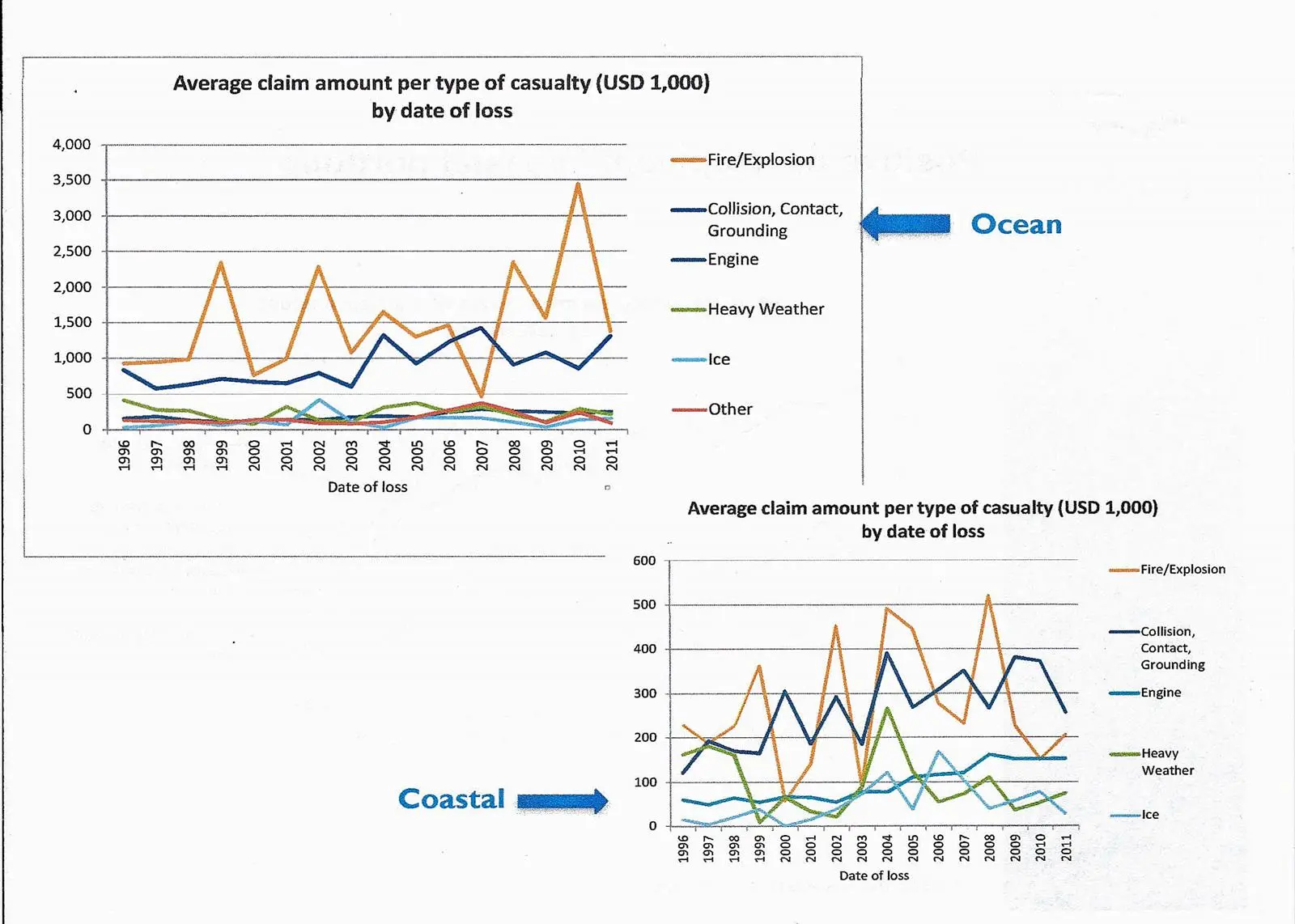
Marine insurers are keeping a beady eye on all this as engine damages still top the list for claims. When Cefor (The Nordic Association of Marine Insurers) issued annual statistics from its database earlier this year, it was shown that in contrast to the absence of major losses, minor claims rose in 2011.
“The total claim cost per vessel is continuing its upward trend from 2010,” confirmed managing director Helle Hammer.
Engine claims were still by far the most frequent individual claim type with 37% of all claims, and a slightly lower impact on the cost at 31% of the total cost due to a number of minor claims. “Engine claims are high on our agenda, and Cefor is paying particularly close attention to the introduction of fuel oil of different grades and the impact this will have on machinery,” added Hammer.
These comments were reinforced a little later when the International Union of Marine Insurance issued its preliminary stats for 2011. While the number of major incidents remained consistent with the trend experienced over the previous four years, said IUMI, the back-year figures continued to deteriorate with the likelihood that 2011 would follow a similar path.
The major cause of serious losses remained “machinery damage and engineroom problems,” accounting for 35.43% of incidents over the last five years. In total, 50% of all major serious incidents reported have occurred to vessels in excess of 20 years of age, it was noted.
As Cefor inferred, a worrying number of claims for engine damage often attributed to fuel mismanagement are finding their way to the London and other marine insurance markets such as Norway. This means that ship operators, if they do not do so already, must ensure the tightest control over fuel supply and handling, especially now that environmental regulation is bearing down on the industry more strongly than ever.
On the whole question of engine damage and slow steaming, The Motorship sought the views of a prominent member of Cefor, the major Norwegian hull and P&I insurer Gard. Regarding slow steaming, it is encouraging that Gard has not seen claims which can be directly related to this practice, but the main worry is the internal fouling of the engines and related components like the turbochargers and exhaust boilers.
Karl Mühlbradt, senior claims advisor at Gard, said that many ships have no by-pass of exhaust to the boiler, and during slow steaming more unburned fuel and heavy exhaust components may be accumulated in the boilers; during manoeuvring or increased loads, fire may occur in the boilers. Gard recommends that owners should always follow the engine maker’s recommendations for slow steaming, and in addition increase to full load at least for one hour per day in order to “clean” the engine and related components. Modern engine designs with electronic contrels will be much better prepared for slow steaming than old, conventional engines.
Mr Mühlbradt points out that the new regulations in Europe and the US will force the sulphur content down to 0.1% in the ECA and California areas by 2015, and down to 0.5% globally by 2020. To reduce the sulphur content to these levels means that ships have to be run on MDO or MGO instead of the HFO for which they are designed. Scrubber systems may allow fuel with no sulphur restrictions to be used also in the future, but such installations have still some practical problems to overcome. MDO and MGO have very low viscosity and lubricity, which will be even lower at high temperatures in a warm engineroom and cause problems to fuel pumps and fuel injectors from increased wear and internal leakages.
Mr Mühlbradt says they fear that in order to produce a sufficient amount of low sulphur fuel, mixing/blending and refinery processes are optimised, and the fuel is more likely to burn worse in the engine, incurring problems with starting, internal fouling and knocking as a result. Problems with starting may lead to grounding/collisions, while bad combustion and fouling can result in severe engine damage.
He says: “We have also seen an increased amount of catalytic fines in the low sulphur HFO, and if the fuel treatment plants are not optimised and continuously properly maintained and adjusted, severe wear to pistons, liners and HP pumps can occur within a short time.
“For hull insurers these claims are very difficult to handle as there are problems with documenting the historic condition of the engine, fuel quality received and when, treatment process on board etc.”
Importantly, “we have also seen that low sulphur MDO or MGO have flashpoints below 60degC, which is the SOLAS minimum allowable flashpoint for fuels to be used on board. Consequently, the ships should not be allowed to sail.”
Finally, and another important consideration: Mr Mühlbradt says Gard is of the opinion that the fuel used on different ships may have a direct impact on the safety of the ship, cargo and crew. As class is not involved in operational issues, and fuel is considered as such, Gard took it up with a class society that it should be involved with what quality of fuel the engines are suitable for. There was a positive response to this approach, and the society in question presented the insurer’s position to IACS.
Class is the reference for marine insurance covers, and class approval and acceptance is a condition for the insurance. With the rules and limitations coming up related to the type of fuel that can be used on board, Gard is of the firm opinion that class should be involved.
Related Articles
 METHANOL
 MONITORING, CONTROL & DIGITALISATION
 MONITORING, CONTROL & DIGITALISATION