



Hedging the bets
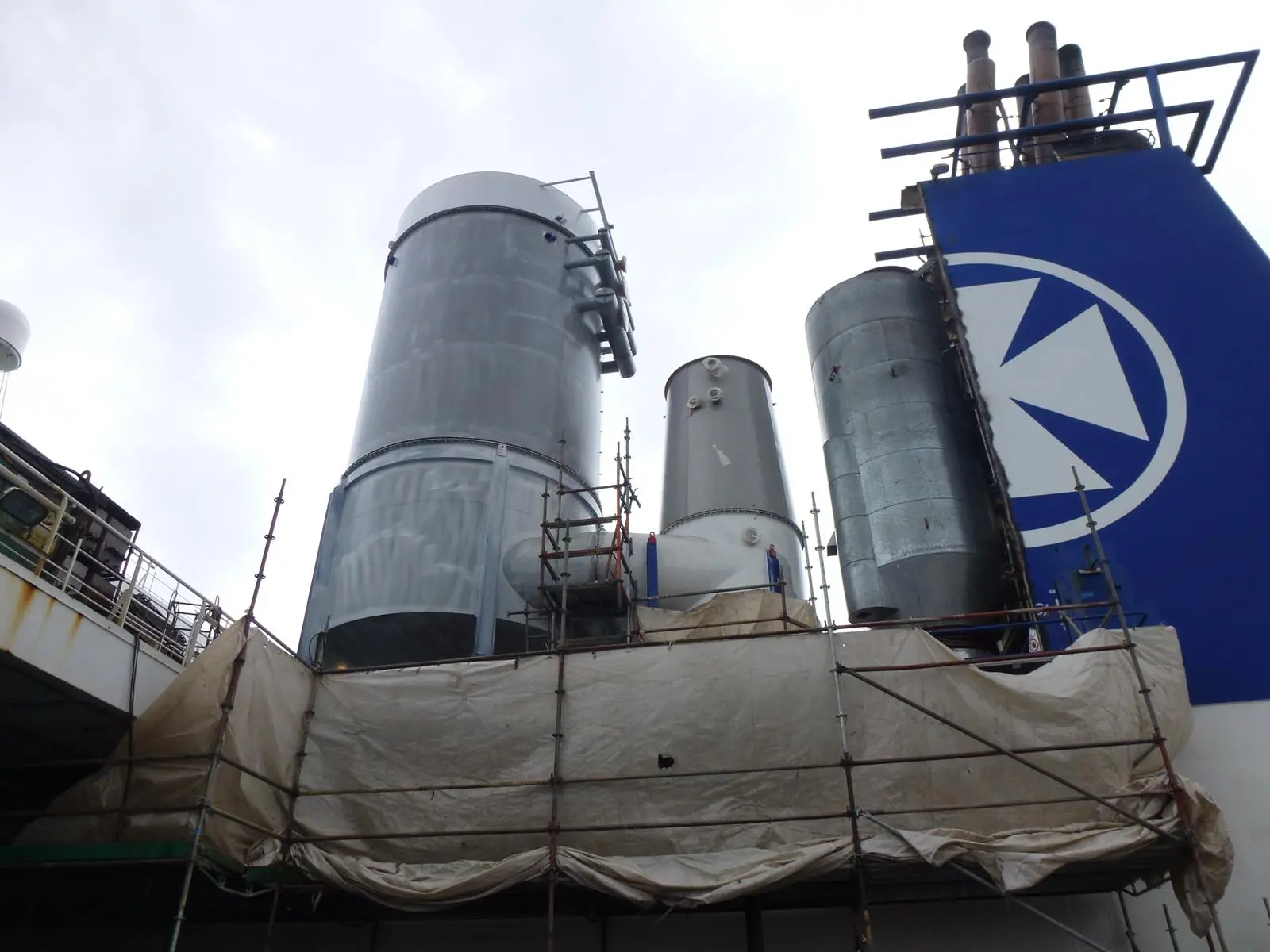
While incorporating 90 tonnes of extra steel into the funnel casing poses significant engineering challenges, it was the regulatory challenges that ultimately determined the SOx scrubber technology chosen by Denmark-based ferry operator DFDS.
After a trial installation on Ficaria Seaways in 2009, DFDS is now retrofitting Alfa Laval’s PureSOx hybrid system to three ro-ro vessels at Polish shipyard Remontowa. They are hybrid scrubbers so the company can evaluate both open and closed loop systems or perhaps settle on continuing to install hybrid systems. It is not simply a matter of the salinity of the water the vessels will transit. “There are still some open questions amongst certain countries in the north European emission control area (ECA) whether open loop scrubbers will actually be permitted,” says Poul Woodall, director of environment and sustainability at DFDS. “It’s a problem for a company where we have to take a big financial decision without the legislation being 100% clear,” he says. “The first movers are taking a risk. We’ve decide to take the risk in that we are going for the hybrid version, but it is a more expensive option.”
Each vessel needs to be evaluated to ensure there is adequate space to install a scrubber and that vessel stability is not compromised. “Can it be done, first of all, and secondly, can you sail with it without any significant cargo loss due to poorer stability or taking some of the cargo space away?” asks Mr Woodall.
Installed after the 21MW MAN 9L60MC-C main engine on Ficaria Seaways, Alfa Laval claims the world’s largest exhaust gas cleaning system on board a ship. On the open sea, PureSOx operates in open loop mode on seawater, while in low salinity waters it operates on freshwater in a closed loop configuration. Switching can be done manually or automatically. Water flow is automatically adjusted to engine power and to the sulphur content of the fuel.
“Like any other major investment, you ask a number of suppliers that you know deliver a decent product, and then it’s part of the negotiations, both technically and financially, to determine who you eventually decide on. We’re fairly confident we’ve made the right decision here, and we look forward to seeing how well they operate.”
DFDS has a growing number of systems to choose from as it rolls out the technology across the fleet. Clean Marine of Norway claims the only system currently on the market with true multi-stream exhaust gas handling, so that all exhaust sources on board – including boilers – are served by one common unit without causing an increase in back pressure. This is achieved by two fans and a gas recirculation mechanism, which together ensure that pressure at the common gas meeting point is maintained at ambient level, irrespective of the amount of exhaust gas fed to the system.
The Advanced Vortex Chamber is another part, said to be unique, of the Clean Marine system. This high-speed cyclone is claimed by the company to offer outstanding separation efficiency and to achieve a high sulphur and particulate matter trapping efficiency at minimum cost. Clean Marine’s system is of the hybrid type, in that it can operate in both open and closed loop modes. It differs from other systems in that it uses caustic soda in both modes, which means vessels can operate in all types of water (including low alkaline and saline water) in either mode and without loss of efficiency.
Clean Marine estimates a payback time of around a year for most vessel types, assuming $300/tonne price difference between MGO and high sulphur HFO, and 100% operation in ECAs. The company is targeting the merchant fleet of bulk, tank/gas, ro-ro and container vessels, but the system is said to be suitable for all vessel types depending on configuration.
Norwegian Cruise Line’s two new Breakaway Plus class vessels being built by Meyer Werft in Germany will have scrubbers from Green Tech Marine. The company will supply five scrubbers per ship for the engines, which range from 14.4MW to 16.8MW power rating. The compactness of the systems is said to mean that no cabin space or other service space will be lost, and the scrubber also replaces the silencer.
Poly Shield Technologies has announced an installation agreement with LMS Shipmanagement for an initial two-vessel installation of its newly developed DSOX-15 fuel purification system. The DSOX-15 system works by creating an emulsion of fuel and process water which is injected into the system’s processing unit under high pressure. Sulphur is released from the fuel making it possible for the sulphur content to mix with the water, from which is then separated out.
DuPont’s Belco system offers shipowners that transit in and out of ECAs a type of functionality that the company considers unique, i.e. true ‘run dry’ capability. The scrubber’s all-metallic construction is designed to withstand high engine temperatures even when the scrubber is not in operation so no bypass is required. This reduces the system’s space requirements. The open tower design is claimed to enable operation without shutdown for periods of over five years.
Hydro Infra Technologies claims its hydro nano gas (HNG) system can be inserted into exhaust outlets to neutralise pollution emissions in a three-step wet and dry process that starts in the combustion chamber. On a molecular level, HNG is a specific ratio mix of hydrogen and oxygen which exploits specific properties of hydrogen generated via water molecules being subject to low energy pulses.
Careful forecasting
DFDS owns or operates a fleet of around 55 ships, and, despite the market variety, some vessels just aren’t suitable for retrofitting scrubbers. Like everything in shipping, financing is not in abundance, says Mr Woodall, so choices have to be made. “For some ships it is not physically possible to do, either for space reasons or for stability reasons. There is also the issue of the expected lifetime of the ship. For such a major conversion, does it have time to pay off?”
Bureau Veritas (BV) has been involved in the DFDS installations as well as others on a variety of vessels. Stability is one of the most important considerations when deciding to install a scrubber, particularly for ferries and cruise ships, says marine environment leader, Martial Claudepierre. It is less likely to be a problem for container and cargo ships, he says.
“It is also important to make sure the scrubber will not weaken the structure, and we have requirements for the additional power required for the dedicated pump and for the associated piping,” says Mr Claudepierre. “You can use the same funnel but up to the top of the ship, the pipe must be independent between main engine and auxiliaries to avoid the possibility of exhaust gas being communicated from one room to another.” In the case where there are two propulsion systems, BV expects two independent scrubbers to be installed.
BV has introduced the ‘Monitoring’ notation to help shipowners deal with the uncertainty surrounding compliance issues and also industry perceptions about unknown or poor system reliability. “We are offering the facility to monitor the SOx emissions so shipowners have an independent way of seeing if the scrubber is running well and to prove to port authorities that, firstly, you are compliant, and if you are not compliant, that you did your utmost to be compliant,” says Mr Claudepierre.
Some manufacturers are looking beyond SOx compliance to ensure the systems they offer will provide a total emissions solution. Wärtsilä offers open, closed and hybrid scrubber systems and has over 20 orders and installations, but the company has also received orders for a hybrid exhaust gas cleaning and selective catalytic reduction system that will provide compliance for upcoming SOx and NOx requirements. The ability to switch between open and closed loop scrubbing can be made at any time.
MAN Diesel & Turbo’s DryEGCS system, developed with Couple Systems, is said to be based on simple and proven technology requiring little maintenance which is compatible with other emission-reduction technologies as it has no significant impact on exhaust gas temperature or back pressure. The exhaust gas is passed through a reactor filled with granules of hydrated lime. Gypsum is formed when it binds with SOx in a completely dry process. For newbuildings, the system can be installed close to the engine for increased stability and reduced impact on cargo space. The system has been retrofitted on the general cargo vessel Timbus.
Ecospec’s CSNOx system is another that is designed with future NOx requirements in mind. CSNOx is a non-chemical system that uses ultra low frequency wave technology to remove SO2, CO2 and NOx from flue gas in a single process. ABS has verified that 99% of SO2, 66% of NOx and 77% of CO2 were effectively removed from the exhaust gas of an 11MW heavy oil diesel engine on a tanker. Ecospec is currently conducting additional formal performance measurements of the system on a Canada Steamship Lines vessel in the Great Lakes, and the company has entered into an agreement with Sembawang Shipyard in Singapore to facilitate the provision of turnkey environment-related solutions.
Related Articles
 PROPULSION
 GENERAL NEWS
 GENERAL NEWS