



HFO still dominant in 2030, says LR study
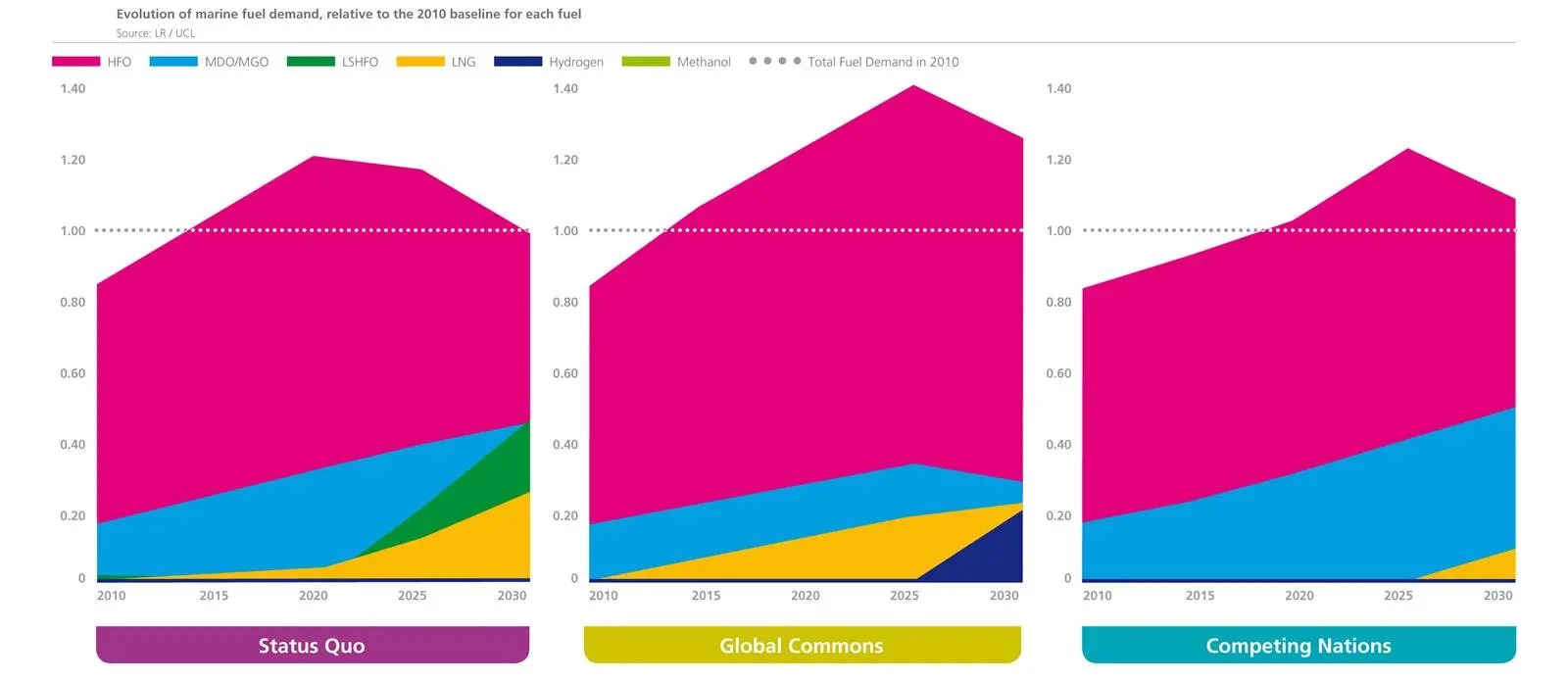
The latest study, conducted by Lloyd’s Register and the UCL Energy Institute concludes, somewhat surprisingly in view of some other forecasts, that heavy fuel oils will remain a dominant fuel for the majority of ships for at least the next 15 years. The conclusion is based on three scenarios which are said to affect future fuel demand for the containership, bulk carrier/general cargo and tanker sectors, which together, says LR, represent around 70% of the global shipping industry’s fuel use.
The three scenarios are:
Status Quo – The world will continue its current growth momentum with some booms and busts over the next 20 years.
Global Commons – A shift to concern over resource limitation and environmental degradation will see a desire for a more sustainable world being developed and fairness in wealth distribution. Governments will find common ground and accelerated economic growth, within a framework of sustainable development, which will follow.
Competing Nations – States act in their own national interest. There will be little effort to forge agreement amongst governments for sustainable development and international norms. This is a self-interest and zero-sum world with a likely rise in protectionism and slower economic growth.
Under all three scenarios, shipping will expand strongly, as forecast in the 2013 report. This alone will account for increased fuel demand, though the increase in fuel use will be limited by emissions regulations and rising energy costs.
There will, without doubt, be an increase in use of gaseous fuels such as LNG plus other alternative fuels, although this will be influenced mainly by price differentials, supply, and future regulatory demands. For example, the ‘global commons’ scenario assumes that the 0.5% global fuel sulphur limit will enter into force in 2020, as first agreed by IMO; under the ‘status quo’ the sulphur cap will be deferred until 2025, as seems possible now, and the ‘competing nations’ scenario would be ikely to see the introduction delayed still further.
Carbon emissions present a similar dilemma. Under the two more conservative scenarios, carbon limiting measures will be restricted to current proposals such as EEDI and probably local restrictions, while the ‘global commons’ will see global measures such as carbon taxation or carbon trading introduced, and this in turn will encourage the adoption of low-carbon, or zero-carbon, solutions, including hydrogen as fuel.
The high retention of HFO – dramatic shift to other fuels. While conversion to alternatives such as LNG, is technically possible, it is likely to be extremely expensive and complex, and most LNG-fuelled ships will be equipped for dual fuel use anyway, so could burn either depending on cost and supply. The take-up of abatement technology such as exhaust gas scrubbers will further encourage retention of HFO. LNG and low-sulphur fuel oils will certainly be used, increasingly, in ECAs and sensitive zones, so under all scenarios their market share will see an increase.
According to Lloyd’s Register, the conclusions are reflected in the fact that its study concentrated solely on the large deep-sea market. Other forecasts which have seen a much sharper take-up for LNG and other alternatives such as methanol and bio-fuels have looked at the short-sea sector, which is more influenced by local supplies and regulation than the global situation.
“I think that the report underlines that any transition from a dependency on HFO will be an evolutionary process,” said project leader, Dimitris Argyros, LR’s lead environmental consultant. “LNG is forecast to grow from a very low base to a significant market share by 2030 – even if there is no major retro-fit revolution – most of the LNG take-up will be in newbuildings. But it is important to note that an 11% share in 2030 is the equivalent in volume of about 20% of the bunker market today.
“What we can say is that the uptake of engine and alternative propulsion technology and the emergence of non-fossil fuels can only be driven by a society’s ability to create a world with lower GHG emissions – the technology is not the barrier. Key will be policy and markets. Shipping can control its own destiny to some extent – but shipowners can only focus on compliance and profitability. If society wants lower GHG emissions and cleaner fuel, change in shipping has to be driven by practical regulation and market forces so that cleaner, more efficient ships, are more profitable than less efficient ships with higher GHG emissions.”
Related Articles
 ALTERNATIVE FUELS & LUBRICANTS
 GENERAL NEWS
 GENERAL NEWS