



Hyundai Glovis Plans World’s Largest Car Carriers
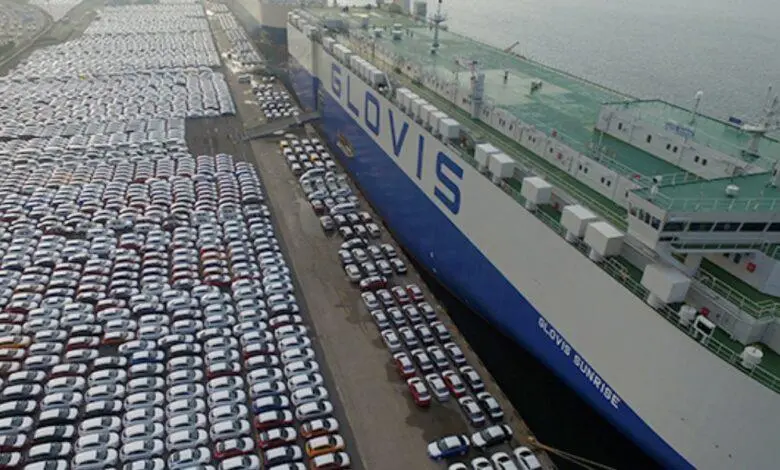
The Seoul-based company’s board has authorised a planned $1.84m investment calling for the construction of 12 newbuilds of 10,800 car-equivalent unit (CEU) load intake. Each will be specified with LNG dual-fuel machinery. A shipbuilding contract has yet to be announced, although it is indicated that completion of the entire programme is sought by 2027.
The largest PCTCs at sea are Hoegh Autoliners’ 8,500 ceu Horizon-class vessels, completed by Xiamen in 2015-2016. The Norwegian operator is due to commission the first of 12 Aurora-class newbuilds of 9,100 ceu from China Merchants Heavy Industry (Jiangsu) during the second half of 2024, while Wallenius Wilhelmsen last month firmed-up a deal with CM Jinling Shipyard covering four PCTCs of 9,350 ceu, plus eight options.
The contractual commitments by leading Nordic names in the sector, and the fleet development signalled by Hyundai Glovis, follow a decade of restrained ordering of PCTCs and the post-pandemic rebound in car demand.
The Korean operator currently deploys about 80 owned or chartered, dedicated vehicle carriers, and maintains a liner-type, global service network. While highly correlated to the light vehicle manufacturing of Hyundai Motor Company and Kia Motors, the company has steadily expanded and diversified its client list and cargo business, such that transportation of foreign marques now accounts for half of all revenue.
The deepsea operation maintained with PCTCs is used not only for factory-new vehicles, but also for shipments of components, construction machinery, breakbulk and project cargo consignments, plus regular flows of CKD (completely knocked-down) units for overseas factories of Hyundai Motor Company and Kia Motors.
The nomination of LNG-capable propulsion engines to power the 10,800 ceu newbuilds allies with the Glovis bid to reduce emissions from the ocean fleet and road transport by at least 20% come 2030 relative to 2021. The long-term plan is a 70% cut in emissions by 2040 and achievement of net-zero status by 2045.
In response to industry concerns over incidents of fires on PCTCs carrying electric vehicles, Hyundai Glovis last year implemented a raft of extra and customised measures to better ensure safety. The company has introduced special equipment such as fire covers and water mist lances.
Fire covers can be placed on burning vehicles to prevent oxygen inflow, restraining heat and smoke, and preventing flames spreading to neighbouring vehicles even in typically densely-loaded situations. The mist lances spray water are said to be effective in penetrating and controlling sources of a fire outbreak, whether close to the bottom of a car or in internal spaces.
Other measures adopted include CCTV on each deck, along with heat and smoke detectors to provide crew with an early warning system.
Related Articles
 ALTERNATIVE FUELS & LUBRICANTS
 GENERAL NEWS
 GENERAL NEWS