



Integration to solve road transport problems in Europe
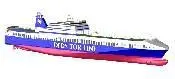
The results of the first 18 months research carried out by the EC funded project ?INTEGRATION? (Integration of Sea Land Technologies for an Efficient Door to Door Intermodal Transport), have been presented in Madrid last week. The main achievements are:
– a new Automated Guided Vehicle (AGV) to automate loading and unloading operation of RORO ships and terminal operations, with a 500 TEU/h handling capacity, and
– new RORO ships specifically designed for the AGV system.
The designed ship-terminal system is based on the integrated use of the technological innovation of the different transport modes. The high handling capacity of the proposed system addresses one of the main bottlenecks to the development of the ?maritime highway?, the loading and unloading time and the waiting time at the berths.
INTEGRATION deals with the transportation of general unitised cargo, containers and swap bodies. Pallet-wide containers and maritime swap bodies allow a more efficient handling of pallets compared to the traditional containers. Complying with the current requirements for cargo security, pallet-wide containers and swap bodies are considered to be the future intermodal transport cargo unit and is able to fully satisfy logistic requirements.
INTEGRATION systems are characterized by very fast cargo loading/unloading operations of the ship, the highest capacity of which include quay ramps and automated operations. Handling tools shift cargo on the horizontal plane with a minimum of vertical movements. Ships are of the RORO type, designed to make the whole cycle of cargo loading/unloading and cargo lashing on board easy, fast and less expensive.
A full range of new RORO and ROPAX vessels has been designed by FINCANTIERI, IZAR and CETENA. The ships are designed to satisfy a wide range of speeds from 10 to -55 knots, and cargo volumes from 80 to 1,300 TEUs bearing in mind the integration requirements for the ships in relation to a wide range of terminal facilities from the smallest and least well equipped to the largest fully automated ones. These new efficient designs will meet market demand and satisfy current and potential requirements for short-sea shipping (including feeder traffic) and the intermodal freight transport.
For example, the biggest RORO ships, carrying 1,500 TEUs with a speed of 20 knots, are designed to compete with the traditional feeder boxships. The loading / unloading cycle for these vessels using a fully AGV automated RORO terminal, equipped with an external fixed ramp, has been calculated at approximately 6 hours. “That enables a single terminal to host up to 4 ships every 24 hours with a yearly handling flow of more than 2 million TEUs, an enormous freight flow comparable to the entire container flow in 2003 of one of the larger Mediterranean ports such as Genoa (including VTE terminal) or Valencia, said Mr. Carlo Camisetti, the INTEGRATION project Coordinator.
Currently, the movement of 2 million TEU containers per year, would require a fleet of 25 container ships, using traditional Lo-Lo container terminals. With the application of the INTEGRATION system, it is estimated that only 14 RORO ships would be needed with a significant reduction in the use of terminals.
The estimated data obviously needs to be field-tested and, for this purpose, two AGVs prototypes built by TTS and Danaher Motion are almost ready and will be used to load and unload RORO ships in the ports of Gothenburg, Genoa and Gioia Tauro starting this coming spring. The feasibility of transhipment operations from a deep-sea boxship to a feeder vessel will be trialed at the Gioia Tauro Medcenter container terminal, using quay cranes to load / unload the container ship and AGVs to move the cargo from the crane to the RORO ship.
Even using a semi-automated RORO ship terminal based on traditional cargo handling procedures and cassettes can be competitive when the terminal is equipped with a fixed ramp allowing the simultaneous loading / unloading of two decks. Taking the example of the smaller RORO ships with a 350 TEU capacity, the terminal could cater for up to 3 ships a day, with a total yearly flow of 750,000 TEUs.
This kind of system can also be applied to ROPAX vessels although the economics are different since it is strongly influenced by the flow of passengers and cars which is subject to seasonal variations in the payload mix. To enhance the ROPAX efficiency it is necessary to reduce the level of ?accompanied trucks? in favour of containers, swap bodies and ?unaccompanied trailers? equipped with trailer trestles to reduce the time spent lashing down trailers.
This new concept of ships and systems developed as part of the INTEGRATION project addresses the requirements coming from a more attractive maritime transport, capable of achieving a significant shift of cargo flow from roads to waterborne transport leading to a growth in intermodal transport. INTEGRATION systems give a practical and viable answer to the huge increase in transport demand for Europe (38% in the period 2000-2010 as stated by the EU Commission White Book on Transport) which cannot be addressed by road transport using current modal systems.
This project is know as the ?Maritime Highways in Europe? and has been designated a priority project by the EU Commission for the development of the Trans-European Transport Networks (two of the four identified areas are in the Mediterranean). These projects, compared to the great road and rail infrastructures (as the ones for example linking Portugal to Kiev in the Corridor 5), could be ready in a relatively short period of time. This means that it is possible to create today, when it is needed most, a sea connection between the Mediterranean European countries and the new European countries through Greece and the Black Sea. This would be an efficient and powerful sea road capable of easing connections and to accelerate the integration of these countries. Maritime Highways will form a network similar to road highways, where the terminals are highway booths open 24 hours a day, 7 days a week, and where cargo can transit or change transport mode. The more this network of terminals will be integrated, widespread, accessible and capable of dealing with traffic flows, the higher will be the possibilities to transport and distribute freight by sea.
Related Articles
 ALTERNATIVE FUELS & LUBRICANTS
 GENERAL NEWS
 GENERAL NEWS