



INVESTIGATION CONCLUDES IRON CHIEFTAIN FIRE HIGHLIGHTS REGULATORY GAP
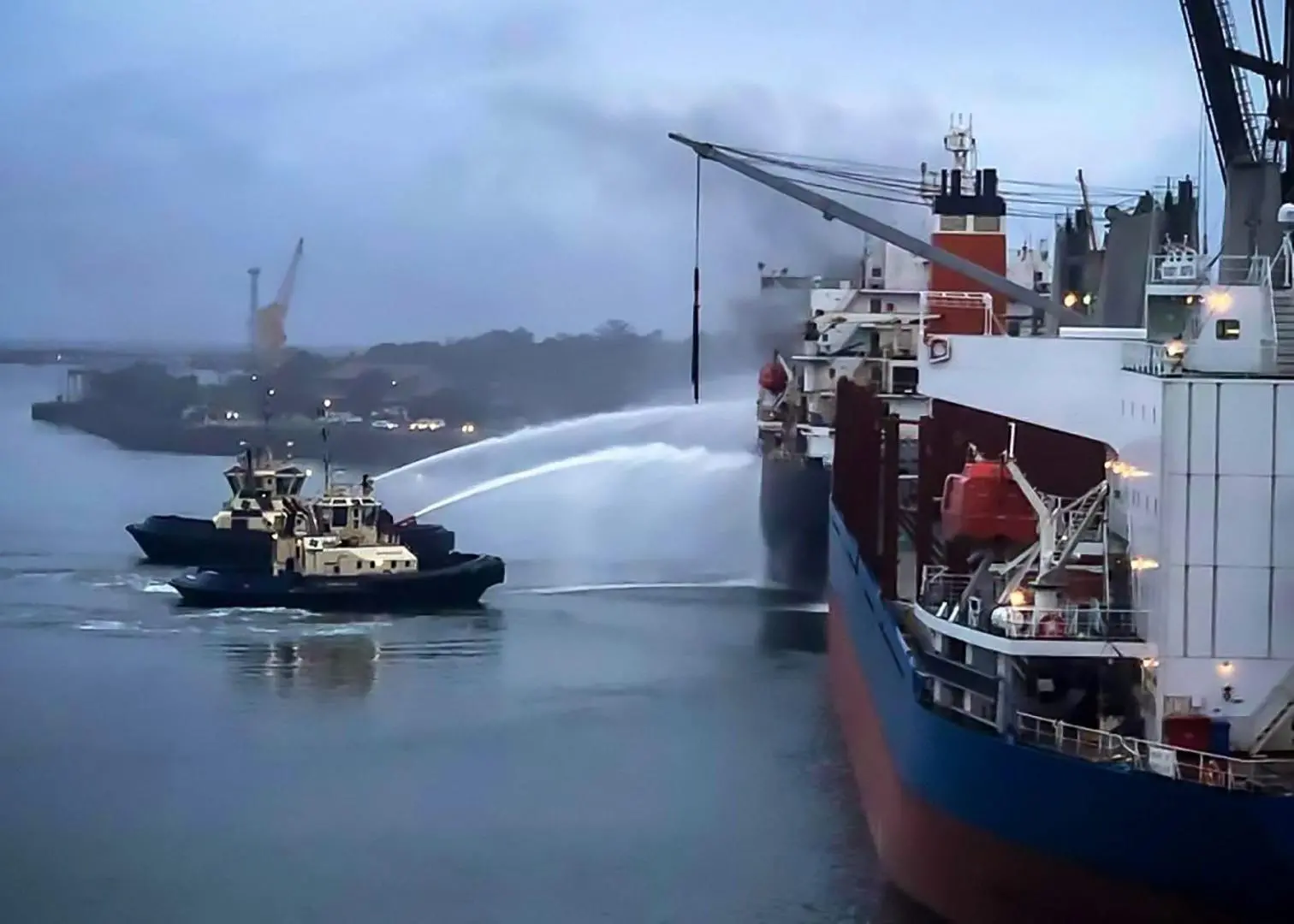
The Australian flagged self-unloading (SUL) bulk carrier was discharging dolomite at Port Kembla, New South Wales, on 18 June 2018 when friction, probably from a failed bearing, generated enough heat to ignite a rubber conveyor belt in the C-Loop internal cargo handling space.
The fire was detected during a regular safety round of the self-unloading system during cargo discharge operations. The ATSB report noted that the initial emergency response by the crew to stop the conveyor belts aided the fire’s early development, as heat could not dissipate. Heat from the fire in the C-Loop space caused thermal stress, cracking and deformation of the adjacent heavy fuel oil tanks, releasing additional fuel for the fire and increasing its intensity and complexity.
Shipboard efforts to control the fire were ineffective, and the fire spread to the exterior of the ship, setting the discharge boom alight. NSW Fire and Rescue responded to the fire, and fire-fighting support also included tugs from Svitzer Australia. It took five days to extinguish the fire, and the ship was declared a constructive total loss and towed to Turkey for recycling.
“The fire on board Iron Chieftain demonstrates how the effectiveness of a shipboard response to a fire depends primarily on the ability to detect the fire at an early stage and quickly extinguish it at the source,” said ATSB Chief Commissioner Greg Hood. “Iron Chieftain’s self-unloading system was not equipped with a fire detection or fixed fire-extinguishing system in the C-Loop space, but nor was it required to be. This highlights the lack of adequate international standards or regulations for dedicated fire detection and fixed fire extinguishing systems in cargo handling spaces of self-unloading bulk carriers.”
The ATSB recommends the introduction and improvement of international standards for suitable fire detection and fixed fire-extinguishing systems in the cargo handling spaces of self-unloading bulk carriers and the introduction of standards for the fire resistant properties of their conveyor belts. “The absence of these measures has been a contributing factor in at least three major shipboard fires over a 25‑year period, including Iron Chieftain,” says Hood.
Previous bulk carrier fires considered by the ATSB included the 1993 fire onboard the Halifax, the 1994 fire onboard the Ambassador, the 2010 fire onboard the Yeoman Bontrup, the 2017 fire on the Spencer Gulf and the 2020 fire on the Donnacona.
In response to the fire, the operator’s parent company, CSL Group, initiated a fire risk mitigation project across its global fleet of self-unloading bulk carriers. Linear heat detection systems and/or closed-circuit television camera systems integrated with video analytics to provide or enhance the capability for early fire detection have since been installed on board six conveyor belt-equipped SUL ships, with installation of similar systems planned for a seventh ship.
A CSL Australia-operated SUL ship with internal conveyor spaces was equipped with a Hi-Fog water mist fixed fire-extinguishing system covering the ship’s internal SUL spaces. In addition, one ship with external conveyor systems was equipped with a deluge system and installation of a deluge system is intended for at least one other ship. Ship‑specific emergency contingency plans for fires in the SUL spaces have been developed and implemented across the CSL Australia fleet.
The Australian Maritime Safety Authority (AMSA) and Lloyd’s Register have agreed to approach the IMO and the International Association of Classification Societies (IACS) respectively, to highlight the issue.
Related Articles
 ALTERNATIVE FUELS & LUBRICANTS
 GENERAL NEWS
 GENERAL NEWS