



Investment In Trade To Swedish Lakes
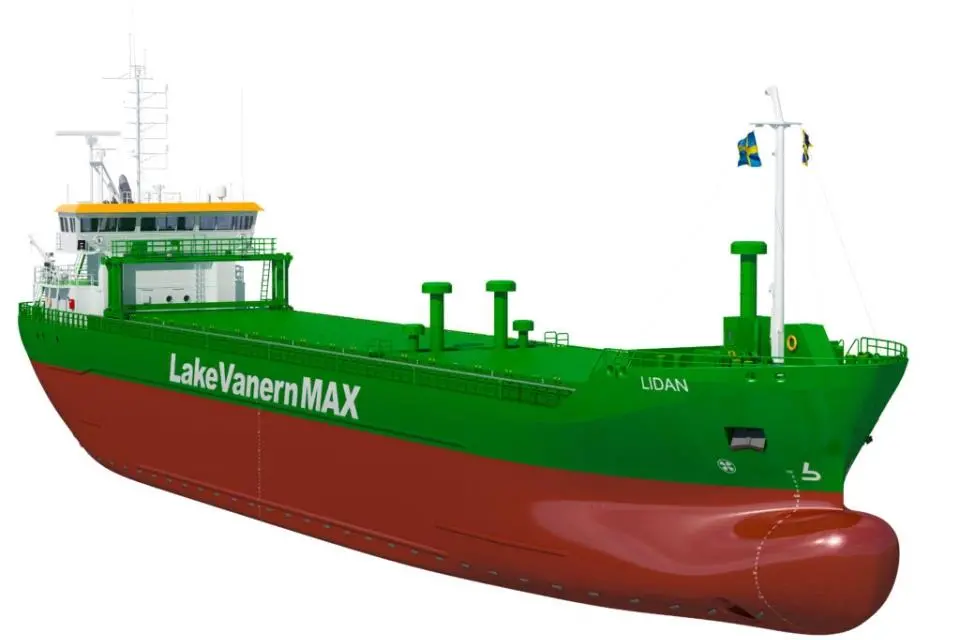
The series of 5,100dwt newbuilds ordered by the Erik Thun Group will be constructed to the maximum dimensions for transit through the various locks up to Lake Vanern, but with design preparation to facilitate lengthening after new locks have been opened some eight or nine years hence.
Shipbuilding contractor Ferus Smit has provided the Thun fleet and others with Vanern-going, general-purpose short-sea traders over the years, and its latest offering is the Mark III version of the Westerbroek yard’s Trollmax type. The specific design for Thun in the current programme is dubbed the Lake Vanern Max, and features a hybrid power setup by way of a battery pack.
The Thun contract encompasses four newbuilds, the first of which is scheduled to be delivered from the Westerbroek canalside premises in the north Netherlands in September 2024.
The multi-purpose Lake Vanern Max vessels are of 89m length overall and 13.35m moulded breadth, the maximum permissible for the chambers of the locks that have to be negotiated at Lilla Edet, Trollhattan and Brinkebergskulle, to accomplish a total 44m rise from the sea. For the canal/seaway navigation, the sailing draught of the new vessels will be restricted to 5.4m from the design’s maximum 6.15m, a measure which will limit operating deadweight by nearly 1,000t to about 4,150t.
Underdeck cargo volume of each of the Thun sisters will be some 206,000ft3 in a single, box-shaped hold with understow.
Strengthening and equipping to Finnish/Swedish ice class 1B standard, and a robust, full double-hull construction, are elemental to ship performance and safety for the arduous year-round, northern duty pattern.
Trollhattan Canal is 82km long, of which about 10km is man-made and the remainder is a natural fairway in the Gota Alv River. The Lake Vanern Max propulsion system configuration, including a large-diameter propeller mounted within a nozzle, meets the particular demands of working through the Gota Alv, and other seaways, as well as icebreaking navigation. The arrangements deliver increased thrust, particularly at lower speeds, and enable primary power to be minimised while still meeting the stringent criteria for 1B ice class certification.
The main engine has a rated output of less than 2,000kW. With combinator mode and the variable-pitch propeller, the fully automatic system constantly selects the optimal load point, maximising propeller efficiency and reducing fuel consumption.
The inclusion of a battery pack will benefit both environmental impact and running costs by enabling peak shaving while under way and by obviating the need for auxiliary engines to be run when at anchor. Moreover, the nomination of an onboard interface so as to draw electricity from the landside grid will allow engines to be shut down at berth, eliminating emissions during port stays.
The shipowning group has nominated various measures in the Lake Vanern Max series to reduce electrical power consumption, one aspect being the selection of cooling water heat exchangers in both main and auxiliary engines so as to harness excess energy.
The locks on the Trollhattan Canal are over 100 years old and are considered to be reaching their technical life expectancy by 2030. To meet the ongoing and future needs of Swedish industry, and allow larger vessels to traffic the seaway, as well as create conditions to support a modal shift from road to water, the Swedish Transport Administration in collaboration with the Swedish Maritime Administration implemented the project for new locks at Lilla Edet, Trollhattan and Vanersborg.
Dialogue with potential suppliers and contractors is ongoing this year, and the planned procurement period is 2025-2026, with a view to the building of new locks taking place between 2026 and 2032.
The canal and Vanern fairways sustain year-round shipping activity. Considerable measures are required to keep the whole system ice-free. The locks are equipped with swirl creators, air-bubbling, hot water sprays and electrically-heated plates in gate housings. During extreme weather conditions, icebreakers are available to keep channels open and shipping on the move. Vessels with the highest ice classes necessitate reduced icebreaker assistance.
Related Articles
 METHANOL
 GENERAL NEWS
 HYDROGEN