



Is nuclear still a game-changer?
Although three other nuclear powered commercial vessels were subsequently built, there was considerable resistance to any wider adoption of nuclear power. These were mainly on grounds of building and operating costs, which in the case of Savannah, were significantly higher than similarly-sized conventional ships, but also on the uncertainties around decommissioning and the safety concerns which prevented access to some countries’ ports.
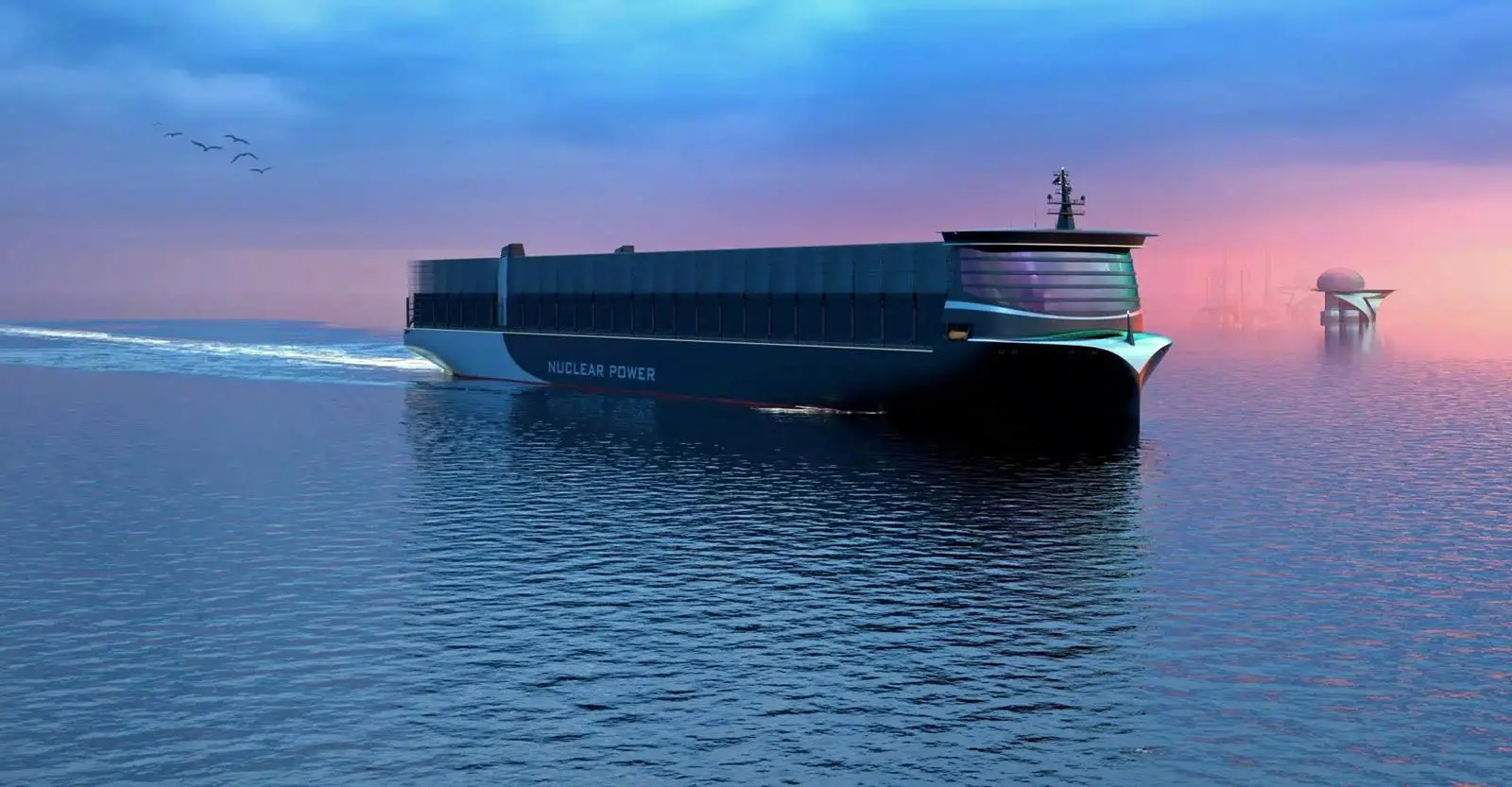
With the present focus on emissions and the environment, nuclear powered ships are being re-examined as a zero-emission option, despite the original concerns still being present. Lloyd’s Register recently released a study, Fuel for Thought: Nuclear, which concluded that nuclear power could transform the maritime industry with emissions-free shipping, whilst extending the life cycle of vessels and removing the uncertainty of fuel and refuelling infrastructure development, but regulation and safety considerations must still be addressed for widespread commercial adoption.
The report draws on nuclear’s proven track record in naval applications, with the study pointing to the role of new small modular reactors (SMRs) in bringing to market suitable low-maintenance plant to meet the propulsion and energy requirements of commercial ships.
LR proposes a model in which shipowners lease power from reactor owners, separating the shipowner from the complexities of licensing and operating nuclear technology. The report sees SMRs as offering a fresh approach to reactor design, with safety, efficiency, and modularity for streamlined production all regarded as potential benefits.
Stringent safety protocols would be paramount, with, in the short-term, LR’s Risk Based Certification (RBC) enabling initial projects to demonstrate an equivalent level of safety to that achieved with conventional fuels. As well as SMRs, pressurised water reactors (PWR), micro reactors and molten salt reactors (MSR) offer other promising technologies for maritime applications. On the downside, perceptions of nuclear power safety and investment readiness levels currently remain low.
LR Power to X director, Mark Tipping, said: “Whilst its use in commercial shipping has been limited, by overcoming negative perceptions and a lack of investment levels, nuclear propulsion could provide immense value for the maritime sector in its decarbonisation journey, allowing for emissions free vessels with longer life cycles which require minimal refuelling infrastructure, or in best case scenarios limit the need entirely.”
LR has joined with maritime and technology innovation company Core Power to conduct a joint regulatory assessment study on the regulatory feasibility and frameworks that would need to be established for a nuclear container ship using a fourth-generation reactor noted for high inherent safety to undertake cargo operations at a port in Europe. A.P. Moller-Maersk is to provide input from its experience as a shipping and logistics provider. The joint development project aims to develop a proposal for a nuclear-powered feeder ship to operate at a European port.
In another project, ABS is working with the Korea Research Institute of Ships and Ocean Engineering (KRISO) to advance commercial SMR-powered ships. ABS will provide analysis of applicable regulatory guidelines and international standards for the design of SMR-powered ships, while KRISO will develop core SMR-powered ship, including conceptual designs for the vessel and propulsion systems.
Patrick Ryan, ABS SVP and CTO said: “ABS is taking a leading role in the support of nuclear power projects in the maritime industry through our knowledge of international regulations and development of class-related related safety requirements. We are proud to apply our experience to these research projects with KRISO. With the increased focus on zero-carbon emissions, modern nuclear technologies offer the potential for decarbonisation in many areas of the sector.”
Research by Dutch naval architecture practice C-Job Naval Architects has demonstrated the potential of nuclear power to become one of the main alternatives in the achievement of sustainable marine shipping. The outcome of the company’s extensive research could benefit all stakeholders in the shipping industry, from companies and investors to port authorities and regulatory bodies.
C-Job research suggests that the use of nuclear energy on large ocean-going vessels could result in a 98% reduction in CO2 equivalent emissions, compared to conventional fuel-based systems. A follow-up study, presented earlier in 2024, has identified a method of converting nuclear energy to propulsion and electrical power that is said to be safe, has minimal space requirements, and offers favourable load response capabilities. The proposed system considers all the components in a nuclear power system on commercial vessels, including reactor types, shielding, heat exchangers, and turbines.
A further important benefit identified by C-Job is that nuclear propulsion could fundamentally change the capital and operational expenditures of ocean-going commercial ships, potentially making their operations more profitable. This is because the cost of fuel, as a part of operational expenditures, grows only marginally with the higher speeds of nuclear-powered vessels.
In two newbuild cases, a container vessel and a bulk carrier, C-Job determined that reactors with 25, 50, and 75 years of service life could all develop higher economic ship speeds than conventional fuel-based options. The additional installation costs associated with nuclear energy is offset by the previously-mentioned low fuel costs and by the fact that a reactor can be used for its entire service life, either in a second ship or by extending the service life of the first ship.
Niels de Vries, head of energy, C-Job, is another who sees nuclear leading to a fundamental change in ship finance: “A potential solution is to adopt a structure where ship owners pay ‘rent’ for the system’s operational hours while specialist companies buy and own the reactors,” he said.
C-Job says it will continue to research nuclear energy for marine applications in its bid to reduce the shipping industry’s harmful emissions, working with several stakeholders to scale down components and facilitate ship integration. As a result, the firm has received its first commission to conduct research into the design of a nuclear-powered commercial vessel.
De Vries continued: “It’s only when owners become willing to invest and build [nuclear-powered] ships that we can develop a concrete framework for the use of nuclear propulsion systems.”
SMR technology features in other maritime-related future fuel proposals beside providing the prime mover in ships. A project by Rolls-Royce SMR, Topsoe and consultancy ULC energy aims to use an SMR to provide electricity and heat energy to produce hydrogen using Topsoe’s Solid Oxide Electrolysis Cell (SOEC) technology. Hydrogen thus produced will have significantly lower carbon intensity compared to conventional hydrogen and can therefore contribute to lowering global GHG emissions in hard to abate industries including shipping.
Sundus Cordelia Ramli, Topsoe CCO Power-to-X, said: “We’re excited to investigate the potential of hydrogen from nuclear SMRs and our SOEC electrolysis technology together with ULC-Energy and Rolls-Royce SMR. With our SOEC technology, we can produce more hydrogen relative to influx of renewable power input when compared to competing electrolysis technologies. To enable net zero by 2050, we need to look into all possible technologies, and we’re confident that our electrolysis technology will be one of the key components in the race for net-zero.”
Safe and economical decommissioning remains an unanswered question. Several years ago, the view was that science would find a viable solution by the time the reactors reached their end of life. Maybe this is still a future hope?
Related Articles
 UNCATEGORISED
 UNCATEGORISED
 UNCATEGORISED