



Japanese Ferry Renewal Continues Apace
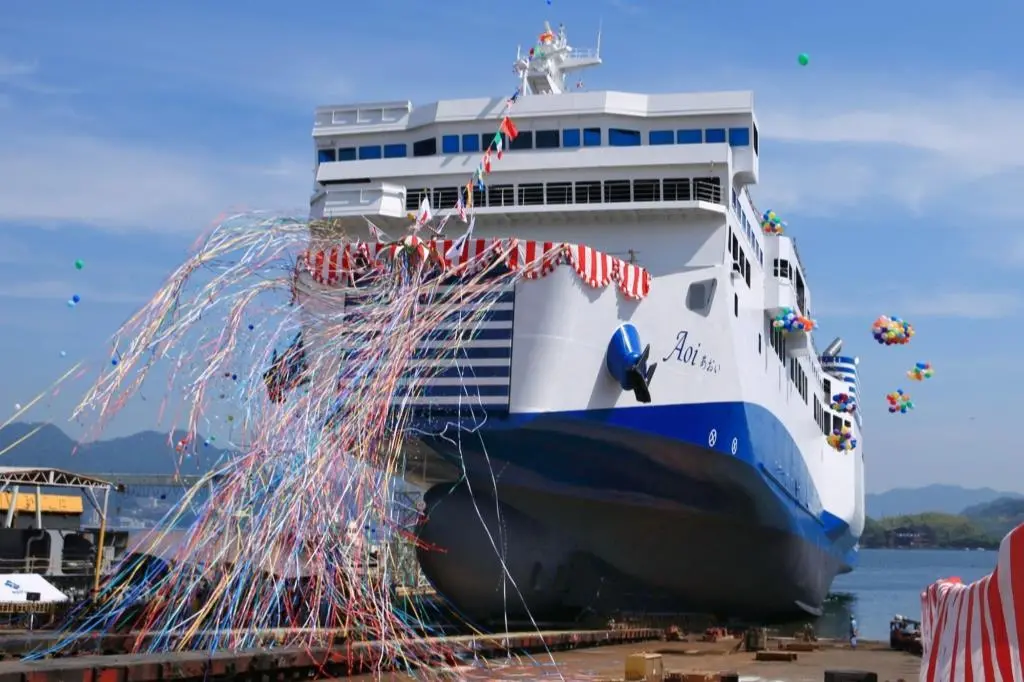
The 132m Aoi has been phased into the service linking the Kobe metropolitan area with Takamatsu, on Shikoku, via the island of Shodoshima. Carried out under the Jumbo Ferry brand, the four-hour crossings of the Harima-nada have hitherto been sustained by two ships dating from 1989/1990, Konpira II and Ritsurin II, the former having finally been withdrawn during December following the entry of Aoi.
The new ship has been constructed by Naikai Zosen at Setoda, to the joint account of Jumbo Ferry of Kobe and the Osaka company Kato Kisen. Some 40% larger than the previous generation of ferries in terms of gross tonnage, Aoi provides a significant reference for small-bore two-stroke, low-speed diesel propulsion. The single drive line, based on an MAN 8S35ME-C9.7 engine specified at 6,610kW, turns a controllable pitch propeller for a service speed of 18.6 knots.
Course stability and manoeuvrability is enhanced by a Schilling rudder, abetted in port by bow and stern thrusters and by judicious control of the variable-pitch screw.
A distinctive feature of the Aoi, and which also figured in the design of the older ships, is the slight overhang on the port side of the hull aft, whereby part of the engine casing and funnel are offset outboard so as to provide less obstruction and increased capacity on the vehicle decks. The funnel structure is extended so as to accommodate a SOx scrubber.
Bow and stern ramp access confers a drive-through capability to serve a mixed traffic including trailers, trucks and cars, complemented by provision for over 600 passengers. A freight-orientated payload may comprise up to 84 trucks of 12m, plus several 8m units and 20 cars, or other permutations within a lane capacity of around 1,100m. This denotes a substantial advance on the previous ships, particularly suited to flows of trailer-borne containers and other cargo connecting with deep-sea shipping at Kobe.
Being much more energy-efficient than her predecessor, Aoi should better ensure the future viability of a service that offers a competitive alternative to road transport between Shikoku and the Kobe conurbation and beyond. A second newbuild is contemplated for 2025 delivery to supersede the Ritsurin II.
Konpira II and Ritsurin II were products of Hayashikane Dockyard at Nagasaki, built for Kato Kisen. A notable record attributed to the 1989-commissioned Konpira II was the longest main engine operating time in Japan (212,800 hours) for an engine manufactured by Pielstick licensee Nippon Kokan (now JFE Engineering).
Related Articles
 METHANOL
 GENERAL NEWS
 HYDROGEN