



Japan’s Steel Industry Backs Coastal Mode
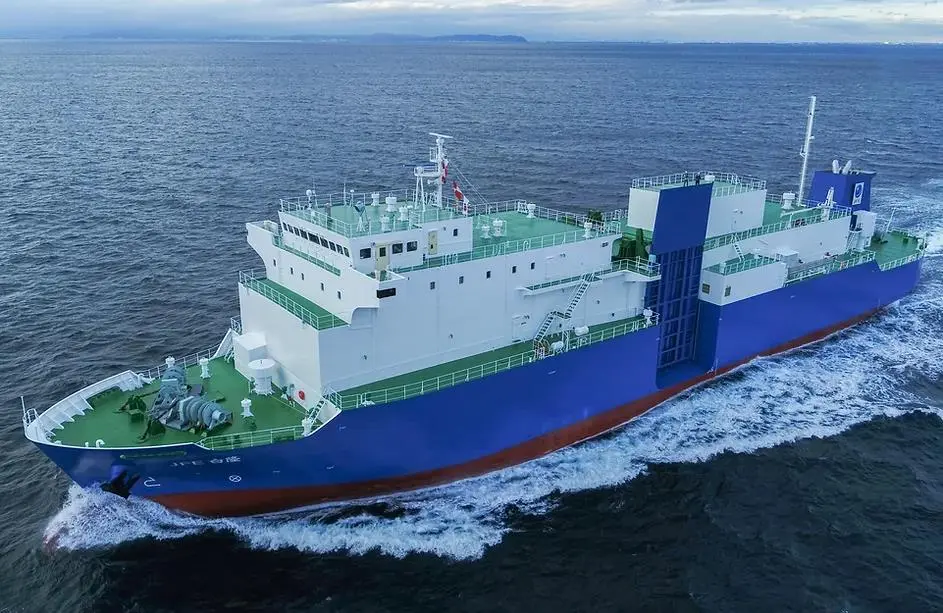
The bespoke ship’s construction was entrusted to Japan Marine United (JMU), part of the JFE organisation, and assigned to the Isogo yard in Yokohama.
JFE Hakuryu is equipped to handle large ro-ro cassettes, weighing up to 100t when loaded with steel coils and plate. Cargo is brought aboard across a ramp on the vessel’s port side and then distributed to two decks affording an overall underdeck capacity of 3,700m3. The loading process is claimed to be completely automated by way of a newly developed handling system. Initial shipments have been made from JFE’s Fukuyama complex in Hiroshima Prefecture, on the Seto Inland Sea.
The propulsive power installation is an L35MC.6 two-cycle engine licensed by MAN Energy Solutions and manufactured by Hanshin Diesel at its Akashi factory. The eight-cylinder model of the camshaft-equipped, small-bore, long-stroke design turns out 5,200kW in its L1 rating at the relatively fast crankshaft speed of 210rpm.
The L35MC.6 and S35MC.7 types in Hanshin’s portfolio ensue from technical collaboration with Kawasaki Heavy Industries and the licensor, developed using scavenging constant-pressure turbocharging to expand the application field of small-bore engines.
The new ship’s auxiliary outfit comprises three gensets of an aggregate 1,800kW and a Miura thermal oil heater.
Illustrative of the fundamental importance of coastal shipping to Japanese steel industry logistics, coastwise vessels carried 36mt of iron and steel between Japanese ports in the 2021 fiscal year, constituting the single largest category of cargo in domestic trade. Coastal transport accounted for 325mt of freight of all types moved over the same period.
Related Articles
 METHANOL
 GENERAL NEWS
 HYDROGEN