



Joint venture leads the way for two-stage turbocharging
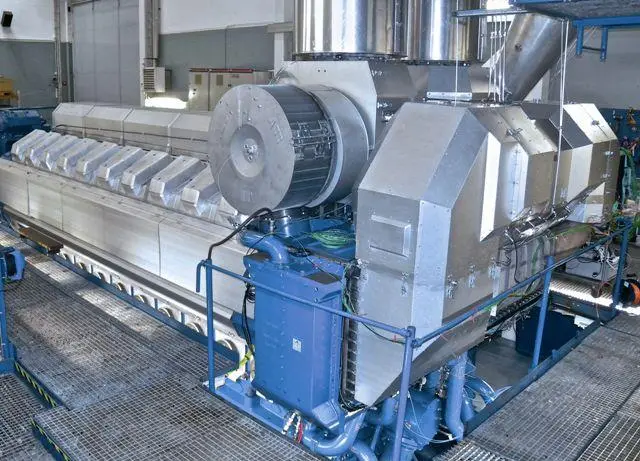
According to Wärtsilä, its advanced engine technology, together with ABB’s two-stage turbocharging, offers significant advantages when it comes to lower engine emissions while still reducing overall fuel consumption.
The application of two-stage turbocharging technology on Wärtsilä medium speed diesel engines has been developed through close co-operation between Wärtsilä and ABB Turbo Systems. In the current programme, Wärtsilä is focusing on developing advanced engine technology, which with the turbocharger, is able to reach the highest possible performance and become a cost-effective commercial solution for its customers. ABB Turbo Systems is delivering the turbocharging technology with defined performance in terms of airflow, pressure ratios and efficiency.
“ABB Turbo Systems is one of Wärtsilä’s main development partners, and has played an important role in Wärtsilä’s product development for more than three decades. Our customers benefit from the productive and successful R&D activities of our two companies, both of whom are leaders in their fields,” says Mikael Troberg, director of Wärtsilä testing & performance.
Two-stage benefits
Wartsila’s engine design employs two turbochargers arranged in series to generate increased air pressure, airflow and a superior turbocharging effect. This, according to the designer, results in an extremely high efficiency rating of up to 76%. The increased air pressure, combined with the advanced engine technology, improves the engine output and power density by up to 10%. At the same time, both fuel consumption and CO2 emissions are reduced.
Wärtsilä adds that further emissions reduction can be achieved with additional engine systems or by the use of exhaust gas after-treatment. A precise combination of fuel consumption levels and reductions in CO2 and NOx emissions can be selected through detailed systems configuration. Intelligent engine control allows optimum operation of the advanced engine design over the whole load range, and a significant reduction in NOx emissions can be reached. Although ship engines operate at sea level, the technology is claimed to offer additional benefits at high altitudes, in power stations for example, where two-stage turbocharging technology is claimed to guarantee the engine’s operational performance by compensating for the reduced air density.
The significant reductions in fuel consumption and emissions achieved so far are the result of extensive joint testing of the two-stage turbocharging system on Wärtsilä test engines at Wärtsilä’s test facility in Vaasa, Finland. Wärtsilä and ABB Turbo Systems report that the targets set originally for the development programme have been successfully met, and the next stage will be a major pilot project with a customer, which is due to be initiated in the near future.
Lower lifecosts
Another driving factor in the development work has been to significantly lower lifecycle costs, and this target has also reportedly been met, while at the same time NOx emissions have been reduced. Wartsila regards its advanced combustion control technology as having considerable market potential in both marine and power generation. In shipping applications, compactness and cost effective design are considered to be of equal importance to the reduction in operational costs. Calculations indicate that in certain applications, the investment in advanced two-stage engine technology could be regained in less than two years of operation.
“The conceptual design for the new power plant engine began three years ago,” says Troberg. “Testing of the concept, and verification of the technology, has been successfully carried out using four-stroke Wärtsilä 20 and Wärtsilä 32 engines. We see this technology as being a key for the next generation of Wärtsilä emissions-friendly engines. The technology has been developed for the four-stroke portfolio, in both marine and power plant applications. The next logical step is the two-stroke engine family for large vessels, typically as single engine installations.”
Emissions agenda
Wartsila adds that emissions control is playing an increasingly important role today, with reduction of CO2 and NOx levels being particularly high on the agenda. Current market demands for environmentally sound solutions with competitive lifetime costs will continue to pave the way for the introduction of new technologies such as those being jointly developed by Wärtsilä and ABB.
Related Articles
 PROPULSION
 GENERAL NEWS
 GENERAL NEWS