



Jones Act spurs US vessel projects
It requires goods shipped between US ports to be transported on ships that are built, owned and operated by US citizens so when the country’s first commercial offshore wind farm was built in 2015-16 off Block Island, the Maltese-flagged jack-up Brave Tern was serviced by two US-flagged jack-ups L/B Caitlin and L/B Paul so that it did not have to enter a US port.
Last year, however, the US House of Representatives passed the Expanding Access to Sustainable Energy Act, which includes an amendment to enforce Jones Act requirements for all offshore renewable energy production, including installation vessels. And in December 2020, the US Senate passed the National Defense Authorization Act, which includes an amendment to ensure full enforcement of the Jones Act and other federal laws in offshore wind development.
Now, at least two projects are set to meet these requirements. On 16 December, the keel was laid at Keppel AmFELS shipyard in Texas for a vessel on order for Dominion Energy. It confirmed in a statement that, “with several gigawatts of offshore wind capacity to be installed along the US east coast in the next decade, access to Jones Act-compliant offshore wind turbine installation vessels is of strategic importance.” The vessel is due to be in service by the end of 2023.
With a lifting capacity of 2,200 tonnes, the vessel’s crane – supplied by Huisman – will have a 130m boom mounted on the 144m hull. The ship will be 47m wide, have a depth of 11.6m and include accommodation for 119 people. It will be suitable both for laying foundations and installing turbines and has been designed to handle “next generation turbine sizes of 12MW or larger,” Dominion Energy said.
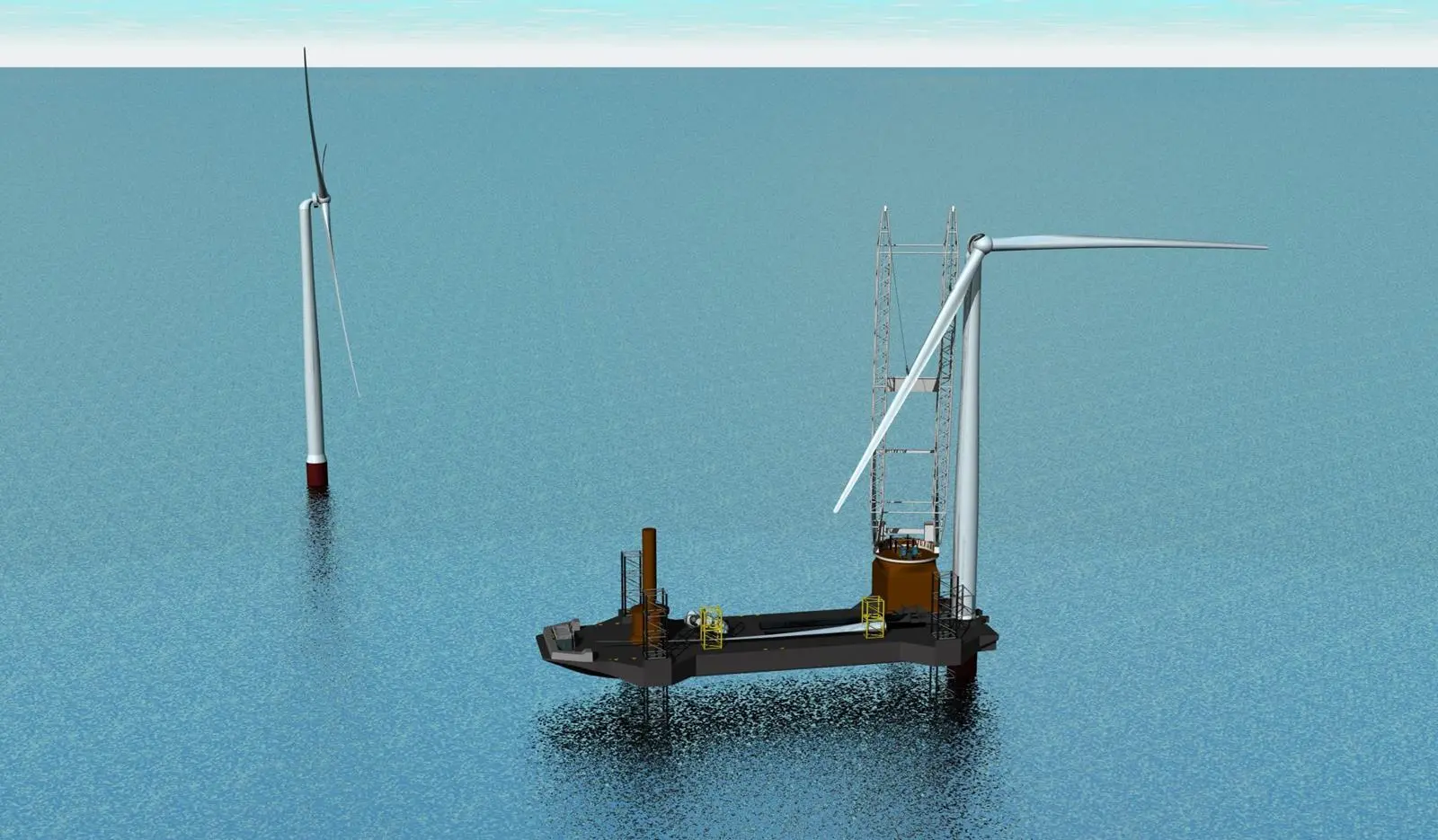
Coinciding with that announcement was another, from Northeast Technical Services Co (NETSCo), about a joint development project with Lloyd’s Register North America to design and develop a Jones Act-compliant wind turbine installation vessel (WTIV).
NETSCo will be responsible for the concept design of the WTIV while LR will check that the design complies with applicable rules and regulations. It will also evaluate the design against international codes and standards and the US Coast Guard’s Code of Federal Regulations.
From a practical point of view, a key design feature is that it will use hull shapes that are common in the US shipbuilding market, NETSCo’s statement said to ensure it could be built in US shipyards. It will also be focused on meeting the requirements of current developments along the US east coast and Great Lakes, in terms of its crane capacity, deck space and water depth.
“The offshore wind industry is expected to see exponential growth in the United States,” said Rafael Riva, LR’s Americas marine and offshore commercial manager, said, so “there will be a pressing requirement for such vessels.”
Jan Flores, NETSCo’s vice president, agreed, adding that this presents “a perfect opportunity for us to …. support the offshore wind turbine market.”
Related Articles
 ALTERNATIVE FUELS & LUBRICANTS
 GENERAL NEWS
 GENERAL NEWS