



Larger Seahorse version in response to market demand
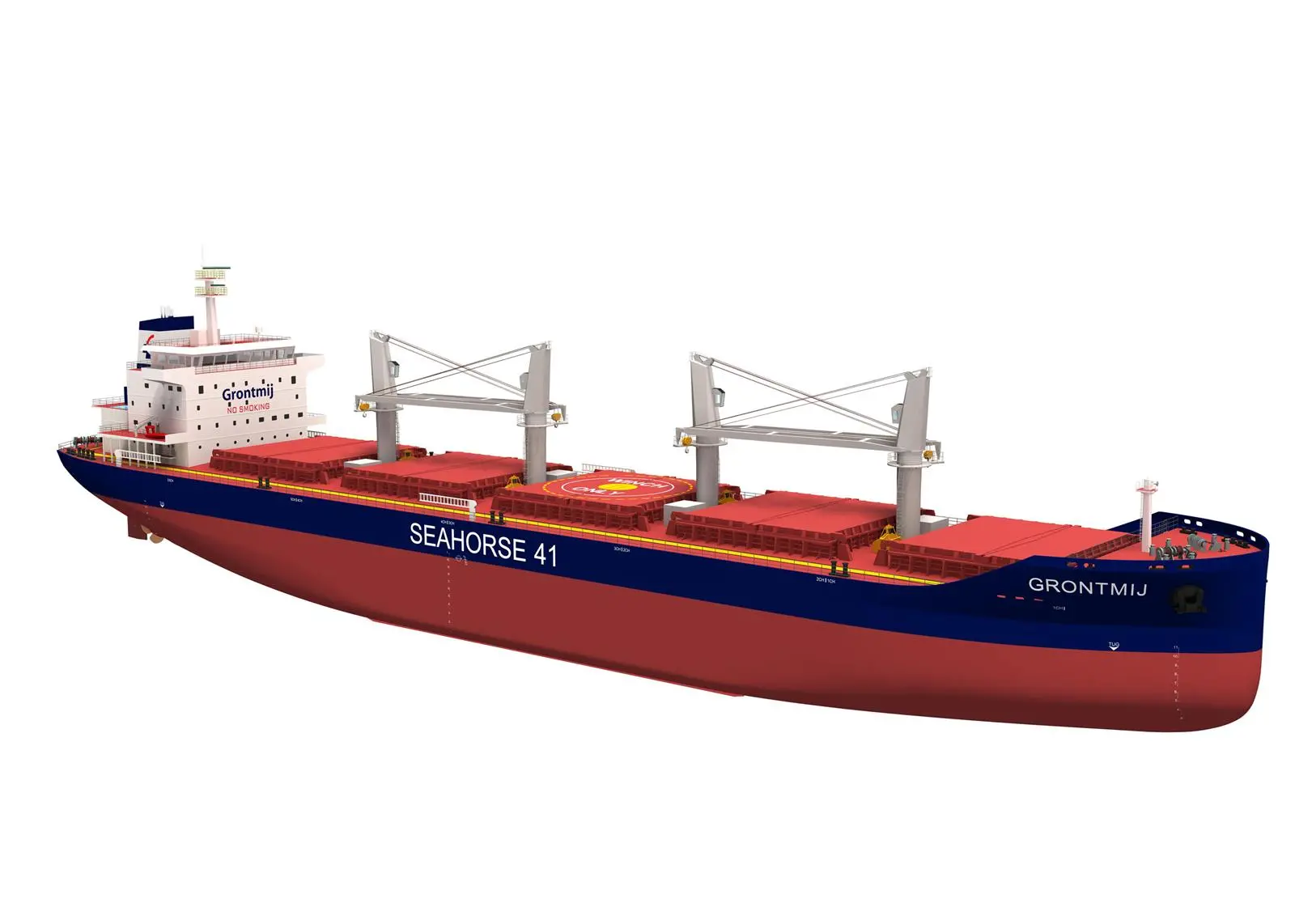
Market receptivity to the Seahorse 35 bulker concept, expressed in the continuing flow of orders for the Danish-originated 35,000dwt type, endorses the manner in which the designers have married a pragmatic, technical approach with the views and requirements of charterers and operators expert in the handysize category of bulkship trading. It also reflects the evolving nature of the design, through an ongoing optimisation process, as well as openness to customisation, that has resulted in the development and production of several variants. That progression has now entered a new phase, with the unveiling of a larger version known as the Seahorse 41, offering a further advance in transport efficiency.
The first contract for the Seahorse 35 generation was awarded in 2008, and the sales tally had reached 45 by the end of January 2013. Advanced negotiations could shortly see the total lifted to 49. To date, the programme has involved nine Chinese shipyards and 12 owners, and 18 of the vessels are now in service. The family includes variants built to ice class criteria or adapted for log transportation, plus the 37,500dwt Seahorse 375 version with B-60 freeboard, and the Seastallion series shaped by a particular owner’s requirements.
The technical focus on imbuing trading versatility and cargo handling performance with ‘future-proofing’ as regards energy efficiency and environmental standard, and ensuring competitive build costs by sourcing tonnage in China, has clearly resonated with the market. Investment and interest have been sustained through the difficult financial and economic conditions that have afflicted the dry cargo business for the past several years, and notwithstanding the scale of the bulkship order backlog as a whole.
Unusual in its adoption of a vertical stem with no bulbous bow, the Seahorse generation emanates from the Danish arm of Grontmij, which absorbed the Carl Bro/Dwinger Marine Consult lineage. Naval architect Michael Schmidt, who headed the Grontmij Carl Bro design team that prepared the Seahorse 35 type in 2007-2008, founded his own company, Schmidt Maritime, in 2009. Schmidt Maritime and Grontmij have a cooperation agreement on bulker design development, and are working together on the further optimisation of the Seahorse 35, with a focus on fuel oil consumption and the energy efficiency design index (EEDI).
Mr Schmidt said in 2012 that the fuel consumption performance of the Seahorse 35 had already been improved by 14% over three years, through recourse to new engine developments, larger propellers and various energy saving measures.
In the unerring bid to further enhance the long-term competitiveness of this new generation of geared, handysize maid-of-all-work, the current offering has been augmented with Seahorse 35 and 375 versions incorporating the Becker Mewis Duct, which the ship designers regard as “presently the most effective energy saving device available”.
Just before the end of 2012, Grontmij and Schmidt announced the Seahorse 41 concept, in response to enquiries for a larger vessel. The 41,000dwt bulker is seen as complementing rather than superseding the Seahorse 35 and 375 line-up. While eschewing the ‘eco’ terminology increasingly applied by the industry to new bulker designs offering significant reductions in fuel consumption, the Seahorse originators’ 5.19g/dwt-nautical mile EEDI energy efficiency calculation for the latest type speaks for itself, since it is 14.4% below the Index baseline.
In the Seahorse 41, length overall has been maintained at 180m, while the breadth has been taken out from 30.0m to the present Panamax gauge of 32.26m, with the scantling draught set at 10.5m and hull depth increased from 14.7m to 15.1m.
Although the 41,000dwt vessel is of somewhat fuller form than its predecessors, the slightly negative impact that this has had on hydrodynamic performance relative to the Seahorse 35 has been more than offset by the efficiency gains achieved by embracing a new MAN two-stroke engine model and a larger-diameter propeller. The after body has been modified to accommodate the larger propeller and the increased depth of the hull has enabled the use of MAN’s latest G50ME-B9.3 engine in five-cylinder configuration. The Seahorse 41 proposal, with its attractive power and fuel consumption properties, also benefits from the adoption of a Mewis Duct.
Rapid advances in two-stroke diesel engine technology over the past five years have yielded improved thermal efficiency ratings in new propulsion installations, securing significant reductions in specific fuel oil consumption (SFOC). The first Seahorse 35 series was constructed to ice class 1C criteria, and was ordered with a fully mechanical MAN 5S50MC-C7 TI (IMO NOx Tier I-compliant) engine of 7,500kW specified maximum continuous rating (SMCR).
Subsequent, non ice-class vessels have been installed with several different versions of the MAN 5S50 series, in which SMCRs have varied from 6,900kW down to 6,050kW in the most highly optimised Seahorse 35 to date. Vessels have also been ordered with the competing engine type, the Wärtsilä 5RT-flex50D.
MAN’s new ultra-long stroke G50ME-B9.3 type meets the demand in the handysize and handymax bulker and also tanker sectors for efficiency optimisation, using larger propellers and suitably adapted aft hull design. The five-cylinder model (SMCR of 6,550kW) proposed for the Seahorse 41 would have a normal continuous rating (NCR) of 5,115kW, to give a 14-knot service speed at the design draught.
At the NCR of 5,115kW, but on the scantling draught, anticipated service speed is 13.5 knots. Grontmij’s expectation is a 19.9t/day fuel consumption at service speed. So-called ‘ECO-speed’ and power settings, however, provide for more fuel-conservant operation, down to little more than 15t/day when running at between 12 and 13 knots with 37,000t-41,000t deadweight loaded. It has to be said that Seahorse 41 vessels may alternatively be fitted with the equivalent model of Wärtsilä prime mover.
The Seahorse 41 is laid out with five flush, double-skinned cargo holds, dispensing with the conventional, hopper-sided tanktops, and suited to the gamut of general bulk cargoes including grain, cement, iron ore, alumina, bauxite, mineral sand, timber, steel products and scrap iron. The under-deck spaces are also fitted for the range of IMSBC dangerous bulk cargoes, and lashing points for ‘neo’ bulk freight are provided in the three largest holds on the longitudinal bulkheads.
The hold spaces confer a maximum 51,800m³ bulk cargo intake, and further payload opportunities are provided by lashing points for weather deck-borne freight. The cargo section as a whole is served by four wire-luffing deck cranes, each of 30.5t load capacity.
Grontmij is a participant in the Green Ship of the Future programme, a Danish pan-maritime industry initiative aimed at formulating strategies and systems to reduce vessel exhaust emissions and improve energy efficiency, and the Seahorse 35 design has served as a developmental platform in various concept studies.
SEAHORSE 41, main particulars
Length oa 180.0m
Breadth 32.26m
Depth 15.1m
Draught, design 9.75m
Corresponding capacity 37,000dwt
Draught, scantling 10.5m
Corresponding capacity 41,000dwt
Gross tonnage 26,699gt
Net tonnage 13,130t
Cargo holds 5
Cargo capacity (grain) 51,800m³
Cargo capacity (bale) 50,300m³
Deck cranes 4
Main engine, specified maximum continuous rating 6,550kW
Main engine fuel consumption, laden, 14 knots 19.9t/day
In-port fuel consumption, cargo handling 4.2t/day
SEAHORSE 41, DNV Class notations
1A1 Bulk Carrier The main class rules for hull, machinery, installations and equipment
ES(D) Enhanced strength, double side skin bulk carrier
CSR Common structural rules
BC-A (cargo holds 2 & 4 empty) Bulk carrier with cargo density >1.0t/m³ and alternate hold loading
GRAB(20) Holds designed for loading/unloading using grabs with maximum weight 20t
ESP Enhanced survey programme
E0 Ship operation with periodical unattended machinery space
HA(+) Hatches strengthened for heavy cargo
DK(+) Heavy-loaded cargo decks
DG-B Suitable for carrying dangerous goods in solid bulk cargoes
TMON Tailshaft monitoring
BIS In-water survey of ship’s bottom and related items
RECYCLABLE Safety protection during vessel operation, demolition and recycling
BWM-T Type-approved ballast water treatment system
CLEAN Reduced environmental impact (air emissions and sea discharges)
Option: Ice Class 1C, 1B, 1A
Related Articles
 METHANOL
 GENERAL NEWS
 HYDROGEN