



Looking beyond contract speed
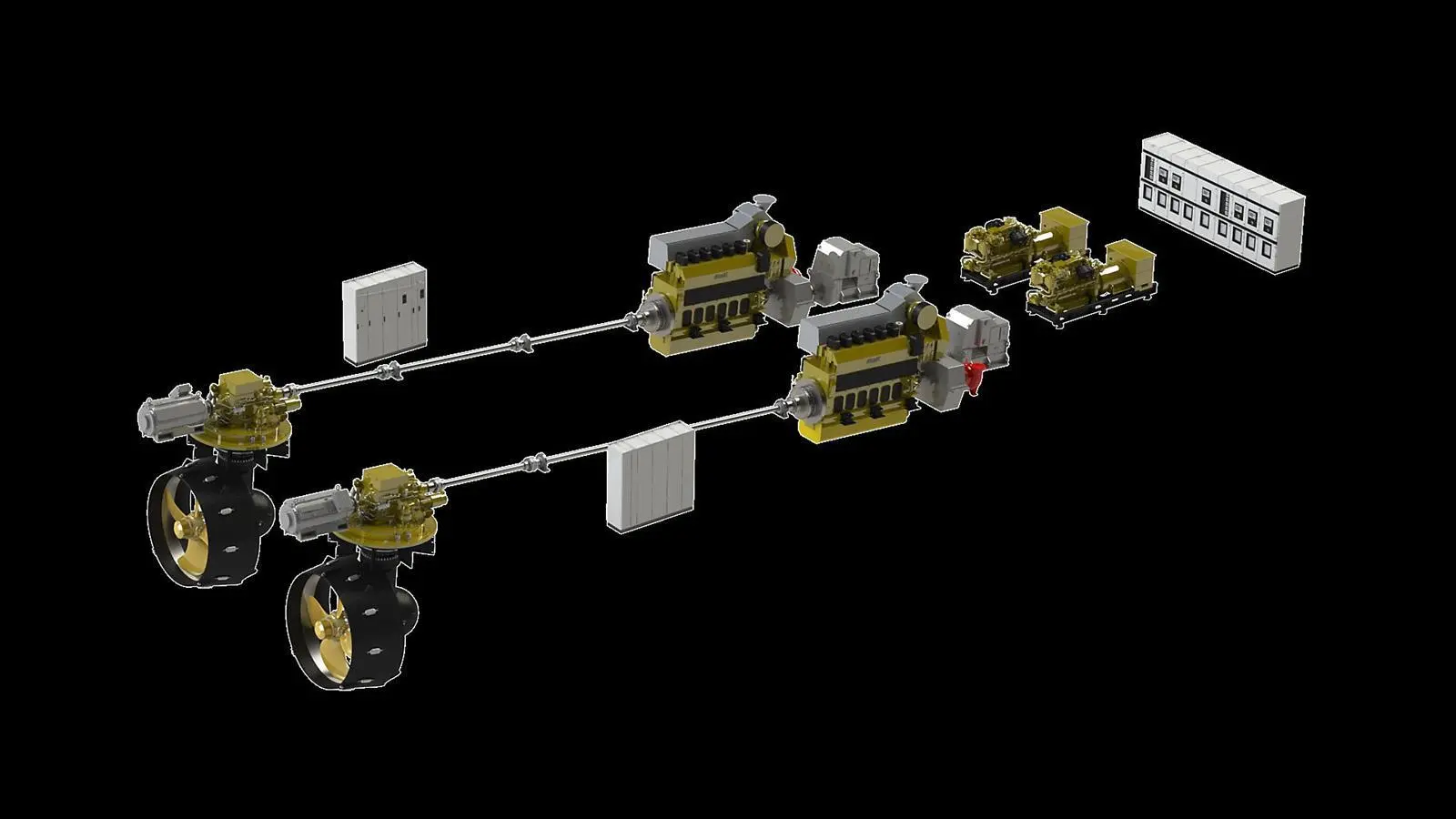
“We don’t take the traditional ‘how many kilowatts do you need’ approach,” says Jonas Nyberg, regional sales manager at Caterpillar Propulsion. “When you think like that you kill your opportunity to be creative.”
The big caveat of being an engine maker is that engines deliver power, says Nyberg, so that is what they tend to focus on. “But the reality is that ship owners don’t care about power, they care about knots. So when we talk the same language as they do, talking about the performance that is required rather than the power installed, then we typically end up with less power installed and a more efficient solution.”
The approach taken by Caterpillar employs a tool it calls Efficiency Workshop. The software allows ship owners to input hull characteristics such as resistance and hydrodynamic data and then apply an operational profile. Propulsion and engine solutions can then be benchmarked against each other, comparing fuel consumption, maintenance demands and load response as well as equipment cost.
According to Nyberg the approach has been well received in the market, and has already been used on several newbuild vessels employing a range of propulsion solutions. Most recently, the method was used in the propulsion design of a series of four ro-pax vessels to be built for Stena Line at AVIC Wehai in China.
The ferries will each have a capacity of 3,100 lane meters and 1,000 passengers. Each will be powered by two MaK 12 M 43 C propulsion engines. The vessels have also been designed ‘gas ready’, meaning that the configuration enables the engines to be upgraded to MaK’s new M 46 dual-fuel engines at a later date (along with other design changes necessary for gas operation).
“It was a significant project not only because the vessels will be ready for dual-fuel engines to be installed, but because we used an investigational approach to how we applied the equipment,” says Nyberg. “It is optimised at every point you can get to, down to the propellers which are selected so that the vessels can actually be run on one propeller. If you are on the bridge and see levers are not all the way down, you select one propeller, press feathering and the propeller is automatically feathered and that engine put into idle to save fuel.”
Hybrid thruster
The approach has also been applied to Caterpillar’s new hybrid thruster concept, The new propulsion setup features both diesel and diesel-electric modes and is claimed to outperform a straight diesel mechanical drive system in all partial load conditions. It also offers improved fuel economy and substantial through-life savings for a variety of offshore support vessels; Caterpillar claims that for vessels spending long periods of time in standby or DP service, the annual fuel savings could be as high as 35%.
“We were trying to solve two specific problems for a project,” says Nyberg. “First we had a customer that wanted to increase the bollard pull of its vessel from 100 to120 tonnes, so we needed to get more power into the vessel than the existing main engines, so we added electric motors to do that.
“We also designed the system to give a diesel electric mode. This means you can take a very big boat and run it off a fairly small genset when in standby, transit or low DP position. Tugboats are very overpowered vessels, you always have all this power online. With this system you don’t need all that power online all the time and that has a self-explanatory effect on fuel consumption.
Caterpillar currently has one hybrid thruster operation and a second scheduled for delivery at the beginning of next year. The first is installed on a continuous duty vessel, but Caterpillar also has a slightly simpler with fixed pitch propellers that it is promoting in the tug market.
For Nyberg and Caterpillar the new propulsion design approach, exemplified by its hybrid thruster, is a logical response to the tendency for such vessels to have too much installed power for the vast majority of their operational time
“When you look at operation don’t look first at power – let power be a consequence of what you want to achieve,” Nyberg says. “That’s really the best path to reducing fuel consumption. This traditional, two engines side by side for comparison – it is not the modern approach and doesn’t really work. Engines have different torque settings and different ways of operating, so you can’t compare. What you can compare is competitive solutions.”
In the (edited) paper that follows, Caterpillar Marine details its value-based equipment approach using the case study of a 150-tonne bollard pull AHTS vessel.
Selecting the optimal design criteria
The bollard pull condition is often considered the most important design condition, as this plays a major role in vessel contract qualification. Looking at the orange line, representing the time spent in each mode, we see that the expected time the vessel will spend in this operational condition is very low compared to other modes.
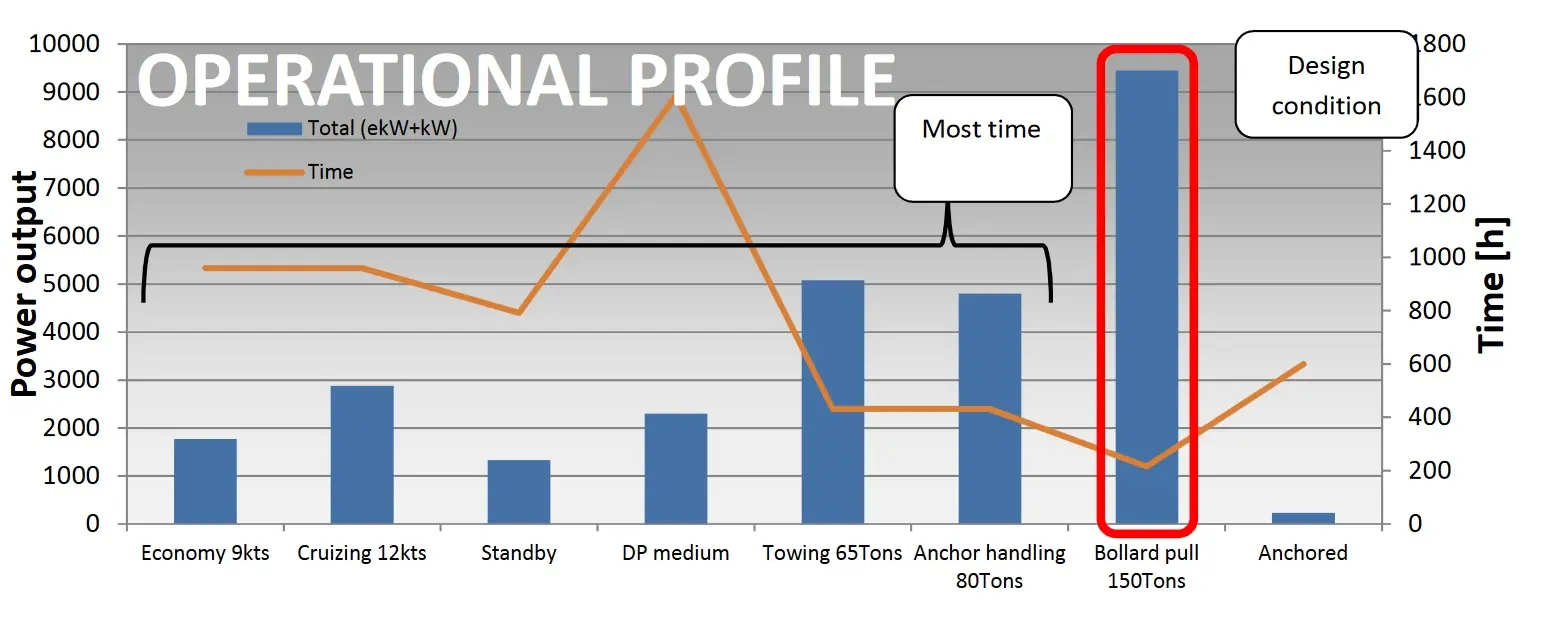 For these vessels, the equipment selection will often start with selecting either the main engine or the propeller diameter. With one of these defined, the other one can be selected so that the required bollard pull can be reached. This design philosophy makes the engineering and risk manageable as the main design goal is to fulfil the one full-power condition using well established engineering rules and practices.
If we look further into the above example and how it performs over the entire operational profile, we see that this vessel would spend less than 4% of the time and 10% of the annual fuel consumption in the full power bollard pull condition. This means 96% of the operational time and 90% of the annual fuel consumption is spent outside of the primary equipment selection mode of operation.
With this in mind, it might make more sense to shift the main propulsion design criteria to include the modes where the vessel spends most of its time and where the vessel aggregates most of the operating cost. In order to do any kind of benchmark over the entire vessel operation, it requires an operational profile to be defined as a benchmark basis. This will allow concepts, designs and propulsion equipment to be evaluated against each other.
One common way to define an operational profile is to define the power consumption over a number of modes. This is an effective way if you’ve already defined your propulsion system and how it will operate. A good example would be optimizing a diesel-electric engine plant to a predefined propulsion system or reading data from an already existing vessel.
The problem with this kind of operational profile is that it really only works when benchmarking engines of approximately the same size and power against each other, or different diesel electric configurations. For cases where you want to benchmark complete vessel performance such as different propulsion systems, propeller diameters, engine solutions or running modes, it’s better to take a more operational driven approach. The idea with this is to base the operational profile on the thing that matters – the operational requirement – and relate this to a hull design.
|
Operational mode |
Requirement |
|
Transit 9kts |
9kts |
|
Transit 12kts |
12kts |
|
Standby |
2kts current, 5kts wind speed |
|
DP |
2kts current, 10kts wind speed, DP2 |
|
Anchor handling |
2kts, 85t pull, 10t tunnel thrusters |
|
Bollard pull |
150t |
This, together with a hull resistance profile/data and the proposed propeller concepts, will give the power consumption per mode for the propulsion candidates. Using this approach makes it possible to benchmark total vessel performance while varying propulsion concept, engine configuration and running modes while still making sure that the propulsion system is able to fulfill all operating modes.
Design evolution
In the below example we will go through the design evolution for a 150t AHTS using the operational profile from the top. The study starts with a very basic design, moving forward by trying to eliminate the inefficiencies one by one.
Looking closer into the initial example of the 150t AHTS and how it could be improved, we start by varying the concept within the borders of a two engine installation. The base numbers are as follows: two MaK 9M32C engines each delivering 4,500kW coupled to two 3.95m main CP propellers. Bow thrusters have been kept the same throughout the entire study, but could just as easily been varied as well.
An easy way to start studying how to improve the concept would simply be to try the next higher and lower ratings of the same base engines and consequently adapt the propeller diameter to achieve the same bollard pull. This would mean that the two alternative configurations would be:
|
Reference |
2xMaK 9M32C (4,500kW) |
3.95m, 150rpm |
|
Higher rating |
2xMaK 9M32E (4,950kW) |
3.6m, 170rpm |
|
Lower rating |
2xMaK 9M32C (4,320kW) |
4.15m, 135rpm |
Varying the engine and propeller diameter together can have a big impact. There is a positive effect when increasing the propeller diameter and decreasing the engine rating. The equipment price for this alternative would of course increase, as the gear and propulsion becomes more costly depending on where you end up with your propeller and gear selection due to the higher torque in the slower turning propeller shaft. Going in the other direction – increasing the rating while reducing the propeller diameter – has a negative effect on the fuel cost as the propeller efficiency drops with the smaller, faster turning propeller.
Optimising transit operation
In this example, 32% of the vessel operation time is spent in transit, amounting to ~30% of the annual fuel consumption. Looking at how the engines operate on a power chart (not included here), we realise that both main engines are needed for every operational mode except anchored, and that the main engines are running at very low load utilization. Average load is only 30%, which is far away from the numbers where most engines are optimized to run. This will in turn drive up fuel and maintenance costs, as normally happens when having too much unused power capacity online.
What, then, can be done to increase average load on main engines? In transit, it seems like running one engine only and shutting the other down would be enough to propel the vessel. Doing so is nothing new and there’s more than one way to do this: simply freewheeling one propeller, driving two propellers with one engine, driving one mechanically and the other one electrically via the shaft alternator/motor.
In this example, we will attempt to increase engine load by installing feathering propellers. This technology allows you to run the vessel with only one propeller active while the other propeller is feathered and locked, creating a minimal amount of drag. Applying the feathering feature to the propellers for this vessel results in a 9% fuel consumption reduction as well as a 17% reduction in scheduled maintenance, as the number of hours per year on the main engines is halved for the transit operation.
Father & son
One limitation with the base configuration is that there are only two main engines, meaning that the ability to vary the number of engines running is limited. A popular way to build this kind of vessel is to utilize four main engines. A twist of this is the father and son arrangement which takes the concept a step further, having four main engines where two are bigger than the other. This gives the operator more running modes and the ability to optimize the operation better.
If we apply two MaK 8M25C engines at 2,666kW together with two 6M25C at 2,000kW utilising the same 3.95m feathering propeller, we can now start varying the number of engines running. This configuration would increase the average engine load to 65% which is a very healthy and efficient load for this kind of engine.
Taking the concept further
In all modes except anchored, the shaft alternators require running at a constant speed. If we keep the constant speed operation in mind and look at the load on the main propulsion, we see that in many modes this is very low. For the transit modes, we have already significantly increased this by running only one propeller at a higher load while feathering the other. For the standby and DP mode, we’re still turning two very big propellers designed to deliver 150t bollard pull in constant speed which, in zero pitch condition, will consume 15-20% of the design power.
A better way to run the propulsion in those modes would be in combinatory or variable speed mode. This would require either to run the main engines in combinatory mode or driving the main propellers in variable speed electrically via the shaft alternator/motor. While both of them would require some additional electrical equipment, this has already been done on many vessels worldwide.
If we also look at the utilisation time of the father/son arrangement, we see that two of the four main engines are not significantly utilised. What would happen if we replaced two of the main engines with generator sets and make the vessel a diesel mechanic/electric hybrid?
This would mean that the total mechanic power would be selected so that it’s enough to efficiently propel the vessel during transit and modest towing operations. When in standby/DP, the vessel would switch over to diesel electric mode, running as a pure diesel electric off of the high speed generator sets. When full power is needed the main engines and generators would all work together in a mixed speed hybrid mode.
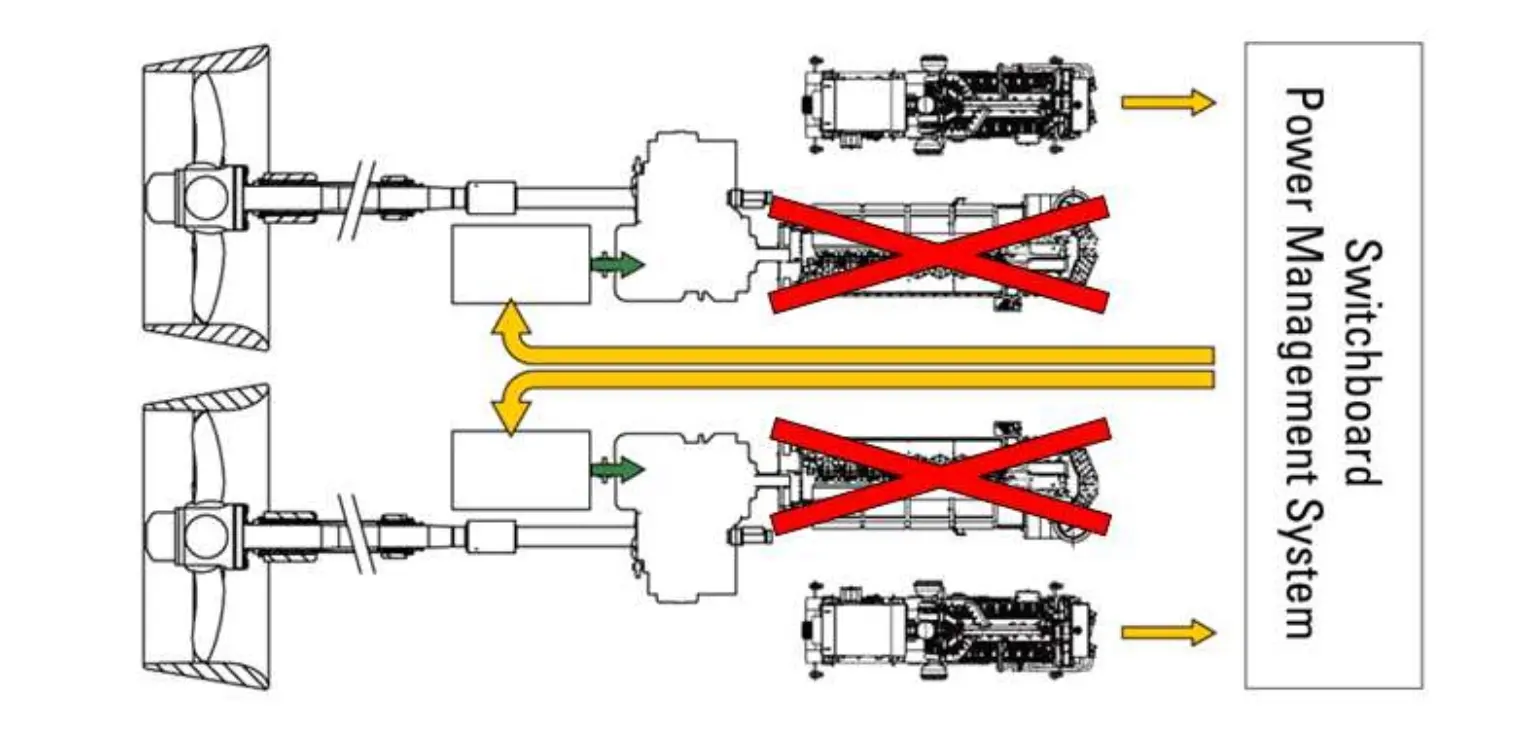
Transit and towing modes are unaffected. Standby and DP are now diesel electric modes with the main propeller in a more efficient variable speed mode. Anchor handling and bollard pull now require main engines and high speed generator sets to work together. Looking toward the engine loads, the average load for the main engines has now increased to 75% and the generator set average load is at 45%.
The above steps have taken the vessel in focus from a very conventional two engine design, added feathering propellers, added the father/son concept, and ultimately made the vessel a hybrid. All of these steps have eliminated the inefficiencies over the operational modes, using solutions that account for various factors such as simplicity, efficiency and cost.
Related Articles
 PROPULSION
 GENERAL NEWS
 GENERAL NEWS