



Losses continue to cause concern to insurers
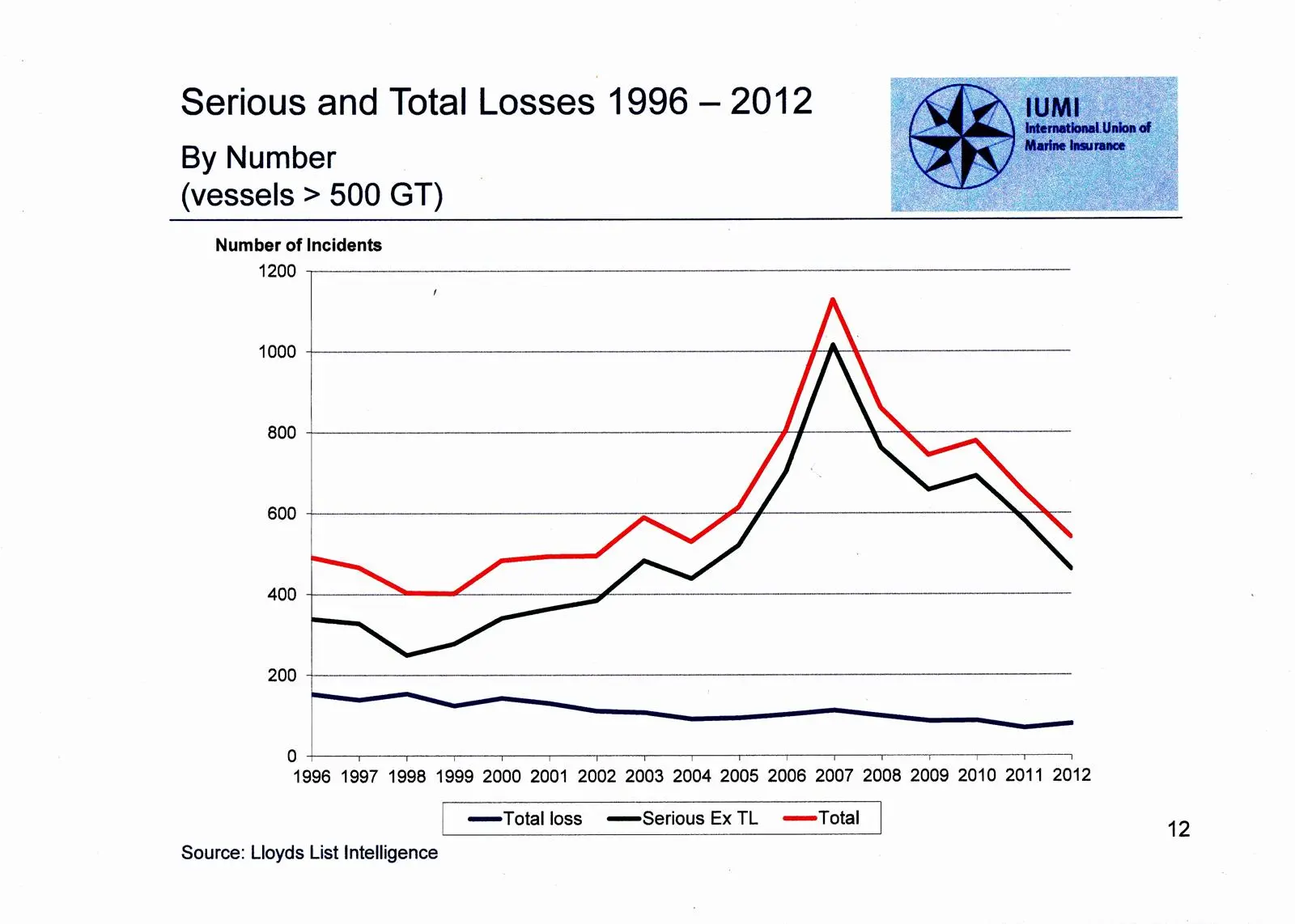
Total losses (all figures relate to vessels of 500gt+) increased marginally last year but the total tonnage they represented was down – sums up IUMI’s cautious assessment as it attempts to put casualty reporting on a more realistic basis in the future.
In a rather twisted analysis, IUMI logs total losses at 0.18% of the world fleet by numbers, an increase from about 0.16% the previous year. However, the German insurance giant Allianz is not so reticent. In its annual safety and shipping review of maritime losses, Allianz Global Corporate & Specialty reports worldwide losses as being down 27% on the 10-year average. And in the 12 months to November 2012, 91 ships were lost, against 106 in the comparable period a year earlier.
Human error remains the main cause of losses (no surprise there), says Allianz, listing fatigue, economic pressures and inadequate training as the main causes of concern. At the same time it attributes the long-term downward trend of losses to improvements in technology, training and regulation, and a proactive response from the shipping industry to safety enhancement.
Nevertheless, the report warns that incidents such as the Costa Concordia highlight that human error remains the greatest risk. Dr Sven Gerhard, who heads the company’s hull and marine liabilities division, aptly observed: “Technology is only as useful as the training behind it, and we don’t always see this human element keeping up with other advances.” He also noted that for some commercial shipowners, especially in the hard-pressed bulk cargo and tanker markets, “there is little money for maintenance or for training.”
Such comments beg the question whether the parlous state of world shipping markets will lead to reduced maintenance and deferred repairs, and thus resulting in hull/machinery underwriters and P&I clubs facing a wall of claims. John Poulson, a highly-experienced casualty surveyor who heads AMA Consulting Services (Eagle Ocean Group) in New York, admits there will undoubtedly be pressure on repair and maintenance budgets. But he thinks that most owners and managers understand that skimping on maintenance in the short term will cost them dearly in the long term. He cautions that one of the first casualties of hard times can often be the ship’s condition survey, and rightly or wrongly it can be left to underwriters and their surveyors to keep owners on the straight and narrow.
Meanwhile, a Lloyd’s broker (appropriately named Lloyd & Partners) reports that the hull insurance market remains stable, with anticipated premium hikes failing to take hold despite the Costa Concordia disaster (now running into a billion dollar plus cost scenario) and other big claims. As others do, the broker blames excess underwriting capacity for the current unsatisfactory situation for insurers.
Back to the IUMI stats, which show that the major single cause of serious losses remains incidents involving machinery in the engineroom, representing 33% of cases.
The factors behind insurers’ woes are many and varied: poor maintenance by engineroom staff who are insufficiently trained or who do not follow the instructions of the engine maker or other equipment manufacturer; spare parts from the ‘black market’; inferior quality bunkers; the effects of slow steaming – to name just a few.
Finding an answer is often extremely difficult. But the Swedish P&I Club, in its annual analysis of claims, promotes a simple technique to find and identify the root causes to a problem. By asking “Why” five times successively you move beyond symptoms and delve more deeply into the root causes. By the time you reach the fourth or fifth “Why?” you will probably be looking at the management practices responsible for the problem.
The club’s analysis contains 11 case studies, and the following is an example. A pump had been dismantled in the engineroom and an eyebolt had been screwed into a threaded hole in the shaft. This was then lifted by a chain-block attached to the eyebolt. The shaft suddenly detached from the eyebolt and fell, crushing an engineer’s hand.
The root cause analysis of this routine maintenance job is summarised thus:
1. Why? The shaft unscrewed and dropped.
2. Why? It was not correctly secured.
3. Why? Not paying enough attention and lack of experience.
4. Why? Lack of proper preparation and procedures. No work permit issued and no risk assessment performed.
5. Why? The company and crew members involved had not recognised prior to the accident that this job was dangerous, as there was no available risk assessment and the chief engineer did not require a work permit. This would indicate a lack of safety culture on board.
Commenting on this case in its spring
Feedback
, the maritime organisation CHIRP says the five questions appear to be a simple but effective technique. Further, one indicator of a company with a good safety culture is that it has a well-established system for internal reporting of near-misses. (More information on www.chirp.co.uk)
Related Articles
 METHANOL
 MONITORING, CONTROL & DIGITALISATION
 MONITORING, CONTROL & DIGITALISATION