



Magnetic signals used to detect faults in electric machines
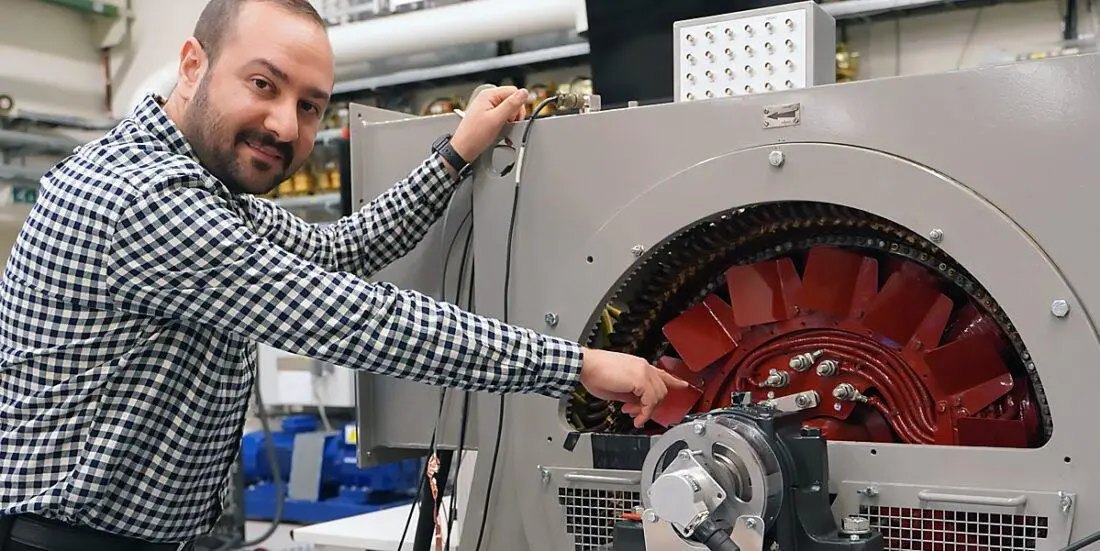
As well as automotive and power applications, the technology can be applied to equipment onboard ships, says Hossein Ehya, a researcher at HydroCen and NTNU. “All the available tools are expensive, and many cannot afford them. In addition, the available methods are not sensitive enough to detect incipient faults, which means that they can detect when there is a severe fault in the machine and it is very close to failing. Our developed method is affordable and it is very sensitive for early-stage fault detection.”
Electric motors can suffer from having a short circuit in the stator or the rotor, or the rotor can become skewed, or other vital components can suffer mechanical damage. A lot of methods for finding faults in generators require knowing how they behave when they’re ‘healthy,’ but often such precise analyses aren’t carried out before they enter service.
“An electric motor doesn’t give us any sign of failure – until it breaks down. That’s why periodic inspections have to be carried out. The machine must be stopped to check for faults and to carry out maintenance, but if the fault can’t be found during the inspection, the machine breaks down,” says Ehya.
With current methods, the machine must either be dismantled to install an internal sensor or inspected using external measuring equipment. External inspections measure vibrations or variations in voltage, but the equipment is not very sensitive and is often used when it is already too late.
“With our method, we use a very affordable sensor that can be mounted in a few minutes on the outside of the machine. The sensor measures the machine’s magnetic field and analyses it. The researchers can then determine whether the machine is ‘healthy’ or has failure symptoms. They can also identify what the problem is,” says Ehya.
So far, the new method has been tested on generators at two Norwegian hydropower plants, but Ehya and his colleagues envision that it will be useful in the automobile and transport industry, on Norwegian oil platforms and for wind power as well.
The project is now in a commercialization phase where the research team is collaborating with Rolls Royce, IKM, Statkraft and Captiva.
Related Articles
 ALTERNATIVE FUELS & LUBRICANTS
 GENERAL NEWS
 GENERAL NEWS