



Major milestone for gas turbine feasibility
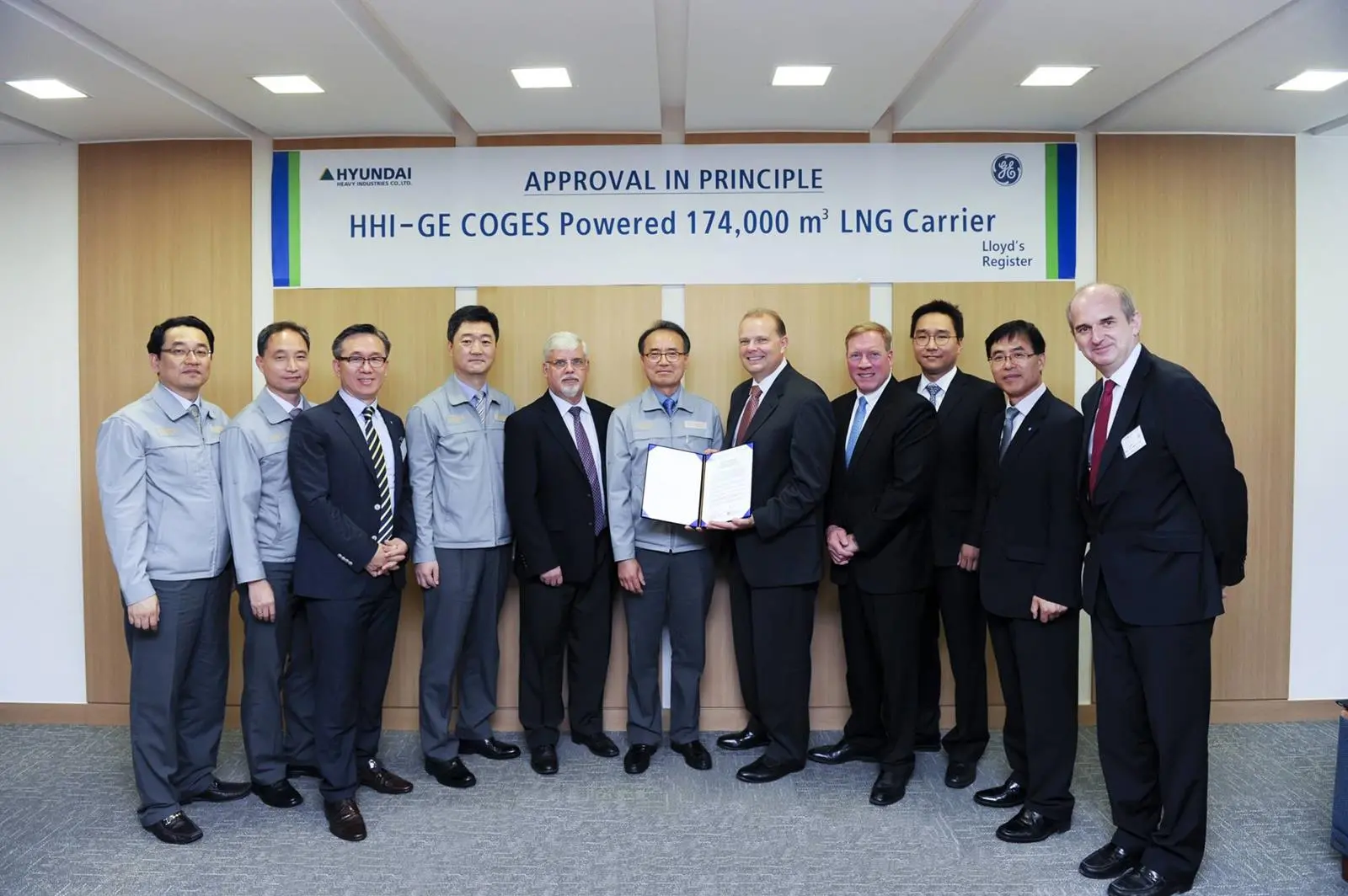
With the announcement that Lloyds Register has given approval in principle for a gas turbine powered LNG ship, a major step forward has been made in the potential for gas turbine power in cargo ships. Up till now gas turbine power has been limited primarily to military ships and some cruise liners and a few top-of-the-range large fast ferries. Gas turbines are not a cheap source of power and the criteria for using these power units has tended to be where the particular characteristic of the gas turbine such as reduced weight, high power density and compact size have been over-riding considerations.
On cargo ships the size and weight of the power units have not tended to be major design factors so that the tried and tested solution of slow speed diesels has been used almost universally. These can still operate on the cheaper heavy fuel oil in most parts of the world although the use of this fuel is becoming more limited so that ships have to upgrade their engines to operate on lighter diesel fuels. Increasing high emission controls have also been an influence on the fuels used and on engine design and emission requirements are becoming an increasing consideration in engine choice.
Meeting tougher emission levels such as the Tier III standards has meant that extra weight and cost has to be added to a diesel installation in the form of exhaust scrubbers which also require more space on board. These increasing costs of the installation and the higher running costs associated with meeting emission standards have started to narrow the gap between the costs of low speed diesel installations and those for gas turbines. Added into the calculations also has to be the reduced space requirements of the gas turbine engine and the flexibility in the location of the engine which can mean more space for cargo and the greatly reduced weight which can also be a benefit that has to be factored into the equation.
The marine gas turbines on the market are all derived from aircraft units and there have been significant advances in their fuel consumption and efficiency in recent years as fuel costs for aircraft are a major operating cost. These advances in aircraft engines are filtering down into marine versions so that the fuel consumption of a gas turbines is not significantly higher that that of a comparable diesel engine. Gas turbines do need a higher grade of fuel but to meet emission standards, diesel engines are also being required to run on a higher grade of fuel much of the time but a significant advantage of the gas turbine is that it can run on LNG as a fuel and where the ship is carrying a cargo of LNG then the cargo boil-off can become the engine fuel at least for the delivery sector of the voyage.
Approval in principle
Whilst many diesel engines can now operate in dual fuel mode alternating between diesel and gas as a fuel they still require dedicated tanks to hold the gas and this requirement will require added space to accommodate the tanks to allow any significant range when using gas as a fuel. Working with shipbuilders from South Korea, GE Aviation and Marine has made out a strong case for installing their gas turbines into LNG ships and has now got the important Approval in Principle for the system from Lloyds Register. Working with Hyundai Heavy Industries (HHI) and Dalian Shipbuilding (DSIC), GE has developed machinery concepts for gas turbine powered LNG ships which means that they can start to actively market these designs to ship owners and charterers.
“We are pleased to see that the GE/DSIC/Lloyd’s Register design team has made milestone progress on this project. We continue to optimize the LNG carrier design to provide customers with a reliable, environmental, and efficient solution,” said Mr. Yang Weizan, LNG Technical Leader from DSIC.
According to Dr. Maogen Xue, Greater China Marine Manager, Lloyd’s Register, “Through the collective experience of GE, DSIC and Lloyd’s Register, along with our collaborative approach to technical challenges, we already have demonstrated that the concept of the COGES propulsion system can be successfully implemented for commercial LNG carrier applications.”
This Approval in Principle will set the pattern for other LNG ships and possibly for a new generation of container ships. The concepts are based on existing designs for a 174,000 cu.metre capacity LNG ship that is currently in production. By using an existing design it is possible to make a direct contrast between the two power units and also much of the design work is already done.
The gas turbine being employed will be GE’s well proven 30 MW unit that is already in service with a wide range of operators, mainly in the military sector. It has been installed in 17 cruise liners and 19 ferries as well and it is use by 33 navies worldwide. In terms of LNG operation this gas turbine was used as power in the World’s first LNG powered fast ferry. GE claims that the engine has over 13 million operating hours at sea.
Gearless arrangement
For the LNG ship the gas turbine will be installed in a COGES arrangement with a secondary steam turbine incorporated into the system to gain extra power from an exhaust heat recovery system. With the main turbine producing 30 MW and the steam power capable of generating an additional 20 MW there will be 50 MW available to supply both the main propulsion power and all the domestic and cargo requirements.
The plan is to have the gas turbine driving a generator that will supply power to an electric propulsion motor. This arrangement takes away the need to have a gearbox to reduce the turbine rpm of 3500 down to the requirements for an efficient low speed propeller. By using a diesel electric drive system it means that the turbine generator can located anywhere in the ship thus further reducing the requirements for engine room space and increasing that for cargo. The steam generator component can supply power to the propulsion, for the hotel loads and ship service loads and the steam can also be used for components requiring live steam.
Because the turbine can operate on both gas and diesel fuel it means that the LNG boil off can be used when the ship is loaded with LNG and the diesel can take over for the ballast voyages which saves having any additional LNG tanks just for propulsion requirements. When operating on LNG GE claims that the turbine can meet all foreseeable emission regulations without post-combustion treatment and the low NOX output allows the engine to be operated in US ports.
Looking at cost considerations outside the fuel and installation GE claims lubricating oil requirements are significantly reduced as are crew requirements for maintenance. On the question of maintenance, GE claims that the turbines need a partial overhaul after 30,000 hours which is around every 5 years and this is best done by replacement which can be carried out in less than 2 days. Gas turbines can be leased to accommodate this and there is a global support network for the engines. The reduced weight of the turbine means 80% less steelwork to support the engine and GE suggests that a ship could carry an extra 7% of cargo.
US$17 million saving
No estimate has been made of the addition capital cost of installing a gas turbine compared with a diesel installation but it is significantly higher. In terms of running costs a turbine vessel of 174,000m3 is expected to save ship owners or operators an estimated US$17.83 million on the assumption that the LNG carrier operates for 20 years with an annual operating cost of US$720,000, since it does not need additional equipment to handle exhaust emissions.
It is assumed that this does not include the additional revenue earning capacity that becomes available from using a gas turbine installation. Because many ship owners separate their capital costs from their operational costs and there is still a lack of appreciation about through life costs the higher capital costs of a gas turbine powered ship may take some time to filter thorough as an overall saving in costs.
“The LNG carrier we introduce today is the culmination of the seamless teamwork of GE and HHI. We will continue to enhance our competitiveness through ongoing technological cooperation including the application of the gas turbine engine to large containerships,” said Shin Hyun-Soo, chief technology officer of HHI.
Brien Bolsinger, GE’s vice president of marine operations, commented: “The next generation of LNG carrier and ultra-large container ship will have a lower life-cycle cost, a higher environmental performance and a flexible design. The small volume and low weight of the turbine installation gives arrangement flexibility and with cruise ships such as the Queen Mary 2, the two turbine generators are installed in the base of the funnel.”
Related Articles
 PROPULSION
 GENERAL NEWS
 GENERAL NEWS