



MAN unveils latest cruise power technology
MAN Diesel & Turbo currently enjoys a market share in the four-stroke engine sector of some 36%. In two-stroke engines MAN dominates with a 75% market share. Despite this, Sokrates Tolgos, head of sales, cruise & ferry at MAN Diesel & Turbo, in a recent presentation in Hamburg, said “The marine industry is facing rough weather. Not only economically, but also from the legislation regarding future emission limits.”
Explaining some of the many changes coming up in the next few years on new and on existing vessels, particularly concerning sulphur content in exhaust gases in ECAs and globally, and on the looming Tier II and Tier III requirements on NOx emissions, he noted MAN has to meet these challenges. The Tier III requirement from year 2016 with an 80% reduction from the Tier I level “is a huge challenge”. He described how the number of ECAs is to increase from the current three in the Baltic, the North Sea and North America to many other regions as well: Norway, possibly the Arctic and Antarctic areas, very likely around Australia and Japan, and maybe by 2018 in the Caribbean.
“This will be a major game changer for the cruise industry,” Mr Tolgos said. “It will also be very interesting to see what will happen in the Mediterranean, as this is also a very important area.” Neverteless, he regards a Mediterranean ECA as “unlikely before 2018”. A further consideration is the EEDI, describing the amount of emissions per transported ton-mile. Mr Tolgos pointed out that “by 2020 we have decreased the EEDI level by another 20% of what we have today”.
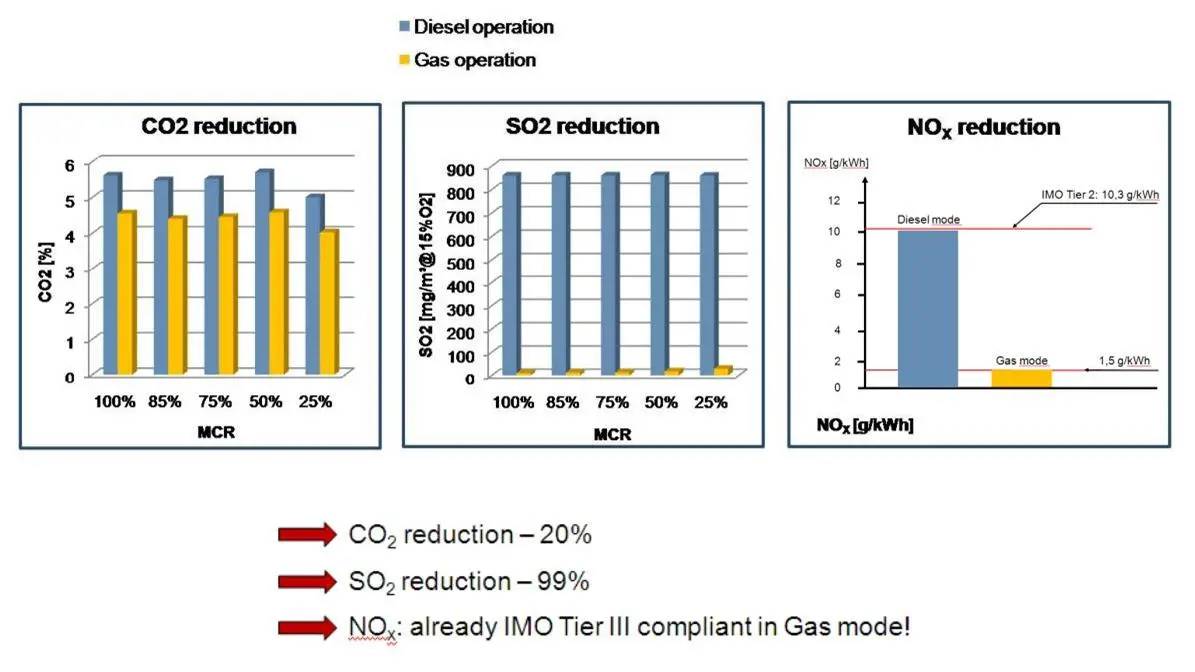
Mr Tolgos presented one of MANs potential strong contenders for the future, dual-fuel technology, where the engine can be operated in diesel mode or in gas mode. CO2 emissions are reduced by some 20% regardless of engine loading when operating on LNG. “This means we have the potential to comply with the EEDI index of 2020, already.”
There is virtually no sulphur in the gas, so SOx emissions are negligible when operating on LNG as fuel. NOx emissions are reduced from the Tier II limit of some 10.3g/kWh, to 1.5g/kWh, meaning the engine will be Tier III compliant in gas mode. “This is a very elegant straightforward solution without the need of any exhaust gas treatment,” Mr Tolgos concluded.
In addition to the environmental benefits, Mr Tolgos pointed out the economic advantages. “If we compare the gas prices with that of low-sulphur distillate fuel we speak today about a factor of three.” Talking about engine price, he said “on the engine you have to calculate around 40% on top as €/kW”. On top of that comes the gas tanks, the gas supply system etc.
“The technology is already there, and existing,” Mr Tolgos said. Currently, MAN Diesel & Turbo has five engines in maritime operation, on one LNG carrier. The first contract received was for EN Elcano’s 173,600m3 LNG carrier, which was has been in operation since August 2010, in all for 48,000h of operation. The vessel’s five 8L 51/60DF (OEM) engines operate in diesel-electric configuration. A new reference is engines for two 170,200m3 LNG vessels for Sovcomflot, being built by STX in South Korea. These vessels will receive two 9L plus two 8L 51/60DF (OEM) engines, totaling 34MW. The first ship is due to be delivered in the fourth quarter of 2013.
The 50/60DF Engine
This engine produces 1,000kW per cylinder, with both diesel oil and gas as fuel, and is available in six to nine cylinders as in-line and 12 to 18 cylinders in V-configuration.
The existing design, fitted with compressor bypass, has been able to switch from diesel fuel to gas fuel at engine load above 15%. According to Mr Tolgos: “It is the only engine on the market that can do this transfer to both directions up to 100% load and it is the only engine on the market in this power class which can accept overload with gas up to 110%. Now MAN’s variable turbine area technology gives a bigger operating range in gas mode, allowing gas to be used below 15% engine load. The engine can be run on gas at a load up to 7% for less than 30 minutes, and up to a 15% load for less than 24 hours at a time. “This can be interesting at pier when you have only a small hotel load and a small load on the engine.”
Recently, in May, MAN received Class certification to operate the engine in a diesel-mechanical mode, such as in a single engine application with CP propeller. The engine map for CPP operation shows that from 68% engine speed and above, one can operate the engine in gas mode.
Dual-Fuel for thee Cruise Industry
Dual-fuel technology is one of MAN’s strong options for the future. “It is evident that our company is striving to complete the portfolio of dual-fuel engines across the total power range,” Mr Tolgos said. Smaller cruise ships are one of the target markets for the new 35/44DF engine (see separate article).
“I think the challenges (with LNG fuel) in the engine room are solved. The storage can also be solved. The main challenge I see it is the re-fuelling procedure and in the infrastructure,” He added. The re-fuelling challenge is how to do it safely, with passengers onboard.
When The Motorship asked when we will see the first cruise ship with dual-fuel engines, Mr Tolgos answered: “Within this decade, I think we will see it in steps. As a first step we will see a mixture of diesel engines and maybe one or two dual-fuel engines.”
He said that when the public and crews get acquainted with gas technology, then we will see full gas cruise ships.
Related Articles
 PROPULSION
 GENERAL NEWS
 GENERAL NEWS