



MARIN sloshing facility promotes advances in multi-phase research
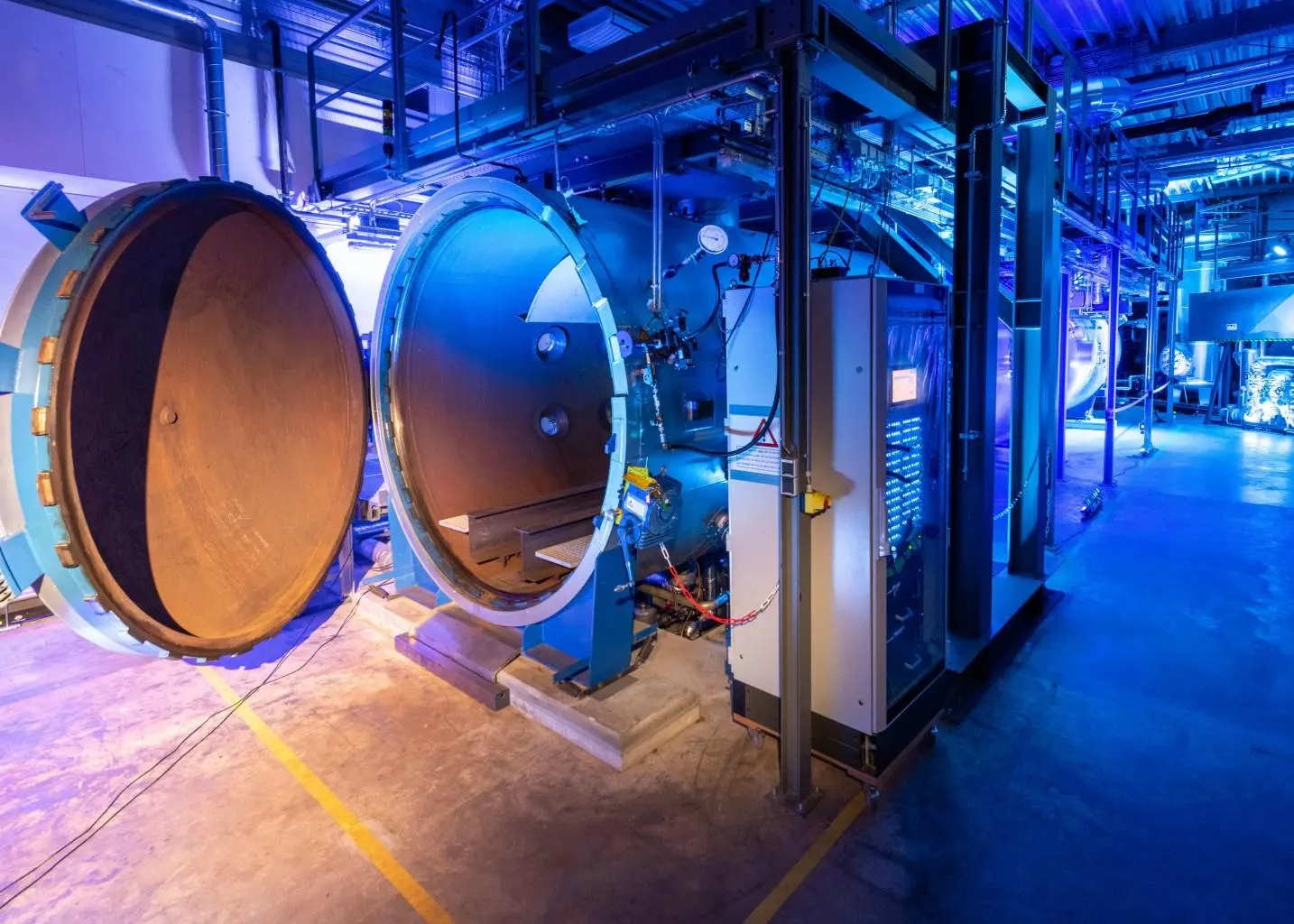
Since 2019, The Atmosphere has been supporting a large-scale, multi-year collaborative research project into Sloshing of Liquefied Natural Gas (SLING).
The project is intended to on improve the understanding of sloshing impacts inside LNG tanks, which will then feed through into optimal design and operation of cryogenic fuel tanks. The project represented a collaboration between academia and commercial companies, and included four Dutch universities, class societies Bureau Veritas, ClassNK and CCS, as well as Total and Shell, Damen and Anthony Veder among other participants.
Research facility
The specialist research facility allows multi-phase dynamics to be varied independently from each other whilst offering high quality measurements during impact tests.
For example, both the wave shape and impact loads can be studied in detail during wave effect tests. Two high-speed cameras and four low-speed cameras offer detailed monitoring within the autoclave. The level of liquid inside the set-ups can be measured and controlled within a 0.1 mm accuracy, while the wave maker at one end of the tank can create waves within 12mm accuracy. The impact load is monitored by pressure sensors embedded within the impact wall.
The circulation of liquids and gases within the autoclave can also be independently controlled in a range from 15°C to 200 °C. The autoclave can be depressurised down to 5 mbar, and pressurised up to 10 bar absolute with a precision of ±2.5 mbar. The 76.5 m3 autoclave can accommodate set-ups of up to 8000 kg which can be connected to gas and liquid connections. Gas compositions of nitrogen, helium, sulphur hexafluoride or steam/water vapour can be created with an accuracy of ±1 volume percent.
Research objectives
The project is intended to improve the understanding of the complex relationship between liquids, vapours and physical structures, such as the internal wall of an LNG containment vessel.
A related issue was that existing theoretical models needed to be developed to take into account physical effects in order to improve the accuracy of sloshing models.
Programme leader Hans Hopman of Delft University of Technology (TU Delft) noted that the research project had made significant progress since 2016 in preparing a theoretical model to permit sloshing impacts to be scaled up from small-scale test models.
At present the project was conducting research into three parallel research areas: the investigation of multi-phase dynamics involved in sloshing impacts; the investigation of the variability of impact loads; and studying the relevance of impact loads on structural responses.
Hopman noted that the second research topic involved detailed investigations of how perturbations on the free surface of the breaking wave develop, along with detailed investigations to quantify their effects on impact loads.
Commercial applicability
Eric Dehouck, deputy CEO of GTT noted that improving the understanding of the effects of sloshing within membrane containment systems represented one of the desired outcomes of the project.
The results from tests conducted on scaled down models did not take fully reflect the effects of multi-phase dynamics in full-size vessels.
This represented a challenge for LNG containment designers that determined design loads based on sloshing model tests.
“Measurements on board a LNG carrier showed that the results obtained at small scale with model tests are conservative,” Dehouck said, adding “We want to strike an optimal balance between the competing demands of mechanical strength and thermal efficiency of the fuel tank for each project.”
While the main focus of the project was on safety, Dehouck noted that improving the understanding of sloshing might also permit the reduction of losses from evaporation within the tank.
“Today this system is developed for LNG sloshing but this system is also applicable for liquid hydrogen or ammonia for floating structures,” Dehouck concluded.
Related Articles
 ALTERNATIVE FUELS & LUBRICANTS
 GENERAL NEWS
 GENERAL NEWS